he Funding Question Every SME Eventually Faces
At some point, every Indian SME hits the same wall.
Orders are coming in.
Expenses are rising.
Growth looks possible—but cash is tight.
That’s when the big question shows up:
Should you borrow money, or should you give away a piece of your business?
This isn’t just a finance decision.
It’s a control decision, a risk decision, and a long-term stress decision.
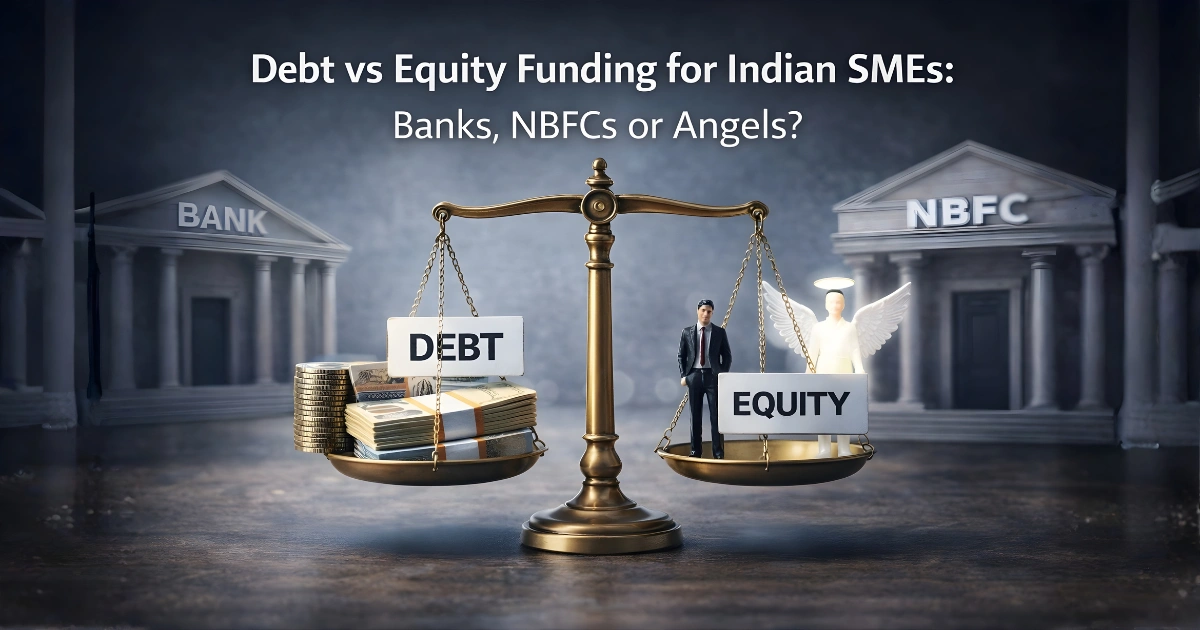
Let’s break down debt vs equity funding for Indian SMEs—clearly, practically, and without startup buzzwords.
Understanding the Core Difference (In Plain English)
Before comparing options, you need the basics right.
What Debt Funding Really Means
Debt funding means borrowing money and repaying it with interest.
This includes:
-
Bank loans
-
Loans from Banks / Non-Banking Financial Companies (NBFCs)
-
Term loans, overdrafts, and working capital limits
Debt allows you to retain full control of your business.
No ownership is given away. No investor interference.
Debt lending allows entrepreneurs to access capital for specific needs—like inventory, machinery, or working capital—without changing who owns the company.
(For a neutral definition, see Investopedia’s explanation of debt financing.)
What Equity Funding Actually Means
Equity financing allows you to share ownership of your business in exchange for capital.
In India, this usually means:
-
Angel investors
-
Early-stage strategic investors
There is no repayment obligation, but:
-
You dilute ownership
-
You share decision-making
-
You give up a portion of future upside
This structure is commonly explained in startup funding guides published by platforms like YourStory and Inc42, which cover early-stage Indian businesses.
Equity is not expensive money upfront—but it can be very expensive long term.
Why Indian SMEs Prefer Debt (And Why That’s Logical)
There is a clear preference among MSMEs towards debt financing in India.
Why?
Because most SMEs are:
-
Cash-flow driven
-
Margin-sensitive
-
Control-conscious
Debt financing:
Loans are taken by firms from banks and financial institutions because:
-
Interest cost is predictable
-
Interest is tax-deductible under Indian tax laws
-
Ownership remains intact
Formal debt can be raised from banks and NBFCs, making it accessible for established businesses.
You can see this preference reflected in RBI MSME credit reports and government MSME financing initiatives.
Bank Loans vs NBFC Loans: Know the Difference
Bank Loans: Cheaper, Slower, Stricter
Banks are ideal when:
-
You have stable cash flows
-
Financials are clean
-
You can wait through paperwork
Pros:
-
Lower interest rates
-
Longer tenures
-
Strong credibility
Cons:
-
Heavy documentation
-
Slow approval
-
Strict eligibility
Most eligibility and compliance requirements are outlined on individual bank sites and the RBI’s lending framework for MSMEs.
NBFC Loans: Faster, Flexible, Costlier
NBFCs step in where banks hesitate.
-
Faster disbursal
-
Flexible underwriting
-
Easier approval for SMEs
NBFCs work well when:
-
Cash flow is uneven
-
You need funds urgently
-
Traditional banks say no
You pay more—but you move faster.
This trade-off is well documented across SME finance studies by SIDBI and industry bodies.
When Debt Funding Makes Sense for SMEs
Choose debt funding if:
-
Your business has stable monthly cash flow
-
You need money for working capital or assets
-
You want to retain full control
-
You can service EMIs comfortably
-
You prefer predictable costs
Real-life example:
A manufacturing SME takes a term loan to buy machinery.
The machine generates revenue. EMIs are predictable. Ownership stays intact.
That’s smart debt.
When Equity Funding Is the Better Choice
Equity funding isn’t bad—it’s just not for everyone.
Choose equity financing if:
-
You’re in an early stage
-
Cash flow is weak or inconsistent
-
You’re planning rapid scaling
-
You want mentorship and strategic help
-
You’re okay with dilution
Angel investors bring:
-
Capital without repayment pressure
-
Industry connections
-
Strategic guidance
-
Shared risk
Many Indian angel networks openly state this value-add approach in their investment philosophies and portfolio write-ups.
For fast-growing businesses, equity acts like growth fuel, not a burden.
The Hidden Cost Comparison: Debt vs Equity
Debt Costs Are Visible
-
Interest rate
-
Processing fees
-
Penalties
You can calculate this upfront using loan calculators offered by banks and NBFCs.
Equity Costs Are Invisible (But Larger)
-
Permanent ownership dilution
-
Loss of decision autonomy
-
Sharing profits forever
-
Exit pressure
Giving up 20% today could cost far more than paying interest over five years.
This is why founders must explore the difference between debt financing and equity financing beyond just cash availability.
A Simple Decision Framework for Indian SMEs
Ask yourself:
-
Do I have predictable cash flow for EMIs?
-
Do I need money for operations or growth experiments?
-
Am I comfortable sharing control?
-
Is speed more important than cost?
-
Will this capital directly generate revenue?
Your answers usually point clearly toward debt or equity.
Common Mistakes SMEs Make
-
Taking equity when debt was sufficient
-
Taking debt without cash flow visibility
-
Ignoring NBFCs as a valid option
-
Choosing cheap money but losing speed
-
Raising funds without a clear use case
Funding amplifies mistakes as much as it amplifies growth.
Pro Tips Most SMEs Miss
-
Use debt for assets, equity for uncertainty
-
Mix funding sources as you grow
-
Refinance NBFC loans with bank loans later
-
Never dilute equity just to fix cash mismanagement
-
Align funding type with business maturity
Smart founders don’t choose sides.
They choose timing.
Final Verdict: Choose the Money That Fits Your Business Reality
For Indian SMEs:
-
Banks and NBFCs (Debt) work best when cash flows are stable, costs matter, and control is non-negotiable.
-
Angel investors (Equity) make sense when growth is aggressive, risk is high, and experience matters.
There is no universally “right” option.
There is only the option that:
-
Matches your stage
-
Matches your risk appetite
-
Matches how much control you’re willing to share
Choose money that helps you sleep—and scale.