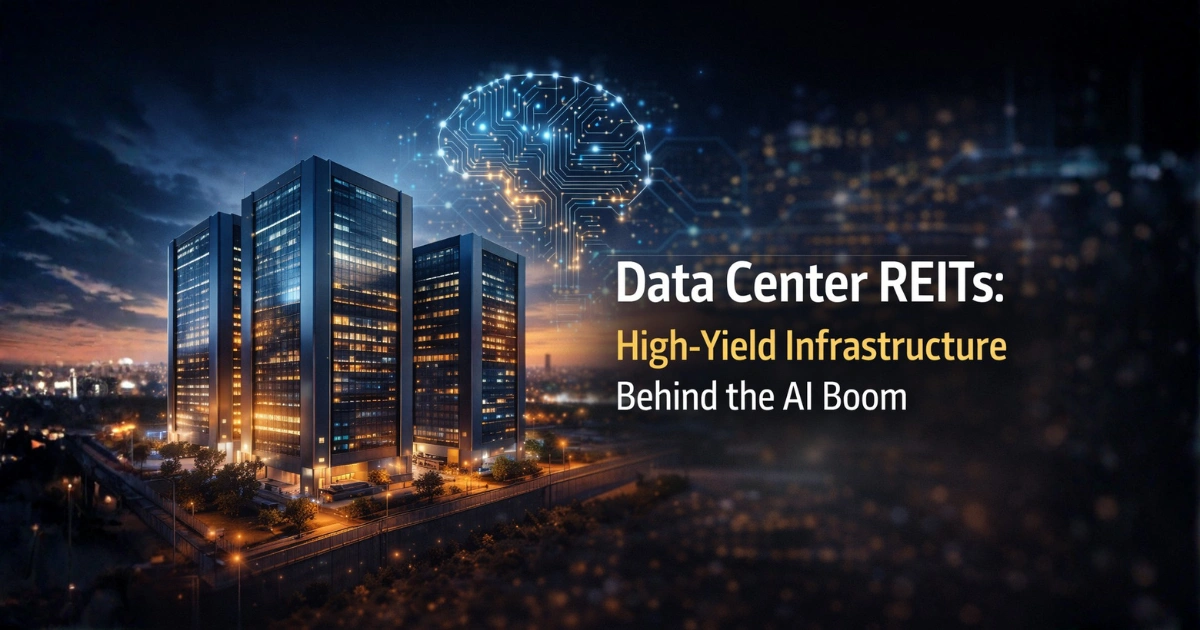
Introduction: The Quiet Real Estate Bet Behind the AI Boom
When people talk about AI investing, the conversation usually stops at chips and software.
Nvidia. Cloud platforms. Big tech balance sheets.
But almost no one talks about the buildings that make all of this possible.
Every AI model, cloud service, streaming platform, and 5G network ultimately runs inside a physical structure—highly secure, power-hungry, climate-controlled facilities that never sleep. Those buildings aren’t owned by tech companies alone. They’re owned by data center REITs.
This is where things get interesting.
Data center REITs have emerged as a high-yield infrastructure investment that lets investors participate in the digital economy without taking pure tech-stock risk. Think of them as the landlords of the digital age—collecting rent while AI, cloud computing, and data consumption keep expanding.
If you’re looking for income, stability, and exposure to long-term tech demand, this is a segment worth understanding properly.
What Are Data Center REITs (and Why They Matter)?
At their core, data center REITs are investment trusts that own, operate, and lease data center properties to enterprises, cloud providers, telecom companies, and hyperscalers.
Instead of betting on which technology wins, you’re investing in the essential infrastructure that all of them need.
Just like:
-
Malls rent space to retailers
-
Office parks lease space to corporates
Data center REITs lease power, space, cooling, and connectivity to digital tenants.
And because REITs are legally required to distribute most of their income, they naturally lend themselves to high-yield and income stability
(SEC REIT structure overview: https://www.sec.gov/education/smallbusiness/investing/reits).
Why Data Center REITs Are Essential Infrastructure
Data centers are no longer “tech optional.” They are mission-critical assets.
Here’s why they qualify as essential infrastructure:
-
Cloud services cannot function without them
-
AI workloads require massive, specialised facilities
-
5G networks depend on low-latency data processing
-
Enterprises increasingly outsource IT infrastructure
This places data centers alongside utilities, telecom towers, and transport hubs—except with far stronger growth tailwinds, as highlighted in global infrastructure reports by firms like McKinsey
https://www.mckinsey.com/industries/technology-media-and-telecommunications
The Real Demand Drivers: Why This Isn’t a Passing Trend
1. AI Is a Structural Demand Shock
AI workloads are computationally heavy. Training and running models consumes enormous processing power, storage, and electricity.
That means:
-
More servers
-
Denser racks
-
Larger, more advanced data centers
This is not cyclical demand. It’s structural—something even hyperscalers openly acknowledge in capex guidance
(AWS & Azure infrastructure commentary: https://www.aboutamazon.com/news/aws).
2. Cloud Computing Is Still Expanding
Despite being labelled “mature,” cloud adoption is far from complete. Enterprises continue migrating workloads from on-premise systems to third-party data centers.
This creates robust demand drivers for well-located, well-powered facilities, as reflected in Gartner’s long-term cloud outlook
https://www.gartner.com/en/information-technology/insights/cloud-computing.
3. 5G and Edge Computing
As latency-sensitive applications grow—autonomous systems, streaming, real-time analytics—data centers must move closer to users.
That expands the physical footprint required, which benefits owners of distributed data center networks, not just operators.
High Barriers to Entry: Why Competition Is Limited
This is where data center REITs really shine.
Building a modern data center isn’t easy.
High barriers to entry include:
-
Massive upfront capital costs
-
Access to reliable power and water
-
Zoning and regulatory approvals
-
Technical expertise in cooling and redundancy
-
Long customer onboarding cycles
You can’t replicate this overnight. And you certainly can’t “disrupt” it with an app.
Once a tenant moves in, switching costs are high. Downtime isn’t an option.
That creates sticky, long-term leases—exactly what income-focused investors want.
Spotlight: Equinix Inc. (EQIX)
Among global players, Equinix stands out as one of the best data center REITs driving the AI revolution.
What makes Equinix different:
-
Global footprint across major metros
-
Carrier-neutral interconnection model
-
Blue-chip tenant base (cloud, enterprises, networks)
-
Strong pricing power due to location and scale
Equinix doesn’t just rent space. It creates digital ecosystems where customers interconnect directly—making its facilities harder to replace.
Investor disclosures:
https://investor.equinix.com
For investors, this translates into:
-
Predictable cash flows
-
Long lease durations
-
Exposure to global digital growth without picking tech winners
Data Center REITs vs Tech Stocks: A Smarter Balance?
Tech stocks offer growth—but they also come with:
-
Valuation risk
-
Earnings volatility
-
Rapid competitive disruption
Data center REITs offer something different:
-
Lower earnings volatility
-
Tangible assets
-
Contracted revenues
-
Dividend income
You may not get explosive upside in a single year—but you get compounding income tied to digital expansion.
For many portfolios, they act as a stabiliser alongside growth assets.
How to Approach Data Center REIT Investing (Action Steps)
Step 1: Focus on Scale and Location
Prime metros with dense network connectivity matter more than raw square footage.
Step 2: Look at Tenant Quality
Long-term contracts with hyperscalers and enterprises reduce income risk.
Step 3: Understand Power Strategy
Power availability is becoming a constraint. REITs with secured, scalable power access have an edge—especially as AI workloads intensify.
Common Mistakes Investors Make
-
Treating data center REITs like traditional office REITs
-
Ignoring power and energy costs
-
Chasing yield without understanding lease quality
-
Overreacting to short-term interest rate movements
Remember: this is infrastructure first, real estate second.
Pro Tips for Long-Term Investors
-
Track occupancy rates and renewal spreads
-
Watch capex plans and power sourcing
-
Use data center REITs as income anchors, not trading bets
-
Reinvest dividends for long-term compounding
Final Thoughts: Why Data Center REITs Deserve Attention Now
AI, cloud, and digital consumption aren’t slowing down. They’re becoming embedded into everyday life.
Data center REITs sit right at that intersection—essential infrastructure with high barriers to entry and income stability.
You don’t need to predict the next breakthrough model or platform.
You just need to own the buildings where the digital future runs.
If your portfolio lacks exposure to data center REITs, you’re missing a critical piece of the modern infrastructure story.