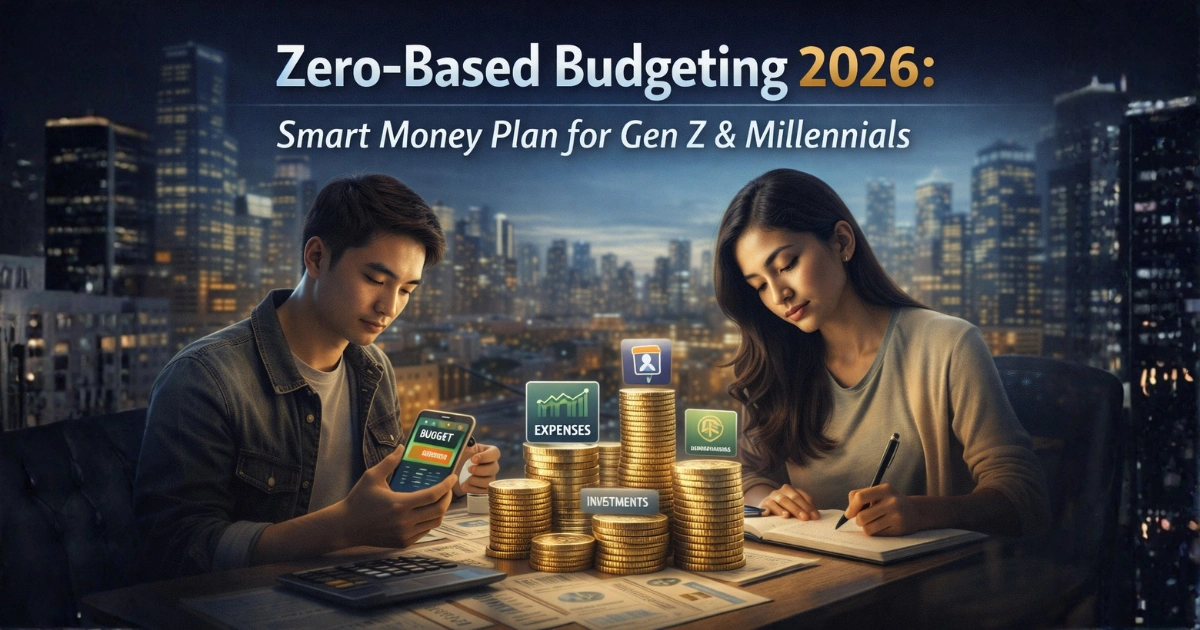
Introduction: Budgeting Isn’t the Problem—Your System Is
Most people don’t fail at saving money.
They fail at controlling where their money goes.
You earn, you spend, you save “whatever is left”—and somehow, nothing is left.
That’s exactly what zero-based budgeting fixes.
👉 Instead of guessing, you tell every rupee what to do.
And in 2026—where expenses are rising and income streams are unpredictable—this approach isn’t optional anymore. It’s necessary.
H2: What Is Zero-Based Budgeting (ZBB)?
Let’s simplify it.
👉 Zero-based budgeting (ZBB) is a method where your income minus expenses equals zero.
That doesn’t mean you spend everything.
It means:
- Every rupee is assigned a job
- Nothing is left “unplanned”
So your money goes into:
- Expenses
- Savings
- Investments
- Debt repayment
H3: Where This Concept Comes From
Originally, zero-based budgeting, or ZBB, is a method where organisations build their budgets from zero each period, justifying every cost.
For a deeper explanation of ZBB principles:
👉 https://www.investopedia.com/terms/z/zero-based-budgeting.asp
H2: Why Gen Z & Millennials Need ZBB in 2026
Let’s be real.
2026 is not the same as 2010.
- Rent is high
- Side hustles are common
- Income is irregular
- Digital spending is invisible
👉 That’s why traditional budgeting fails.
H3: Gen Z vs Millennials Differ in Financial Planning
If you want insights into financial behavior trends:
👉 https://www.pewresearch.org
👉 But both need one thing: clarity and control
H2: How Zero-Based Budgeting Actually Works
Here’s the simple formula:
👉 Income – Expenses = 0
H3: Step-by-Step ZBB Setup (Budget 2026)
Step 1: Calculate Total Income
Include everything:
- Salary
- Freelance income
- Side hustle
Step 2: List All Expenses
You can track expenses using tools like:
👉 https://www.etmoney.com
👉 https://www.moneycontrol.com
Step 3: Assign Every Rupee a Job
Allocate money into:
- Needs
- Wants
- Savings
- Investments
👉 Your goal is to reach zero balance (planned, not empty)
Step 4: Adjust Until It Balances
If expenses exceed income:
- Cut non-essential spending
If income exceeds expenses:
- Increase savings or investments
H2: Create a Flexible Budget for 2026 (Not a Rigid One)
👉 The goal is to create a flexible budget for 2026, not a strict one.
H3: How to Keep It Flexible
- Keep a buffer category
- Allow small “fun money”
- Adjust weekly if needed
For budgeting frameworks and strategies:
👉 https://www.nerdwallet.com
H2: Real-Life Example (Simple ZBB Breakdown)
Let’s say your monthly income is ₹50,000:
- Rent → ₹15,000
- Food → ₹8,000
- Transport → ₹3,000
- Savings → ₹10,000
- Investments → ₹7,000
- Entertainment → ₹5,000
- Misc → ₹2,000
👉 Total = ₹50,000 (Zero-based achieved)
Every rupee has a purpose.
H2: Common Mistakes to Avoid
Even a powerful system fails if used wrong.
❌ Ignoring Irregular Expenses
To understand emergency fund planning:
👉 https://www.rbi.org.in
👉 Always keep a buffer.
❌ Not Updating the Budget
Your budget should evolve with your income and expenses.
H2: Pro Tips for Making ZBB Work
- Track spending weekly (not monthly)
- Use budgeting apps for automation
- Increase savings % gradually
- Combine ZBB with SIP investments
- Review your budget every month
For SIP basics and investing:
👉 https://www.amfiindia.com
H2: Why Zero-Based Budgeting Works So Well in 2026
Because it matches today’s financial reality:
- Works with irregular income
- Gives full visibility of money
- Helps avoid overspending
- Supports both saving and investing
👉 It’s not just a budgeting method.
It’s a money control system.
Conclusion: Give Your Money a Job—or It Will Disappear
If you don’t plan your money, it gets planned for you—by expenses, EMIs, and impulse spending.
Zero-based budgeting flips that.
👉 You stay in control.
👉 Every rupee works for you.
Whether you’re Gen Z or a millennial, this is one of the simplest and most effective ways to manage money in 2026.
Start small. Try it for one month.
You’ll immediately see the difference.