Introduction: The Decision That Shapes Your Startup’s Future
Every startup hits this question sooner or later:
Should you build slow and steady… or raise money and scale fast?
This isn’t just a funding decision. It defines how much control you keep, how fast you grow, and even the kind of business you end up building.
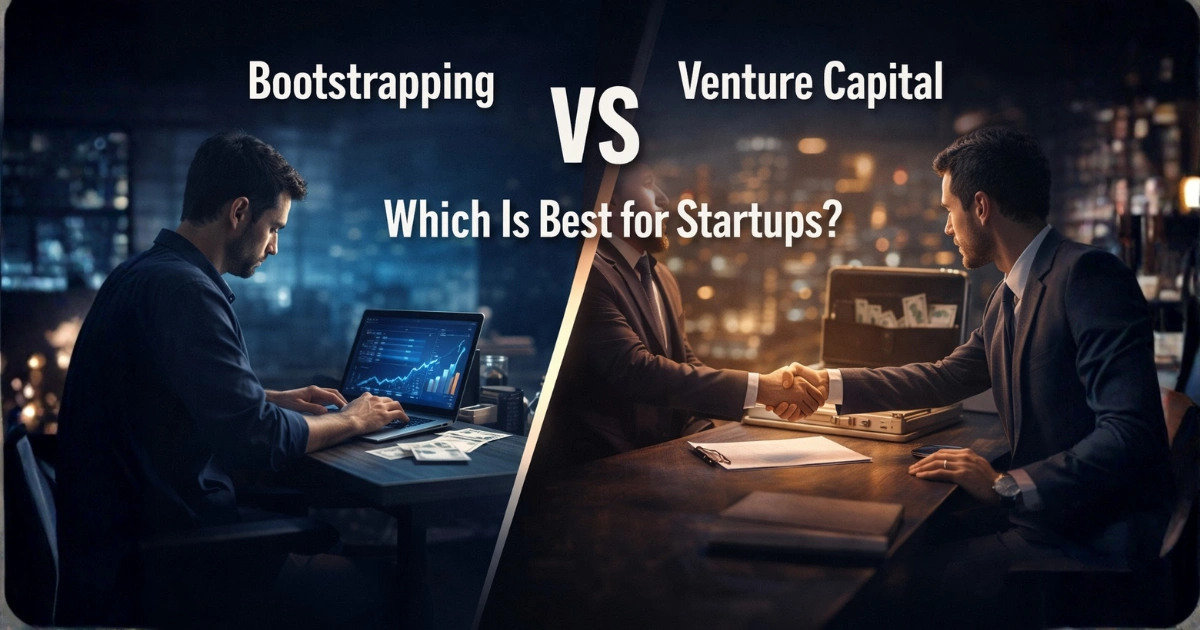
The bootstrapping vs venture capital debate isn’t about which is better overall. It’s about what’s right for your startup, your risk appetite, and your long-term vision.
Let’s break it down in a practical way—no hype, just clarity.
What is Bootstrapping (And Why Founders Still Choose It)
Bootstrapping means building your startup using:
- Personal savings
- Revenue generated from the business
- Minimal external funding
In simple terms, you fund your own growth.
Bootstrapping for startups is ideal for those who want complete business ownership and control over every decision.
👉 Many founders initially rely on tools like Stripe or Shopify to generate early revenue without external funding.
Why bootstrapping works (especially early on)
Bootstrapping definitely helps you effectively if you are a beginner and at the early stages of a startup.
You’re forced to:
- Stay lean
- Focus on profitability early
- Validate your idea quickly
There’s no safety net. And that’s exactly why it works.
What is Venture Capital (And When It Makes Sense)
Venture capital (VC) is when investors fund your startup in exchange for equity.
In simple terms:
- You get capital
- Investors get ownership
Venture capital entails obtaining external investments in exchange for a share in your company.
Why startups choose VC
Venture capital is superior for startups that:
- Need rapid scaling
- Operate in competitive or high-tech markets
- Require large upfront investment
👉 Top VC firms like Sequoia Capital and Andreessen Horowitz specialize in funding high-growth startups.
What you gain (and give up)
With VC, you gain:
- Capital for hiring and expansion
- Access to investor networks
- Strategic guidance
But you also give up:
- Equity
- Partial control
- Some decision-making freedom
Venture capital is perfect for those who can manage equity dilution.
Bootstrapping vs Venture Capital: The Core Differences
Let’s simplify the comparison:
Control vs Speed
- Bootstrapping → Full control, slower growth
- Venture Capital → Faster growth, shared control
Risk vs Pressure
- Bootstrapping → Financial risk is yours
- VC → Growth pressure from investors
Profit vs Scale
- Bootstrapping → Focus on profitability
- VC → Focus on scaling fast
👉 According to insights from Harvard Business Review, funding choices significantly impact long-term strategy and control.
Both bootstrapping and venture capital funding for startups involve risks—the difference lies in where that risk comes from.
How to Decide: Bootstrap or Venture Capital?
The choice between bootstrap or venture capital depends on your startup’s goals, growth ambitions, and personal preferences.
Choose Bootstrapping If:
You should lean toward bootstrapping if you:
- Want to retain full control
- Have a clear monetization path
- Are building a niche or service-based business
- Prefer sustainable, steady growth
👉 Many successful founders highlighted on Indie Hackers follow this path.
Choose Venture Capital If:
VC makes more sense if you:
- Need capital to scale quickly
- Are entering a competitive market
- Require heavy upfront investment
- Want to build a large, market-dominant company
👉 Platforms like Crunchbase show how funded startups scale aggressively.
A Practical Example: Two Founders, Two Paths
Let’s say two founders launch similar SaaS products.
Founder A (Bootstrapped)
- Starts small
- Focuses on early revenue
- Grows steadily
- Keeps full ownership
Founder B (VC-funded)
- Raises funds early
- Hires aggressively
- Spends on marketing
- Scales faster but owns less
👉 Growth patterns like these are often tracked in reports by CB Insights.
Action Steps: How to Make the Right Choice
If you’re still unsure, use this framework:
1. Define your end goal
Do you want profitability or a high-growth exit?
2. Analyze your capital needs
Can you start lean, or do you need heavy funding?
3. Evaluate your risk tolerance
Are you okay risking your money—or sharing ownership?
4. Understand your market
Is speed critical in your industry?
5. Map your growth timeline
Steady growth or aggressive scaling?
Common Mistakes Founders Make
- Raising VC too early
- Avoiding funding out of fear
- Chasing trends
- Ignoring equity dilution
👉 Business case studies from Y Combinator often highlight these mistakes.
Pro Tips for Maximum Impact
- Start bootstrapped, raise later if needed
- Validate before scaling
- Control your burn rate
- Focus on revenue early
- Protect your equity
Conclusion: There’s No “Best”—Only What Fits
The bootstrapping vs venture capital debate doesn’t have a universal winner.
It comes down to this:
- Want control and steady growth → Bootstrapping
- Want speed and scale → Venture Capital
👉 The best founders understand that funding is a strategy—not a status symbol.
What matters is choosing the path that aligns with your vision—and executing it well.
Build the business you actually want, not the one that just looks impressive.