You’re finally earning well, managing expenses, and maybe even saving a little.
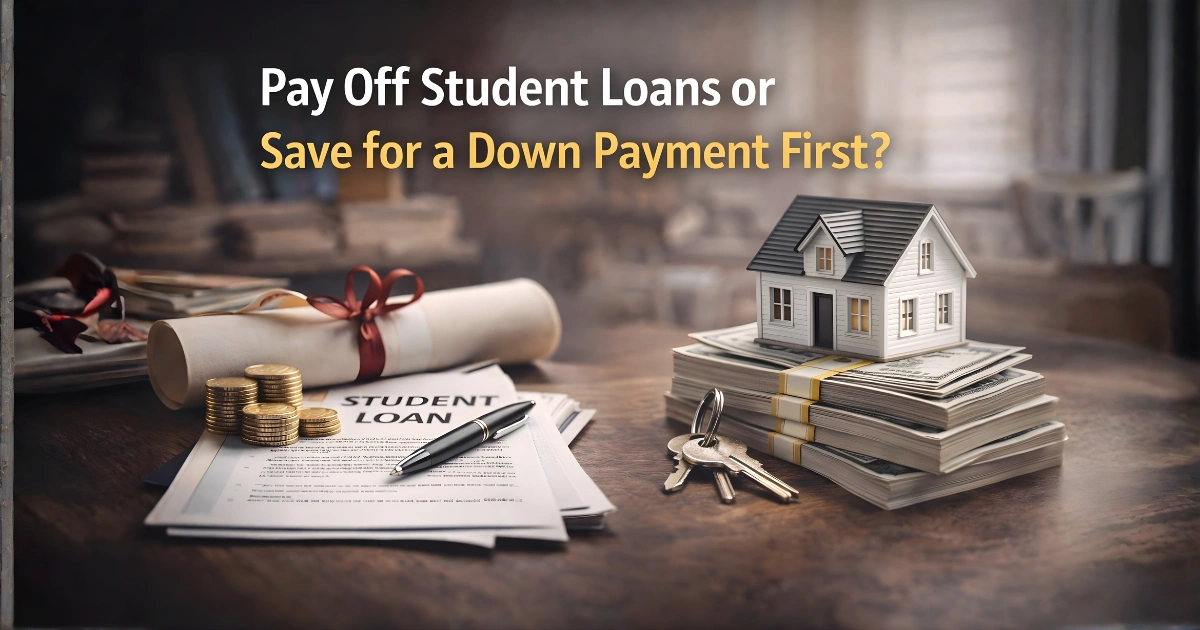
But now you’re stuck between two big financial goals — buying a home and paying off student loans.
Part of you wants stability and roots.
Another part wants freedom from debt.
Most generic advice online keeps repeating the same line:
“It depends on your situation.”
That’s technically true — but not helpful.
The real challenge here isn’t just financial. It’s emotional.
Owning a home feels like progress.
Becoming debt-free feels like relief.
So how do you choose between paying off student loans or saving for a down payment without regretting the decision later?
Let’s break it down using real-world logic, not textbook theory.
Step One — Understand the Trade-Off, Not Just the Numbers
This decision goes far beyond interest rates and balances. In reality, it’s about:
-
stability vs flexibility
-
emotional security vs financial leverage
-
short-term relief vs long-term wealth
Some advisors argue that clearing debt first creates freedom.
Others point out that buying property early can build wealth faster if prices keep rising.
Both viewpoints are valid — depending on your priorities.
Before choosing, you need clarity on three things:
-
your interest rates
-
your cash-flow flexibility
-
your risk tolerance
To understand how interest impacts long-term cost, this explainer from Investopedia is useful:
👉 https://www.investopedia.com/terms/i/interest-rate.asp
Now, let’s look at each path practically.
When It Makes Sense to Pay Off Student Loans First
1) Your Student Loan Interest Rate Is Higher Than Mortgage Rates
If your education loan carries a significantly higher interest rate than a home loan, paying it down often gives a better guaranteed return.
Example:
-
Student loan at 10%
-
Expected home loan around 7%
In this case, every rupee used to reduce student debt saves more interest than it would earn elsewhere.
This is why many financial planners recommend tackling high-interest debt first — a principle also explained by NerdWallet:
👉 https://www.nerdwallet.com/article/loans/student-loans/pay-off-student-loans-or-save
2) Your Debt Is Straining Monthly Cash Flow
If loan EMIs are eating into your monthly income, adding a mortgage can stretch you thin.
Reducing debt first can:
-
lower financial stress
-
improve your credit profile
-
increase home loan eligibility later
Some people also use excess emergency savings to reduce high-interest debt — but only after keeping a minimum safety buffer intact.
For guidance on emergency fund sizing, see:
👉 https://www.investopedia.com/terms/e/emergency_fund.asp
Action Steps — If You Choose the “Pay Off Debt First” Path
-
list loans by interest rate
-
prioritize highest-interest balances
-
refinance cautiously (only if terms are stable)
-
direct bonuses or increments toward principal
Pro Tip:
If you’re close to clearing your loans, finishing them first can create strong momentum for your next goal.
When It Makes Sense to Save for a Down Payment First
1) Your Student Loans Are Low-Interest & Well-Managed
If your loans are:
-
low interest
-
predictable
-
not hurting cash flow
then saving for a home may create more long-term value.
In many cities, property prices rise faster than inflation. Delaying purchase can mean paying more later.
You can explore housing price trends in India via NHB Residex:
👉 https://nhb.org.in/residex/
2) You’re Ready for Lifestyle Stability
A home isn’t just an investment — it’s a life anchor.
Saving for a down payment may make sense if you:
-
plan to stay in one city long-term
-
want family stability
-
feel exhausted by rising rents
Homeownership often reduces uncertainty — and for many people, that emotional stability matters.
Action Steps — If You Choose the “Save First” Path
-
set a realistic home budget
-
open a separate down-payment account
-
automate monthly savings
-
avoid dipping into it casually
Pro Tip:
The goal isn’t just buying a house — it’s owning one without suffocating your monthly cash flow.
The Smart Middle Ground — Do Both, Strategically
You don’t always have to choose one extreme.
In many real-life situations, the smartest approach is parallel progress.
This works best when:
-
income is stable
-
debt interest is manageable
-
spending discipline is strong
How to Split Your Money Wisely
A simple structure:
-
essentials
-
emergency fund
-
split surplus between:
-
student loan prepayments
-
down-payment savings
-
This approach feels slower — but builds resilience.
What Should Come First Each Month?
Your savings/debt categories should come before lifestyle spending.
This “pay yourself first” principle is explained well here:
👉 https://www.investopedia.com/terms/p/pay-yourself-first.asp
Real-World Scenarios — What Should YOU Do?
Scenario 1 — Early Career, Moderate Salary
👉 Focus on debt first, then save aggressively later.
Scenario 2 — Stable Income, Planning to Settle
👉 Save for a down payment while paying minimum loan EMIs.
Scenario 3 — Overwhelmed on All Sides
👉 Pause big goals.
👉 Build emergency fund.
👉 Regain control first.
Sometimes stability matters more than speed.
Common Mistakes People Make
-
treating the decision emotionally, not strategically
-
ignoring interest rates
-
rushing into homeownership due to social pressure
-
overpaying loans while neglecting savings
-
assuming there’s only one “right” answer
Financial choices aren’t moral decisions.
They’re trade-offs — and trade-offs should be intentional.
Conclusion — The Best Choice Is the One That Supports Your Life
This isn’t about right or wrong.
It’s about:
-
cash flow
-
timing
-
stress levels
-
long-term stability
Some people feel empowered by being debt-free.
Others feel secure owning a home earlier.
The real goal isn’t following trends — it’s aligning money with your life plan.
If you’re stuck, write down your numbers and ask yourself:
👉 “Which option reduces stress today without damaging my future?”
That answer is usually the right one.