
Most budgets fail quietly.
Not because people don’t care about money—but because money leaks in places no one is watching. A coffee here. A delivery fee there. ₹50–₹200 spends quietly added up to more than I expected. By month-end, the balance looks thin, and the question is always the same: Where did it go?
That’s the problem zero-based budgeting solves.
Zero-Based Budgeting (ZBB) isn’t about cutting joy or obsessing over spreadsheets. It’s about taking control before the month starts—so your money works on purpose, not by accident.
If you’ve ever felt like you earn enough but still don’t move forward, this is the framework that changes that.
What Is Zero-Based Budgeting (In Plain English)
Zero-Based Budgeting is a method where your plan starts from scratch every month.
The core rule is simple:
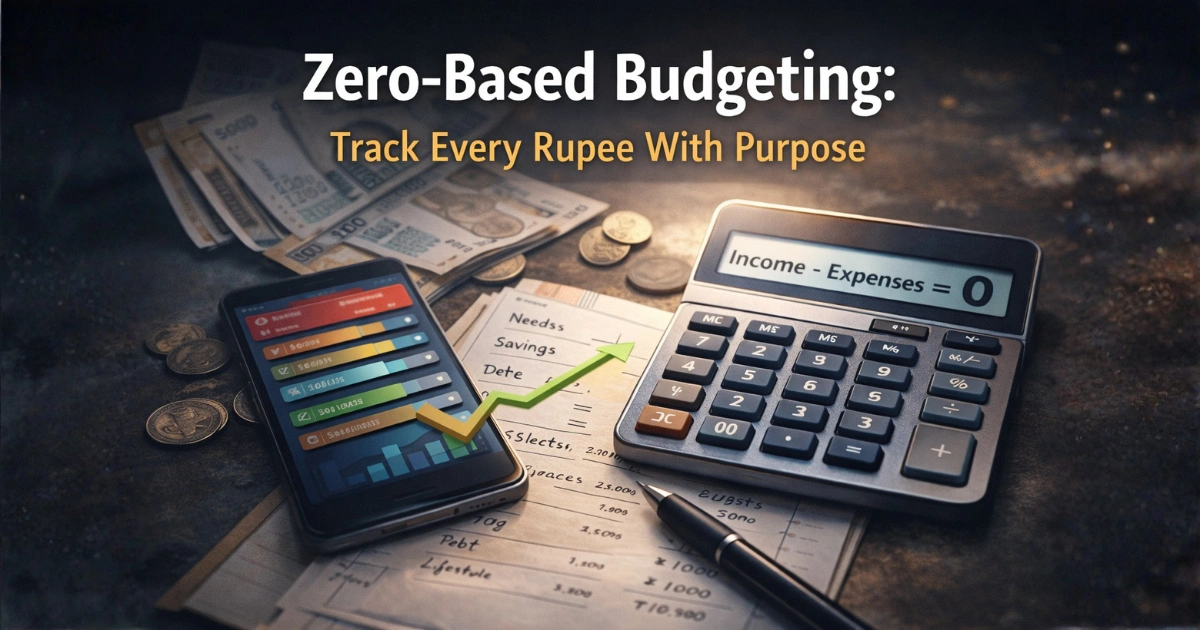
Income − Expenses = Zero
That doesn’t mean you spend everything.
It means every rupee is assigned a job—whether it goes to needs, savings, investments, or debt.
When the month begins, nothing is “unplanned.”
When the month ends, nothing is “unaccounted for.”
This concept is widely used in both personal finance and corporate finance, and is explained clearly by Investopedia:
👉 https://www.investopedia.com/terms/z/zero-based-budgeting.asp
Zero-Based Budgeting works by taking every single rupee you earn and telling it exactly where to go—before life gets a chance to redirect it.
Why Traditional Budgets Don’t Work (And ZBB Does)
Most people budget like this:
-
Pay bills
-
Spend as needed
-
Save whatever is left
The problem? There’s usually nothing left.
Zero-based budgeting flips the order. You assign first, spend later.
Instead of hoping money behaves, you decide how it behaves.
Behavioral finance research consistently shows that unplanned spending—not income—is the biggest reason budgets fail:
👉 https://www.psychologytoday.com/us/blog/the-science-behind-behavior/201903/why-budgeting-fails
That’s why ZBB feels strict at first—but freeing once it clicks.
Start From Scratch (Every Month)
This is the part people resist—and also the part that makes ZBB powerful.
Each month, you start from scratch. Last month’s budget doesn’t automatically roll forward.
Why?
-
Expenses change
-
Priorities shift
-
One-time costs come and go
Starting fresh forces awareness. It stops lazy assumptions like “this is what I always spend.”
It also makes waste visible—fast.
Categorize & Prioritize (The Right Way)
Once you know your total income, the next step is to categorize & prioritize.
This is where clarity replaces guesswork.
Start with:
-
Fixed needs (rent, EMIs, utilities)
-
Variable needs (groceries, transport)
-
Savings and investments
-
Debt repayments
-
Discretionary spending
Then prioritize in this order:
-
Survival
-
Stability
-
Progress
-
Lifestyle
This approach aligns with core personal finance frameworks recommended by financial planners globally:
👉 https://www.consumerfinance.gov/about-us/blog/making-budget-work-you/
This is how ZBB allocates every rupee efficiently based on needs and goals—not impulses.
Assign Every Rupee a Job
This is the heart of zero-based budgeting.
Every rupee supports your goals only if it has a clear assignment.
That means:
-
Savings are planned, not leftover
-
Spending limits are intentional
-
Guilt disappears because decisions were made upfront
When you assign every rupee a job, money stops feeling random.
If ₹1,000 has no assignment, it will vanish.
If it has a job, it will show results.
Steps to Implement Zero-Based Budgeting
Here’s a clean, practical way to get started—no apps required.
Step 1: Write down total monthly income
Salary, side income, freelance work—everything after tax.
Step 2: List all expenses from zero
Yes, from zero. Don’t copy last month blindly.
Step 3: Assign amounts until income hits zero
When you’re done, Income − Expenses = Zero.
Step 4: Track all expenses
Track cash, card, and UPI. No exceptions. Small leaks come from ignored payments.
Step 5: Review weekly
Don’t wait till month-end. Small course corrections save the month.
Expense-tracking discipline is one of the strongest predictors of budgeting success, according to multiple consumer finance studies:
👉 https://www.nerdwallet.com/article/finance/how-to-budget
Use the zero-based budgeting method consistently for 2–3 months, and patterns become obvious.
A Simple Family Example (Real Life)
Household income: ₹90,000
Assigned like this:
-
Needs: ₹45,000
-
Savings & investments: ₹25,000
-
Debt repayment: ₹10,000
-
Lifestyle & discretionary: ₹10,000
Total = ₹90,000
Zero left unassigned.
When spending happens, it’s measured against the plan—not emotion.
That’s how every rupee supports your goals, even when income doesn’t change.
Benefits of Zero-Based Budgeting (That Actually Matter)
The benefits aren’t theoretical. They’re practical.
-
You stop overspending without “trying harder”
-
Savings happen automatically
-
Small expenses stop sabotaging progress
-
Guilt around spending reduces
-
Financial decisions become calm, not reactive
The biggest benefit?
You finally know where your money goes—and why.
Common Pitfalls (And How to Avoid Them)
-
Forgetting irregular expenses (insurance, school fees)
-
Not tracking small spends
-
Being too rigid instead of realistic
-
Giving up after one “bad” month
-
Treating the budget as punishment
ZBB isn’t about perfection.
It’s about awareness and adjustment.
Pro Tips From Experience
-
Overestimate variable expenses at first
-
Keep a small buffer category if needed
-
Review categories monthly—not daily
-
Adjust, don’t abandon
-
Stay honest with yourself
The goal isn’t control for control’s sake.
It’s control so freedom becomes possible.
Final Thoughts: Control First, Freedom Follows
Zero-based budgeting doesn’t make you rich overnight.
What it does is remove blind spots—the biggest enemy of financial progress.
When Zero-Based Budgeting is done right:
-
Spending aligns with values
-
Saving stops feeling forced
-
Money becomes a tool, not a stressor
Explore this guide for steps, family examples, pitfalls, and wins—and then try it for one month.
That’s usually all it takes to feel the difference.