
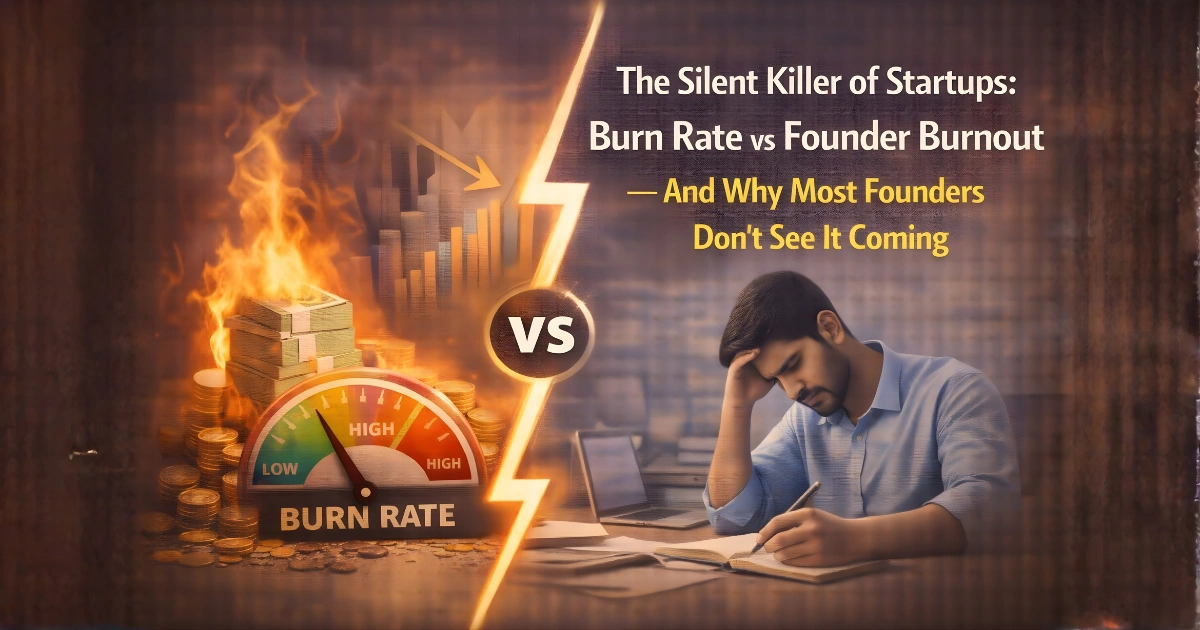
Every startup founder learns the language of cash flow, metrics, and financial burn rate. You track your runway. You forecast expenses. You live inside spreadsheets.
But here’s the uncomfortable truth nobody talks about out loud:
Sometimes the silent killer of startups isn’t the money burning inside the budget — it’s you burning out alongside it.
The real danger isn’t only financial burn rate. It’s the human burn rate happening in parallel — something consistently highlighted in research on entrepreneurial stress and burnout published by Harvard Business Review (https://hbr.org) and the World Health Organization’s guidance on chronic workplace stress (https://www.who.int/teams/mental-health-and-substance-use/mental-health-in-the-workplace).
And most founders don’t notice it until they’re already past the point of recovery.
This isn’t a story about failure. Failure is loud and obvious. The silent killer of ambition isn’t failure — it’s burnout with no support system, quiet stress, exhaustion masked as “grind,” and a culture that glorifies endurance over sustainability.
In this article, we’ll look at burn rate in a broader sense — not just capital loss, but the emotional, psychological, and operational drains that slowly undermine businesses from the inside.
Because the real killer of startups isn’t just burnout or messy cost overruns.
It’s when all of those forces stack together — and nobody is talking about it.
🔍 Burn Rate Is More Than a Financial Metric — It’s a Health Indicator
In finance, burn rate refers to how quickly a startup spends its cash before becoming profitable — a concept widely covered in startup finance resources such as Investopedia’s Burn Rate framework (https://www.investopedia.com/terms/b/burnrate.asp).
We usually frame it around:
-
Payroll
-
Software and tools
-
Marketing expenses
-
Operational costs
But there’s a deeper layer that rarely appears in investor decks:
-
Mental fatigue
-
Emotional exhaustion
-
Decision paralysis
-
Loss of confidence
-
Quiet, unspoken fear
That’s where the silent startup killer takes root — a pattern repeatedly observed in studies on founder burnout and entrepreneurial wellbeing from the American Psychological Association (https://www.apa.org/topics/burnout).
Burn rate isn’t just about money draining from a bank account.
It’s about founders draining themselves dry in parallel.
And that’s where startups begin to crack long before the money runs out.
🧠 Founder Burnout: The Silent Killer in the Startup World
Let’s say it clearly:
Founder burnout is the silent killer in the startup world.
It doesn’t show up on dashboards. It doesn’t trigger a board meeting. There’s no alert when a founder loses sleep for the third week in a row — despite burnout now being formally recognized by the World Health Organization as an occupational phenomenon (https://www.who.int/news/item/28-05-2019-burn-out-an-occupational-phenomenon).
Burnout creeps in quietly:
-
You stop celebrating small wins
-
You work longer while producing less
-
You say “everything is fine” while drowning
-
You replace clarity with constant activity
Externally, everything looks normal.
Internally, the core is cracking.
That’s why many leadership researchers refer to it as the silent killer of startups.
🏚️ When Burn Rate Turns Founders into Frauds (Without Realizing It)
There’s a harsh truth many founders eventually experience — one echoed in HBR’s research on impostor syndrome among entrepreneurs (https://hbr.org/2018/05/overcoming-imposter-syndrome).
The silent startup killer doesn’t just exhaust you.
It slowly turns founders into identity frauds — not legally, but emotionally.
You:
-
Smile through investor updates you no longer believe
-
Pretend certainty while doubting every decision
-
Tell your team “we’re good” while barely holding together
You’re not lying — you’re protecting the mission.
But over time, you disconnect from the work, the team, and yourself.
By the time you recognize it, burnout has already done its damage.
🏗️ Startup Cost Burnout: When Systems Work Against You
Sometimes burnout isn’t emotional — it’s structural.
Startup cost burnout happens when:
-
Tools are bloated
-
Systems are inefficient
-
Processes are outdated
This creates constant friction — something operational research and McKinsey organizational productivity studies (https://www.mckinsey.com/capabilities/people-and-organizational-performance) repeatedly link to execution fatigue and leadership stress.
The cost isn’t just financial.
It’s psychological.
And nobody logs that on the expense sheet.
⚖️ Burn Rate vs Burnout: Two Forces Feeding Each Other
Here’s the cycle founders overlook — one also discussed in Stanford research on decision fatigue and cognitive overload (https://www.gsb.stanford.edu/insights/topics/leadership).
-
High operating burn rate
-
Pressure to grow faster
-
Founder overwork
-
Emotional burnout
-
Poor decisions & stalled execution
-
Burn rate increases further
Financial burn hurts the company.
Founder burnout hurts direction.
Together — they quietly erase survival odds.
Startups don’t always crash.
Sometimes, they fade out slowly.
🧭 How to Recognize Burnout Before It Breaks You
Founders often delay acknowledging burnout out of fear, stigma, or pride — a pattern identified in entrepreneur mental-health research by organizations such as the National Institute of Mental Health (https://www.nimh.nih.gov/health/topics/caring-for-your-mental-health) and Mind Workplace Wellbeing Studies (https://www.mind.org.uk/workplace/).
Early warning signs include:
-
Longer hours, weaker results
-
Emotional reactions instead of strategic thought
-
Heavy decision fatigue
-
Avoiding conversations
-
Mentally checked-out presence
If this feels familiar — burnout isn’t approaching.
It’s already here.
❌ Common Mistakes Founders Make When Burnout Starts
Burnout doesn’t destroy startups alone.
The response to burnout does.
Mistakes that intensify damage:
-
Treating exhaustion as a productivity problem
-
Hiding stress instead of naming it
-
Adding more work instead of clarity
-
Building systems that depend only on you
As many founder-wellbeing case studies show, burnout thrives in silence.
The moment you talk about it — you regain leverage.
💡 Pro Tips: Healthy Burn Rate, Healthy Founder
You don’t reduce burn rate only by cutting costs — you also reduce it by strengthening capacity, clarity, and recovery.
Evidence-based recommendations from University of California entrepreneurship & wellbeing research (https://www.berkeleywellbeing.com) and global Founder Mental Health initiatives (https://founderwellbeing.org) include:
-
Replace urgency culture with priority culture
-
Build a support network (mentors, peers, advisors)
-
Create recovery boundaries
-
Audit work that drains vs compounds
-
Delegate earlier than you feel ready
Treat energy the same way you treat cash runway.
Both determine whether the company survives.
🛠️ Action Steps: Protect Yourself & Your Startup
If burnout is creeping in — or you want to prevent it — start here:
-
Track human burn rate, not just financial burn rate
-
Build a realistic operating rhythm
-
Separate effort from impact
-
Normalize asking for help
-
Create systems that don’t collapse if one person stops
For deeper learning, explore burnout-prevention and resilience guidance from the World Health Organization (https://www.who.int/health-topics/mental-health) and startup-focused wellbeing programs such as Mindful Founder support initiatives (https://www.mindful.org).
Sustainable leadership isn’t about being invincible.
It’s about staying whole.
🎯 The Bottom Line
Burn rate doesn’t live only inside your budget.
It lives inside you.
The real silent killer isn’t just financial loss or operational inefficiency — it’s the slow erosion of the founder at the center.
Success isn’t avoiding burnout forever.
It’s recognizing it early, addressing it honestly, and building a company that doesn’t require self-destruction to survive.
Your startup doesn’t just need capital.
It needs a founder who can last the journey.
🚀 Call to Action
If you’re pushing hard right now, pause and take inventory — not of your finances, but of yourself. Reflect on your workload, your headspace, your energy.