
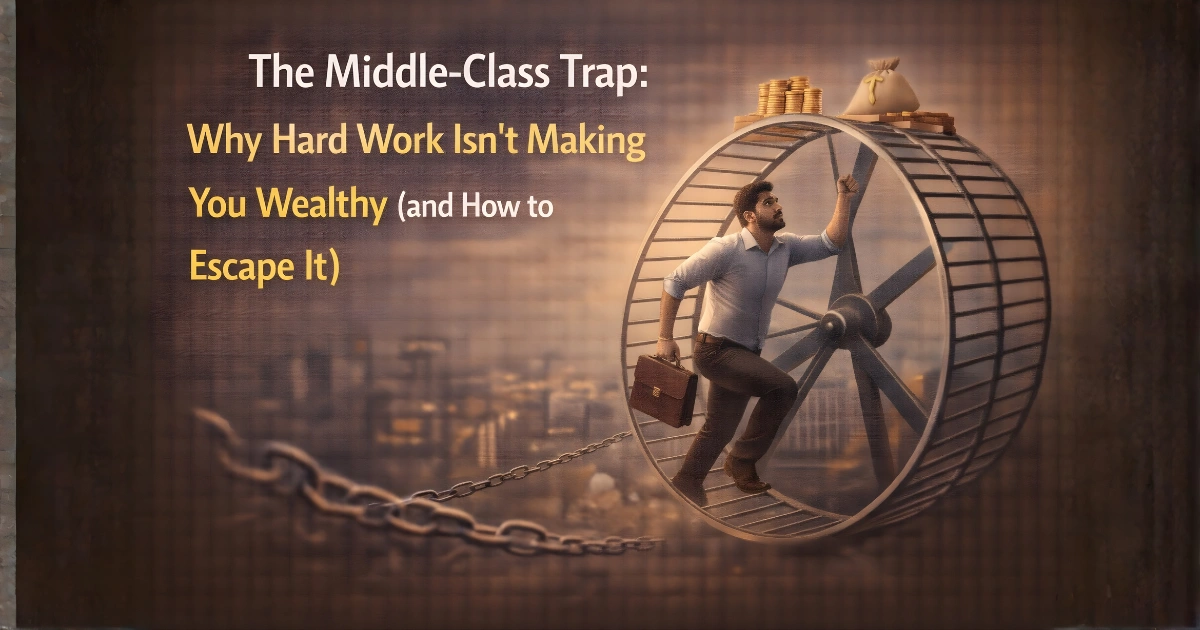
We grow up believing a simple formula: study hard, get a stable job, work diligently, earn promotions, and someday… wealth will follow.
But for a large chunk of the middle class, reality plays out very differently.
Long hours. Endless responsibilities. A decent salary on paper — yet constant financial pressure. No real assets, no breathing room, and the haunting feeling that one unexpected expense can derail everything.
This isn’t about laziness or lack of effort.
It’s about a system where trading time for money caps your growth — no matter how hard you work.
That’s the heart of the Middle-Class Trap.
Let’s break down why it happens, how mindset and habits quietly reinforce it, and what it really takes to escape.
The Real Problem — Trading Time for Money
Most middle-class careers follow a linear model:
You work hours.
You get paid for those hours.
If you want to earn more, you work more — or hope for a raise.
This is what’s called trading time for money, a concept often discussed in financial independence frameworks such as this overview of active vs passive income:
👉 https://www.investopedia.com/terms/p/passiveincome.asp
It sounds sensible… until you realize time is limited.
There are only so many hours you can sell.
Meanwhile, the wealthy don’t rely on effort alone. Their money grows because:
Assets work while they sleep
Income isn’t tied to clock-in hours
Systems, ownership, and investments generate returns
Wealth scales. A salary doesn’t.
That’s why two people can work equally hard — yet one stays stuck while the other builds financial freedom.
Why the Middle Class Stays Stuck
Lifestyle Creep — The Silent Trap
As income rises, expenses rise with it.
A better phone. A bigger house. More subscriptions. Costly dinners. Upgraded everything.
This pattern is known as lifestyle creep, explained here in detail:
👉 https://www.investopedia.com/terms/l/lifestyle-inflation.asp
Not because we need it — but because we don’t want to lose status.
Instead of building assets, people spend to look successful.
We convince ourselves:
“I deserve this — I worked hard.”
True. But if every increase in income fuels lifestyle upgrades, wealth never compounds.
The Poor Mindset in Disguise
You don’t have to be poor to think like the poor.
The scarcity mindset vs growth mindset dynamic is well-documented in behavioral economics:
👉 https://www.behavioraleconomics.com/resources/mini-encyclopedia-of-be/scarcity/
It shows up in subtle ways:
You avoid financial discomfort
You think short-term instead of long-term
You fear taking calculated risks
You rely on one source of income
You confuse being busy with being productive
You don’t upgrade your mindset
Hard work becomes the comfort zone — not growth.
One Source of Income = Constant Stress
Most middle-class families depend on a single salary.
If that job disappears, everything collapses — EMI, rent, school fees, lifestyle commitments.
Meanwhile, the wealthy diversify through multiple income streams:
👉 https://www.nerdwallet.com/article/investing/passive-income-ideas
They don’t just earn — they build income engines.
That’s the real difference.
Assets vs. Liabilities — The Divide That Changes Everything
Here’s where the mindset split becomes crystal clear.
Assets put money in your pocket.
Liabilities take money out.
A simple breakdown of assets vs liabilities in personal finance:
👉 https://corporatefinanceinstitute.com/resources/accounting/assets-vs-liabilities/
Stocks, real estate, businesses, equity — assets grow.
Cars, gadgets, credit-fuelled lifestyle — liabilities drain.
The middle class collects liabilities disguised as “success.”
The wealthy collect assets disguised as “boring decisions.”
Wealth isn’t about how much you earn — it’s about what your money starts earning for you.
Common Middle-Class Habits That Keep You Trapped
Not criticisms — just patterns worth noticing.
You spend to look successful rather than to grow
You avoid discomfort — so you avoid opportunities
You upgrade lifestyle before upgrading skills
You treat risk as danger instead of strategy
You believe long hours equal progress
You think saving money is enough
You never question your income model
Working hard isn’t the problem.
Stopping at hard work is.
Real-Life Example — Two People, Same Salary, Different Future
Rahul and Neha both earn the same income.
Rahul buys a car upgrade, new phone, frequent vacations — because “life is short.”
He’s constantly trading time for money to maintain lifestyle.
Neha invests first:
Index funds
A side-skill she later monetizes
Small but consistent investments in equity
Why this matters? Because long-term compounding works quietly over time:
👉 https://www.investopedia.com/terms/c/compounding.asp
Five years later:
Rahul works harder than ever.
Neha works smarter — because her money works with her, not just for her.
Same income.
Different decisions.
Opposite outcomes.
Action Steps — How to Break Out of the Middle-Class Trap
Escaping isn’t about overnight success or reckless risk.
It’s about intentional shifts.
Step 1 — Build Income Beyond Your Job
Start small, but start.
Freelance skills
Digital products
Consulting
Side business
Content-based revenue
Investments that generate passive returns
A helpful starter guide to building additional income streams:
👉 https://www.shopify.com/blog/side-hustle-ideas
One additional stream reduces dependency — and fear.
Step 2 — Invest Before You Upgrade Lifestyle
Reverse the default habit:
Invest first. Spend later.
Even modest, consistent investing beats endless consumption.
Here’s a beginner-friendly guide to systematic investing habits:
👉 https://www.investor.gov/introduction-investing/investing-basics/compound-interest
Step 3 — Take Calculated Risks
Fear keeps people stuck.
But most growth comes from discomfort.
Study. Learn. Prepare.
Then take smart, measured risks — not blind leaps.
A great primer on calculated risk-taking in careers and business:
👉 https://hbr.org/2017/10/are-you-taking-enough-smart-risks
Step 4 — Upgrade Your Mindset Before Your Income
Books. Mentors. Courses. Exposure.
Your mind must grow before your money does.
Because without mindset shifts…
wealth slips away even if you manage to earn it.
A helpful introduction to financial mindset and behavior change:
👉 https://www.morganhousel.com/psychology-of-money
Mistakes to Avoid on the Journey
Treating income growth as the only goal
Waiting for “the perfect time”
Thinking investments are only for rich people
Assuming security comes from a job alone
Believing productivity equals busyness
Progress comes from leverage — not exhaustion.
Pro Tips to Stay Out of the Trap
Track where your money actually goes
Audit lifestyle upgrades before committing
Build skills that scale — not just tasks
Surround yourself with growth-oriented people
Question habits that feel comfortable but limiting
Wealth follows intention — not routine.
Conclusion — Hard Work Builds Stability. Ownership Builds Freedom.
Hard work creates dignity, stability, and discipline — and those matter.
But hard work alone will never make you rich if your income remains linear and dependent on your time.
Escaping the middle-class trap means shifting your identity:
From earner → to builder
From consumer → to owner
From short-term comfort → to long-term freedom
Start small.
Invest early.
Learn faster than you upgrade your lifestyle.
Your future self will thank you.