
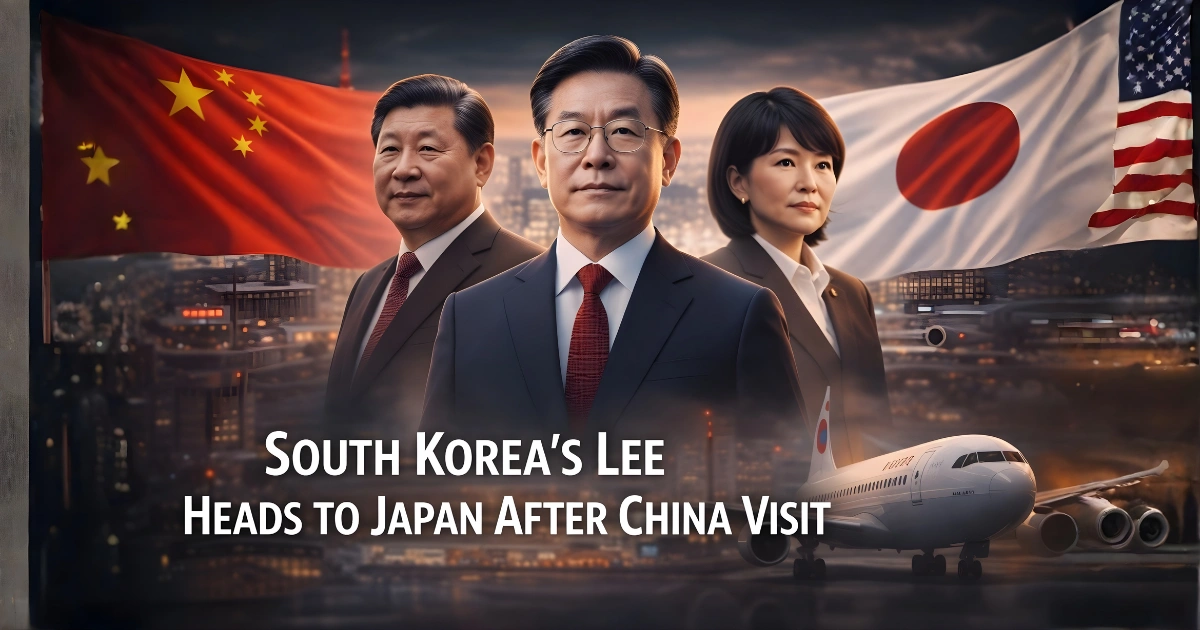
Introduction: One Trip, Two Capitals, and a Delicate Balancing Act
Diplomacy rarely moves in straight lines.
Sometimes, it moves in careful curves—one capital at a time.
That’s exactly what Lee Jae-myung, South Korea’s president, is attempting right now. After wrapping up a high-profile visit to Beijing, Lee is preparing to travel to Japan for a planned summit with Sanae Takaichi—a meeting that comes at a sensitive moment in East Asian geopolitics.
The timing matters.
China and Japan are navigating renewed friction. South Korea sits between them—economically intertwined with China, strategically aligned with Japan and the US, and historically complicated with both.
Lee’s diplomacy is not about grand speeches. It’s about positioning.
This blog breaks down why South Korean President Lee Jae-myung met China’s Xi Jinping first, what his planned summit in Nara with Prime Minister Takaichi really signals, and how this sequence could shape regional politics in the months ahead.
South Korean President Lee Jae-myung’s China Visit: Why It Came First
Before Japan, there was China.
China’s Xi to Host South Korea’s Lee — A Symbolic First Step
During his four-day state visit, Xi Jinping hosted South Korean President Lee Jae-myung in Beijing, marking Lee’s first official visit to China since taking office.
That alone made headlines across global media, including coverage by Reuters and Bloomberg tracking Asia diplomacy:
More importantly, Lee became the first South Korean president to visit China early in a new administration cycle—a move Seoul-watchers immediately read as strategic signalling.
South Korean President Lee Jae-myung said he hoped for a “new phase” in ties with China during his state visit.
Those words were carefully chosen.
Why Beijing Matters So Much to Seoul
For South Korea, China is not just a neighbour. It is:
-
Its largest trading partner
-
A critical player in North Korea diplomacy
-
A manufacturing and supply-chain anchor
According to South Korea’s Ministry of Trade data, China consistently accounts for the largest share of Korean exports:
Ignoring Beijing is not an option for any South Korean leader.
Lee’s visit aimed to:
-
Stabilise economic ties
-
Reopen political communication channels
-
Reduce uncertainty around trade and technology
The trip wasn’t about choosing China over anyone else. It was about keeping doors open.
A “New Phase” With China — What Does That Actually Mean?
Diplomatic language is often vague by design.
When Lee spoke of a “new phase” in China–South Korea relations, he wasn’t promising alignment. He was promising predictability.
What Seoul Wants From Beijing
South Korea’s priorities are pragmatic:
-
Fewer trade disruptions
-
Clearer signals on tech restrictions
-
Constructive engagement on North Korea
These priorities align with long-standing South Korean foreign policy positions outlined by the Blue House:
Lee’s approach so far suggests engagement without dependence—a fine line, but a necessary one.
From Beijing to Nara: Why Japan Is the Next Stop
Once Lee finishes in China, attention shifts quickly to Japan.
Mr Lee’s Planned Summit With Ms Takaichi in Nara
Japan’s Prime Minister Sanae Takaichi is arranging to host South Korea’s President Lee Jae-myung for a summit meeting in the historic city of Nara.
Nara isn’t just a scenic backdrop. It’s symbolic—often chosen for diplomacy aimed at resetting or softening relationships rather than escalating rhetoric.
The summit comes amid a China-Japan rift, making South Korea’s role more complex—and more important.
Why the China-Japan Rift Raises the Stakes
Relations between Beijing and Tokyo have been under strain due to:
-
Regional security concerns
-
Maritime disputes in the East China Sea
-
Competing influence across Asia
Japan’s security concerns regarding China’s regional posture have been widely documented by Japan’s Ministry of Defense:
These tensions have pushed Japan closer to the US and South Korea on security cooperation.
This puts Lee in a difficult—but potentially powerful—position.
He must:
-
Maintain workable ties with China
-
Strengthen cooperation with Japan
-
Avoid being seen as choosing sides
That’s not easy diplomacy. It’s precision diplomacy.
What Japan Wants From the Lee–Takaichi Summit
Japan’s goals are clearer than they appear.
From Tokyo’s perspective, hosting Lee achieves several things:
-
Reinforces trilateral cooperation with South Korea and the US
-
Signals stability amid regional tensions
-
Positions Japan as a reliable diplomatic anchor
Prime Minister Takaichi’s government sees South Korea not just as a neighbour, but as a strategic partner in a volatile region—especially on security and supply-chain resilience.
South Korea’s Balancing Strategy: Not Neutral, But Flexible
Some analysts call this “hedging.” Others call it realism.
Lee’s diplomatic moves suggest a strategy built on:
-
Economic engagement with China
-
Security cooperation with Japan
-
Avoiding zero-sum alignments
South Korea is not sitting on the fence. It’s walking a narrow bridge.
This approach reflects broader middle-power strategies increasingly discussed in global policy forums such as the Council on Foreign Relations:
Common Misreadings of Lee’s Diplomacy
Here’s where commentary often goes wrong.
Mistake 1: “Lee Is Pivoting Toward China”
He isn’t.
Meeting Xi Jinping first doesn’t mean prioritising China over Japan or the US. It means acknowledging economic realities.
Mistake 2: “Japan Comes Second, So It Matters Less”
Order doesn’t equal importance.
The Japan summit is happening amid heightened China-Japan tensions, which arguably makes it more consequential.
What This Means for the Region (In Plain Terms)
If Lee succeeds:
-
China gets reassurance without concessions
-
Japan gets cooperation without confrontation
-
South Korea gains room to manoeuvre
If he fails:
-
Seoul risks pressure from both sides
-
Trade and security uncertainties grow
-
Regional fault lines deepen
This isn’t about headlines. It’s about stability.
Pro Tips for Reading Diplomatic Signals Like This
When following high-level diplomacy, ignore:
-
Who smiled more
-
Who spoke longer
-
Who stood where
Instead, watch:
-
Sequence of visits
-
Language used (“new phase” matters)
-
Choice of meeting locations (Nara matters)
Diplomacy is about what’s implied, not just what’s said.
Action Steps for Observers, Investors, and Policy Watchers
If you track geopolitics professionally—or even casually—here’s what to watch next:
-
Joint statements after the Nara summit
-
Any mention of trade, tech, or North Korea
-
Changes in trilateral cooperation language
These signals will tell you far more than official photos.
Final Thoughts: A Test of Modern Asian Diplomacy
South Korean President Lee Jae-myung’s back-to-back engagements—with China first, Japan next—are not accidental.
They reflect the reality of Asia today:
-
Interdependence without trust
-
Cooperation without comfort
-
Dialogue without illusions
Whether this approach succeeds will depend less on speeches and more on follow-through.
For now, Lee is sending a clear message:
South Korea intends to talk to everyone—and be beholden to no one.