
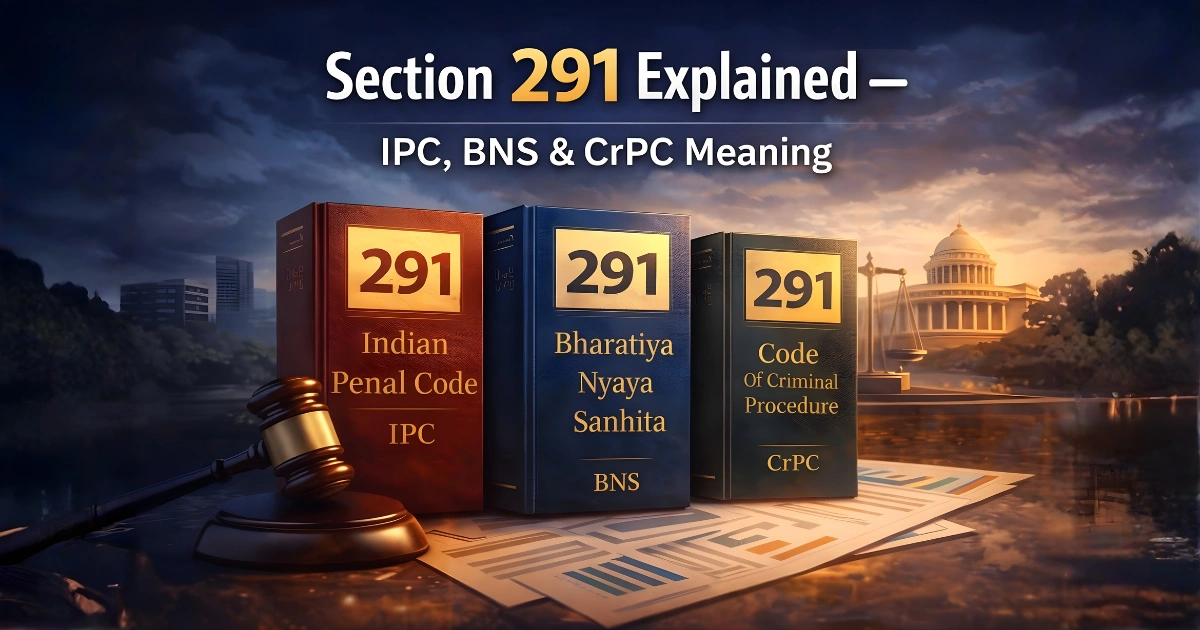
Introduction — One Section Number, Many Different Legal Meanings
If you search for Section 291, you’ll quickly realise something confusing — the same section number does not mean the same thing across different Indian laws.
Under the Indian Penal Code (IPC), Section 291 is about continuing a public nuisance even after being ordered to stop (see the IPC text on the India Code portal here: https://www.indiacode.nic.in).
Under the Bharatiya Nyaya Sanhita (BNS) — the new criminal law — Section 291 has a completely different meaning and deals with negligent conduct with respect to animals. You can refer to the official BNS framework here:
https://bns.gov.in (or consolidated text via India Code).
And in the Code of Criminal Procedure (CrPC), Section 291 isn’t even an offence — it is a procedural provision about deposition of medical witnesses. Reference copy available here:
https://legislative.gov.in/actsofparliamentfromtheyear/code-criminal-procedure-1973
To make it more confusing, people often assume Section 291 also exists in the IT Act or Companies Act — but it doesn’t apply there in the way they think. For clarity, refer to the official acts here:
-
Information Technology Act, 2000 — https://www.meity.gov.in
-
Companies Act, 2013 — https://www.mca.gov.in
So, let’s break everything down simply —
Act-wise, meaning-wise, and purpose-wise — with examples.
No jargon. No legal fog. Just clarity.
⭐ Section 291 — Quick Reference Table (At a Glance)
| Act | Provision Name | Description | Punishment / Nature | Status / Note |
|---|---|---|---|---|
| Indian Penal Code (IPC) | Continuance of nuisance after injunction to discontinue | Punishes anyone who repeats or continues a public nuisance after being ordered by a lawful public servant to stop. | Imprisonment up to 6 months, or fine, or both. | Recodified as Section 293 in BNS |
| Bharatiya Nyaya Sanhita (BNS) | Negligent conduct with respect to animal | Punishes anyone who knowingly or negligently omits to take proper care of an animal in their possession, leading to probable danger to human life or grievous hurt. | Up to 6 months’ imprisonment or ₹5,000 fine, or both. | Corresponds to former IPC Section 289 |
| Code of Criminal Procedure (CrPC) | Deposition of medical witness | Allows deposition of a medical professional recorded before a Magistrate to be used as evidence without calling the witness again. | Procedural — no punishment | BNSS version serves a different procedural purpose |
| IT Act / Companies Act | Not Applicable | No Section 291 defining an offence or core liability | Not applicable | Commonly misinterpreted |
🟢 Section 291 Under IPC — “Continuance of Nuisance After Order to Stop”
Reference (India Code Act Library):
https://www.indiacode.nic.in
Meaning in simple words
Section 291 IPC says:
Whoever repeats or continues a public nuisance even after being ordered by a lawful public servant to stop — shall be punished.
This applies where a person:
-
causes disturbance or inconvenience to the public, and
-
is ordered to discontinue it, but
-
still repeats or continues the nuisance.
Punishment
-
Imprisonment up to 6 months, or
-
Fine, or
-
Both
Real-life example
A shopkeeper blocks a public footpath with goods. The municipal officer orders him to clear it. He clears it — but later blocks it again.
➡️ That can become an offence under Section 291 IPC.
Important update
Under the Bharatiya Nyaya Sanhita, this offence is now re-numbered as Section 293.
🟡 Section 291 Under BNS — “Negligent Conduct with Respect to Animals”
Reference (BNS Framework Overview):
https://bns.gov.in
This section is not the same as IPC Section 291.
Meaning
Section 291 BNS punishes a person who:
-
knowingly or negligently fails to take proper care or safety measures for an animal in their possession, and
-
such negligence creates probable danger to human life or grievous hurt.
Punishment
-
Up to 6 months’ imprisonment, or
-
Fine up to ₹5,000, or
-
Both
Example
A person keeps an aggressive dog unchained in a public area and it attacks a passer-by.
➡️ This may fall under Section 291 BNS.
Correspondence
This provision evolved from IPC Section 289, not IPC 291.
So:
-
IPC 291 ≠ BNS 291
-
BNS 291 = Former IPC 289
🔵 Section 291 Under CrPC — Evidence of Medical Witness
Reference (CrPC Act Text):
https://legislative.gov.in/actsofparliamentfromtheyear/code-criminal-procedure-1973
This is not an offence section.
It allows:
A deposition of a medical professional recorded before a Magistrate to be used as evidence in trial, without recalling the witness — provided due process was followed.
Purpose:
-
avoids recalling doctors unnecessarily
-
speeds up trials
-
preserves valid medical testimony
The BNSS equivalent section serves a different procedural role — numbering does not match.
❌ Section 291 — IT Act & Companies Act (Not Applicable)
There is no Section 291 in:
-
Information Technology Act, 2000 — https://www.meity.gov.in
-
Companies Act, 2013 — https://www.mca.gov.in
…that defines an offence, liability, or major legal principle.
Most online confusion comes from mislabelled content or copied notes.
⚠️ Common Confusions & Mistakes
-
❌ Assuming Section 291 has one universal meaning
-
❌ Mixing BNS 291 with IPC 291
-
❌ Believing it applies to IT Act or Companies Act
Each Act has its own purpose, context, and structure.
🧭 How to Read Section Numbers Correctly (Practical Tips)
-
Always check which Act the section belongs to
-
Don’t rely on section number alone
-
Read the provision title + description
-
Identify whether it is:
-
an offence
-
a procedure
-
not applicable
-
Law is contextual — the same number can mean different things across statutes.
💡 Pro Tips (For Students, Lawyers & Readers)
-
Search using: “Section 291 + Act Name”
-
Cross-verify using:
-
India Code Portal — https://www.indiacode.nic.in
-
Official Government Sources
-
-
Always confirm:
-
provision name
-
scope
-
punishment
-
recodification status
-
Conclusion — Section 291 Is a Number, Not a Single Law
Section 291 is just a section number — not one fixed offence.
Across laws, it means different things:
-
IPC — continuing a nuisance after order to stop
-
BNS — negligent conduct with respect to animals
-
CrPC — procedural rule for medical witness depositions
-
IT Act & Companies Act — not applicable
Understanding the Act-specific context is what truly matters.
Call to Action
If you’re confused about any section or want clarity on how a provision applies in your case — share your query, and I’ll explain it in simple, practical language.