
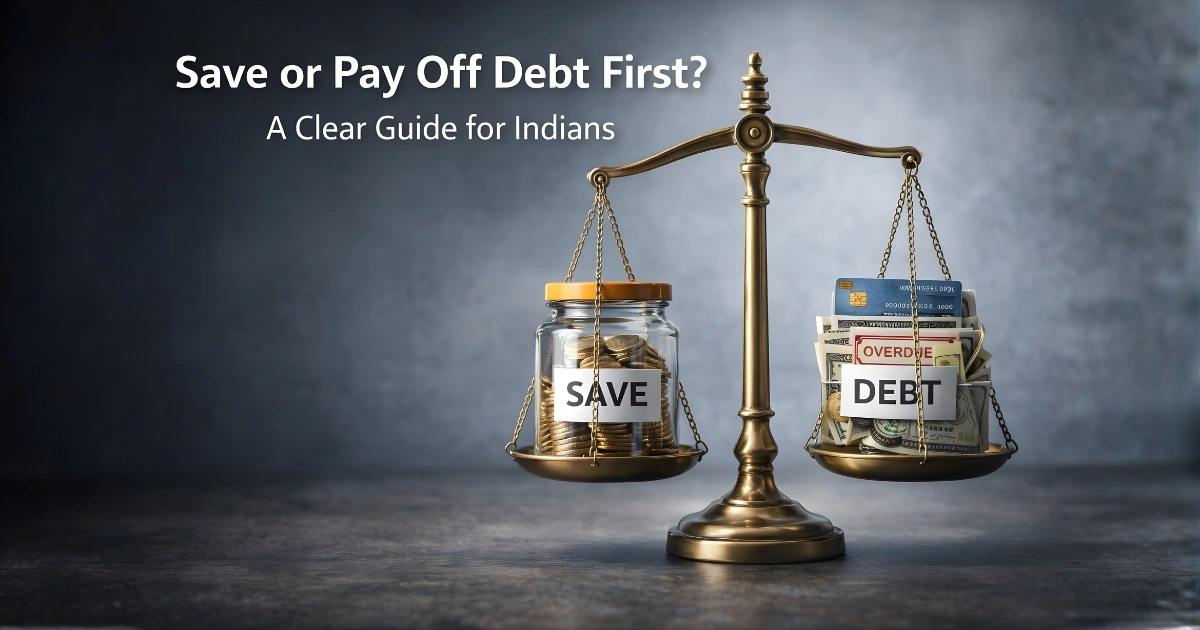
The Money Dilemma Most Indians Live With
You open your banking app after salary day.
There’s an EMI due.
A credit card bill staring at you.
And that quiet guilt telling you that you should be saving something too.
So you split the money.
A little goes into savings.
The rest barely dents your debt.
And next month, you’re back in the same place.
If you’re an Indian managing EMIs and credit card debt, this confusion isn’t a personal failure. It’s what happens when no one gives you a clear priority framework.
Surveys on household finance consistently show that debt-related stress in India is driven more by cash-flow pressure than income levels
👉 https://www.rbi.org.in/financialeducation
The real question isn’t pay off debt or save first.
It’s what should your money do first to protect you.
Let’s answer that properly.
Why This Decision Feels So Confusing
On one side, you’re told:
“Always save something. Start early.”
On the other:
“Debt is bad. Clear it as soon as possible.”
Both are technically correct. But doing both without a sequence creates chaos.
Here’s the reality most people ignore:
Just as you owe EMIs to your lenders for borrowed money, debt interest is working against you every single day—whether you’re thinking about it or not.
Financial education material from SEBI highlights how compounding works both for and against investors
👉 https://investor.sebi.gov.in
Savings grow slowly.
Debt grows aggressively.
Until you respect that difference, money decisions will keep feeling stressful.
Step 1: Understand Debt Interest (This Changes Everything)
Not all debt is equally dangerous.
The interest rate decides priority—not emotion.
High-interest debt (financial emergency)
-
Credit cards
-
Payday loans
-
Buy-now-pay-later balances
-
Personal loans
These often charge 30–45% annual interest, as documented in consumer lending data
👉 https://www.rbi.org.in/Scripts/BS_ViewBulletin.aspx
Lower-interest debt (manageable, not urgent)
-
Home loans
-
Education loans
-
Some vehicle loans
These usually sit in the 8–11% range.
This is why most experts agree that one must first pay off the most expensive loan before doing anything ambitious with savings.
Ignoring this is like trying to fill a bucket with a hole at the bottom.
Step 2: Should You Pay Off the Debt First or Save First?
This is where most articles give lazy answers.
Here’s the practical Indian answer:
👉 Pay off the debt first—but not blindly.
If you have high-interest debt such as credit cards or payday loans, paying off high-interest debt first should be your top priority.
But stopping savings completely creates a new problem:
The next emergency sends you right back into debt.
The balanced rule that actually works
-
Aggressively pay off high-interest debt
-
Simultaneously build a small emergency fund
This approach aligns with global personal finance frameworks recommended by institutions like CFPB
👉 https://www.consumerfinance.gov/consumer-tools/debt-collection/
This protects your present and your future.
Step 3: Why Credit Cards Should Almost Always Come First
Let’s be blunt.
If you’re investing, saving aggressively, or prepaying home loans while carrying credit card balances—you’re losing money.
A simple example
-
Credit card interest: ~3% per month
-
Savings account interest: ~0.3% per month
Even diversified investments cannot reliably beat credit card interest without risk, as explained by Morningstar
👉 https://www.morningstar.com/personal-finance
So if you’re asking pay off debt or save first, the answer is clear when credit cards are involved:
👉 Pay off the debt first. Every extra rupee.
This is not conservative advice.
It’s basic arithmetic.
Step 4: The Role of an Emergency Fund (Don’t Skip This)
Many people hear “pay off debt first” and go extreme.
They throw everything at debt and leave themselves exposed.
That’s a mistake.
Without a buffer:
-
Medical bills go on credit cards
-
Repairs turn into new loans
-
Progress gets undone
Healthcare cost data from IRDAI shows why even small emergencies derail finances
👉 https://www.irdai.gov.in
What to do instead
While paying off high-interest debt:
-
Build a basic emergency fund
-
₹50,000–₹1,00,000 is enough initially
This fund is not for lifestyle spending.
It’s insurance against going backwards.
Step 5: Where EMIs Fit into the Priority Framework
Most Indian households live with EMIs. That’s normal.
The mistake is treating all EMIs the same.
Here’s the correct order
-
Credit cards & payday loans → kill first
-
Personal loans / BNPL → next
-
Emergency fund (basic) → parallel priority
-
Home loan EMIs → continue as planned
-
Long-term investing → once pressure reduces
Why not prepay home loans immediately?
Because:
-
Home loans are lower-interest
-
They come with tax benefits
-
Liquidity matters more early on
This reasoning is also supported by long-term housing finance analysis
👉 https://www.nhb.org.in
Prepaying a home loan while carrying credit card debt is financially backwards—even if it feels responsible.
Step 6: A Simple Action Plan You Can Follow
Here’s a clean framework for Indians juggling EMIs and debt:
-
Pay minimums on all loans
-
Aggressively clear credit cards
-
Build a small emergency fund
-
Finish personal loans
-
Increase emergency fund to 3–6 months
-
Start small, consistent investments
-
Invest systematically
-
Consider selective loan prepayments
-
Optimise for long-term growth
This phased approach mirrors structured debt-reduction models used globally
👉 https://www.investopedia.com/articles/personal-finance/090916/debt-reduction-strategies.asp
You don’t need to do everything at once.
You need to do things in the right order.
Common Mistakes That Keep People Stuck
Watch out for these traps:
-
Investing while carrying credit card debt
-
Saving emotionally instead of strategically
-
Prepaying low-interest loans too early
-
Ignoring debt interest because EMIs feel “manageable”
-
Using credit cards again after clearing them
Progress isn’t about motivation.
It’s about structure.
Pro Tips That Make This Easier
-
Automate debt payments before savings
-
Keep savings and spending accounts separate
-
Don’t chase returns while paying high interest
-
Review priorities every 6–12 months, not weekly
-
Focus on cash flow, not just net worth
Clarity reduces stress faster than discipline ever will.
Final Thought: This Isn’t a Moral Choice. It’s a Sequence Problem.
Saving is good.
Debt-free living is good.
But doing them in the wrong order creates stress, not security.
For most Indians with EMIs and credit card debt, the smartest move is:
-
Pay off high-interest debt first
-
Protect yourself with a basic emergency fund
-
Then grow savings and investments calmly
Once the sequence is right, money stops feeling like a constant fight.
Start with the most expensive problem.
Everything else becomes easier after that.