For years, e-invoicing felt like something only large companies had to worry about.
That comfort zone is gone.
As we move into 2026, e-invoicing is no longer a “large enterprise” issue. Thousands of mid-sized businesses are now firmly inside the compliance net—often without realizing it.
And the mistake most businesses make is simple:
they assume e-invoicing applies based on current turnover.
It doesn’t.
Let’s clear the confusion.
What Changed—and Why This Matters in 2026
The e-invoicing threshold is not based on just one year.
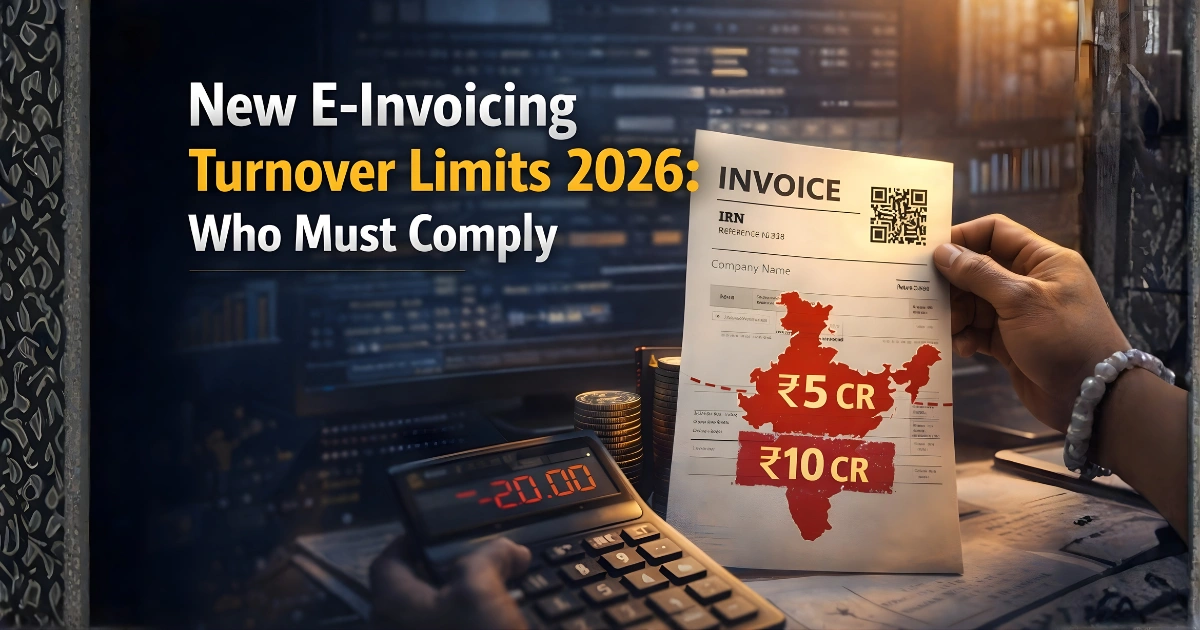
Under GST rules notified by the government and implemented through the GST Portal, the limit for mandatory e-invoicing is for businesses with an annual turnover of over ₹5 crore in any financial year starting from FY 2017-18 onwards.
That means:
-
Even if your turnover is lower today
-
Even if your business has slowed down
-
Even if you’re currently below ₹5 crore
If you crossed ₹5 crore once between FY 2017-18 and FY 2024-25, e-invoicing applies to you in 2026.
This is where most non-compliance begins—quietly.
Who Must Comply with E-Invoicing in 2026
1. Businesses Crossing ₹5 Crore (Even Once)
Let’s be precise.
The limit for mandatory e-invoicing is for businesses with an annual turnover of over ₹5 crore in any financial year since FY 2017-18.
This requirement is issued under GST notifications and enforced through system checks explained in CBIC circulars and GST FAQs.
This is not optional.
This is not based on your current year alone.
If your GST registration has ever reported turnover above ₹5 crore:
-
You are required to generate e-invoices
-
Your invoices must be validated through the Invoice Registration Portal (IRP)
No IRP validation = no legal invoice under GST.
2. Types of Transactions Covered
E-invoicing is not for all invoices—but the coverage is wider than many assume.
It applies to:
-
B2B (Business-to-Business) transactions
-
B2G (Business-to-Government) supplies
-
Export invoices
It does not apply to:
-
B2C invoices (as of now)
-
Certain exempt categories notified separately by the government
The scope of coverage is detailed in e-invoicing guidelines on the GST portal.
If your business issues B2B or export invoices, e-invoicing is unavoidable once the threshold is crossed.
The ₹10 Crore Rule: Where Timelines Get Tighter
There’s a second threshold most people miss.
Businesses with an Annual Aggregate Turnover (AATO) of ₹10 crore or more face an additional compliance requirement introduced to tighten real-time reporting.
These businesses must:
-
Generate IRP-validated e-invoices
-
Upload invoices within 30 days of the invoice date
This rule was introduced to prevent back-dated uploads and is enforced through the Invoice Registration Portal (IRP) infrastructure described in GST system advisories.
So even if you’re e-invoicing already, delayed uploads can now create violations.
What the GST Council Mandated—and Why It’s Not Changing
The Goods and Services Tax Council mandated that businesses with an annual turnover of ₹10 crore (and above) must follow stricter real-time compliance for e-invoicing.
This isn’t a temporary measure.
It’s part of a broader GST strategy:
-
Real-time data capture
-
Reduced fake ITC claims
-
Automated return validation
These objectives are consistently reflected in policy decisions published via CBIC and GST Council press releases.
Which means rollbacks are unlikely.
If anything, thresholds may go lower over time—not higher.
How E-Invoicing Actually Works (Plain English)
Let’s remove the jargon.
Here’s what compliance looks like in practice:
-
You create an invoice in your billing or accounting software
-
The invoice data is sent to the Invoice Registration Portal (IRP)
-
IRP validates the data and issues:
-
An IRN (Invoice Reference Number)
-
A QR code
-
-
Only then is the invoice considered valid under GST
The step-by-step process is documented in the GST e-invoicing user manual.
Without IRP validation:
-
The invoice is invalid
-
ITC can be denied to your customer
-
Penalties may apply
Real-World Example (This Is Where People Slip)
A manufacturing firm crossed ₹6.2 crore turnover in FY 2021-22.
In FY 2024-25, turnover dropped to ₹4.5 crore.
They assumed:
“We’re below ₹5 crore now, so e-invoicing doesn’t apply.”
That assumption is wrong.
Because they crossed the threshold once, e-invoicing applies permanently, unless GST rules change.
This is the most common—and costly—mistake.
Common Mistakes Businesses Are Making
These aren’t technical errors. They’re awareness gaps.
-
Checking only current-year turnover
-
Ignoring older GST returns available on the GST return dashboard
-
Assuming CA or ERP will “auto-handle” compliance
-
Generating invoices first and uploading later
-
Missing the 30-day upload rule for ₹10 crore+ AATO businesses
GST systems don’t flag these mistakes politely.
They flag them with notices and penalties.
What Happens If You Don’t Comply
Non-compliance isn’t theoretical anymore.
Possible consequences include:
-
Invalid invoices under GST law
-
Customer ITC denial (and commercial disputes)
-
Penalties for incorrect invoicing
-
Scrutiny during audits
In short: e-invoicing failures ripple outward—to customers, cash flow, and credibility.
Action Steps to Stay Safe in 2026
Step 1: Check Your Historical Turnover
Review GST returns from FY 2017-18 onward using the GST Portal.
If you crossed ₹5 crore even once, e-invoicing applies.
Step 2: Confirm Your AATO Category
If your Annual Aggregate Turnover is ₹10 crore or more, set up systems to ensure invoices are uploaded within 30 days.
Step 3: Align Your Software
Ensure your billing or ERP system:
-
Is IRP-integrated
-
Can generate IRNs and QR codes
-
Handles export invoices correctly
Step 4: Train Your Team
E-invoicing is not just a CA task.
Your sales and accounts teams must understand:
-
When invoices are valid
-
What cannot be edited post-IRP
-
Why timelines matter
Pro Tips from the Ground
-
Don’t wait for a GST notice to “confirm applicability”
-
Historical turnover matters more than current slowdown
-
Customers will push back hard if ITC is denied
-
Test e-invoicing in a sandbox before going live
-
Document your compliance trail—it helps during audits
Discipline upfront is cheaper than explanations later.
Conclusion: E-Invoicing in 2026 Is About Reach, Not Size
E-invoicing is no longer about how big you are today.
It’s about whether you ever crossed the line.
If your business crossed ₹5 crore once, you’re in.
If your AATO is ₹10 crore or more, timelines tighten.
The rules are clear.
The systems are automated.
And the tolerance for “we didn’t know” is gone.
If you’re unsure, check now—before an invalid invoice creates a bigger problem.