
The Problem Isn’t Big Expenses. It’s How They Arrive.
Every year, the same things hit your wallet—travel plans, school fees, festivals, weddings, insurance renewals.
And every year, they feel like surprises.
Not because you didn’t know they were coming.
But because you didn’t prepare for them in advance.
That’s where most budgets break.
According to insights shared by the Reserve Bank of India (RBI) on household financial behaviour, predictable expenses are one of the biggest causes of cash-flow stress when not planned monthly
👉 https://www.rbi.org.in
The solution isn’t cutting fun or avoiding life.
It’s planning for predictable expenses before they become financial stress.
That’s exactly what the sinking fund method is designed to do.
What Is a Sinking Fund (In Simple Terms)?
Let’s clear the confusion first.
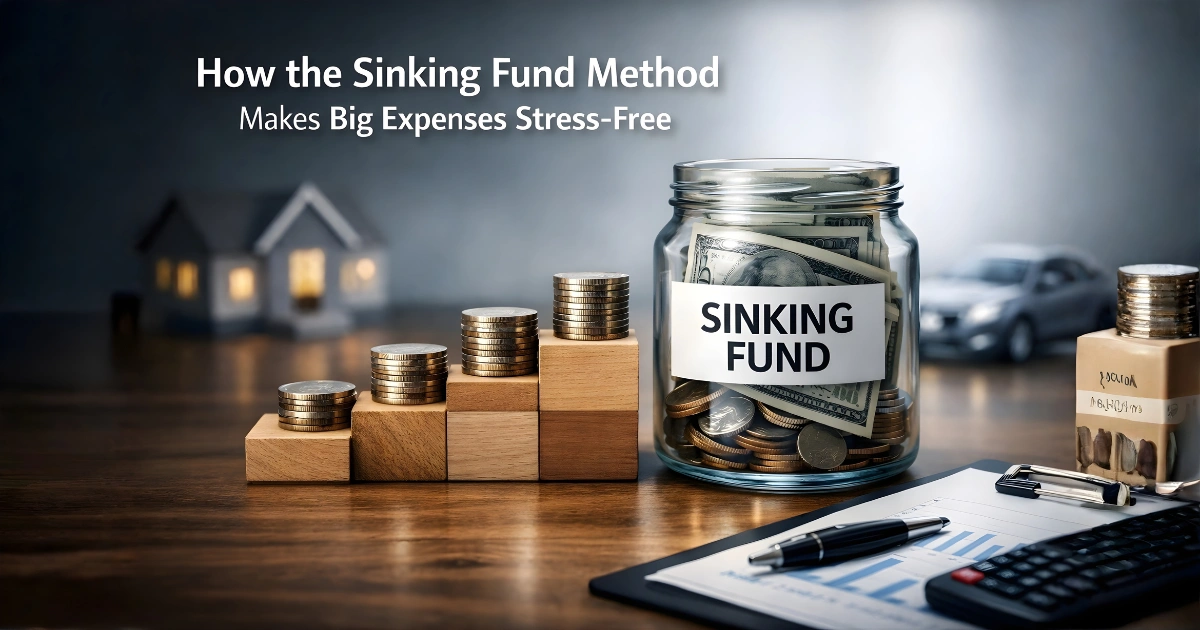
A sinking fund is a dedicated savings account for planned future expenses.
Instead of paying a large amount all at once, you set aside small, regular amounts over time.
That money “sinks” quietly into a separate fund—ready when the expense arrives.
In traditional finance, sinking funds refer to money set aside to repay debts or bonds over time—a concept widely explained in corporate finance literature
👉 https://www.investopedia.com/terms/s/sinkingfund.asp
In personal finance, the idea is the same—just far more practical.
Sinking funds help you set aside money for planned expenses like:
-
Travel and vacations
-
School or college fees
-
Festivals and gifts
-
Insurance premiums
-
Annual subscriptions
-
Home repairs
Nothing fancy. Just smart preparation.
Why Most People Struggle with Big Expenses
Here’s the mistake most people make.
They treat big expenses as exceptions instead of certainties.
So when they arrive:
-
Savings take a hit
-
Credit cards get swiped
-
EMIs quietly increase
Consumer finance studies published by SEBI consistently show that lack of advance planning leads to unnecessary short-term debt
👉 https://investor.sebi.gov.in
The stress doesn’t come from the expense itself.
It comes from paying for it all at once.
The sinking fund method fixes this by building the habit of treating those costs as monthly expenses, not emergencies.
How the Sinking Fund Method Actually Works
The logic is simple.
Instead of asking,
“Where will I find ₹60,000 for travel in December?”
You ask,
“How much do I need to save every month to be ready?”
A quick example
-
Planned travel cost: ₹60,000
-
Time left: 12 months
Monthly sinking fund contribution:
₹5,000 per month
That’s it.
By the time December arrives, the money is already waiting—exactly the kind of forward planning recommended by personal finance educators worldwide
👉 https://www.consumerfinance.gov
Step 1: Identify Expenses That Deserve a Sinking Fund
Not every expense needs one.
Sinking funds are best for predictable but irregular expenses.
Good candidates include:
-
Annual travel or vacations
-
School and college fees
-
Festivals, weddings, family functions
-
Insurance premiums
-
Gadgets or appliances you plan to replace
-
Home maintenance
If you know it’s coming and it’s not monthly, it belongs in a sinking fund.
Step 2: Decide How Many Sinking Funds You Need
You don’t need ten different accounts.
Start simple.
Two easy approaches
-
One sinking fund account with clear labels inside your tracker
-
2–3 sinking funds grouped by category (Travel, Education, Events)
The goal is clarity—not complexity.
As budgeting frameworks from Harvard Business Review highlight, simplicity improves consistency
👉 https://hbr.org
Remember:
A sinking fund is a tool, not a spreadsheet competition.
Step 3: Calculate Monthly Contributions (This Is the Key)
This is where the magic happens.
For each sinking fund:
-
Estimate the total expense
-
Divide it by the number of months left
-
Treat that amount like a fixed monthly bill
This approach mirrors the “pay-yourself-first” principle promoted by behavioural finance research
👉 https://www.behavioraleconomics.com
You stop “hoping” you’ll manage the expense later.
You start preparing for it calmly, month by month.
Step 4: Automate and Separate the Money
A sinking fund only works if it’s:
-
Separate
-
Untouched
-
Consistent
Best practices
-
Use a separate savings account or sub-account
-
Automate transfers right after salary credit
-
Do not mix this money with daily spending
Banks and fintech platforms increasingly encourage goal-based savings for this exact reason
👉 https://www.morningstar.in
Separation creates discipline without effort.
Step 5: Use the Fund Guilt-Free When the Time Comes
This part matters.
When the expense arrives, use the sinking fund without guilt.
That’s what it’s there for.
No panic.
>No credit card hangover later.
-start=”5371″ data-end=”5407″>You planned. You prepared. You paid.
That’s financial maturity.
Common Mistakes to Avoid
Even smart people mess this up. Watch out for these:
-
-
-
Treating sinking funds like emergency funds
-
Underestimating costs “to keep savings low”
-
Skipping contributions during tight months
-
Dipping into sinking funds for impulse spending
-
Creating too many funds and giving up
-
</
-
ul>
t=”5762″ data-end=”5813″>Keep it boring. Keep it simple. Keep it consistent.
Pro Tips That Make Sinking Funds Effortless
-
Start with one sinking fund if you feel overwhelmed
-
Increase contributions when income increases
-
Review sinking funds once or twice a year
-
Round up monthly contributions to create buffer
-
Keep sinking funds separate from investments
Sinking funds are about stability, not returns.
How Sinking Funds Change Your Relationship with Money
Here’s the underrated benefit.
When you use sinking funds:
-
Big expenses stop feeling scary
-
Budgets stop breaking
-
Savings stop disappearing
-
Debt becomes optional, not necessary
You’re no longer reacting to life.
You’re planning for it.
That’s the real win.
Final Thought: Predictable Expenses Should Never Feel Like Emergencies
If an expense happens every year, it shouldn’t shock your finances every year.
Once you learn what a sinking fund really is and start using it properly, money stops feeling chaotic.
You replace stress with structure.
Surprises with preparation.
And panic with calm.
Start with one sinking fund this month.
Your future self will thank you quietly—right when that big expense arrives.