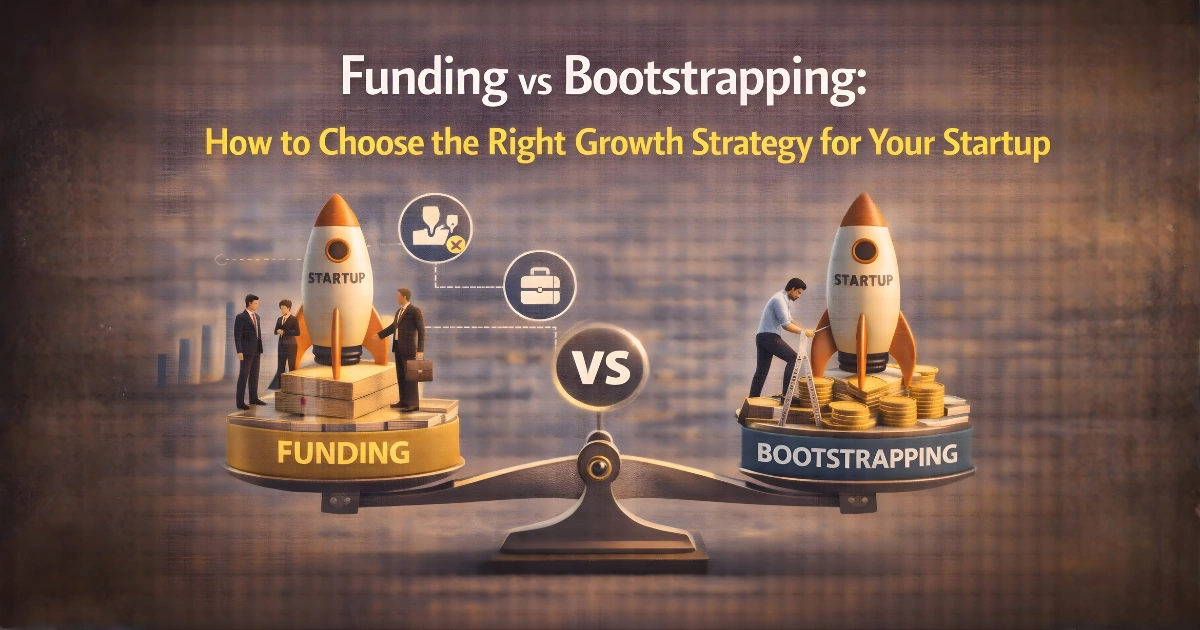
Funding vs. Bootstrapping: The Decision That Can Make or Break You
Some founders chase investors before they’ve written a single line of code. Others refuse outside money on principle and grind their way forward dollar by dollar. Both paths create success stories — and both have buried companies that made the wrong call for their stage, market, and goals.
Choosing between funding and bootstrapping (self-funding) isn’t just a financial decision. It shapes your pace, your ownership, your stress levels, and even the kind of company you end up building. Get it right, and the path ahead feels aligned and intentional. Get it wrong, and you’ll constantly feel like you’re fighting your own strategy.
This guide breaks down the trade-offs in plain language, with real-world context instead of startup platitudes — so you can make the decision that actually fits your business.
🔍 What Bootstrapping (Self-Funding) Really Means
Bootstrapping means you grow using personal savings, early revenue, and lean operations instead of outside capital. In many cases, that also means slower hiring, smaller bets, and a tighter focus on profitability from day one.
If you want a deeper look at the philosophy behind bootstrapping, explore the approach popularized by Basecamp founders here:
👉 https://basecamp.com/bootstrapped
In practice, it looks like:
-
Working from home instead of renting an office
-
Building only the features customers will pay for
-
Reinvesting revenue instead of taking big salaries
-
Saying “no” to opportunities you can’t afford yet
✅ Pros of Bootstrapping
Bootstrapping appeals to founders who value independence and sustainability. When you self-fund, you:
-
Keep full ownership and decision-making control — no outside investors steering direction
-
Retain 100% equity and protect future exit value
-
Develop stronger financial discipline, because every dollar matters
-
Grow at a sustainable pace instead of chasing vanity metrics
Many successful companies such as Mailchimp and Zoho grew without external funding. Read Zoho’s bootstrapped journey here:
👉 https://www.zoho.com/company/aboutus.html
Bootstrapping can also create healthier companies. When you’re accountable to customers instead of investors, you’re forced to build something people will actually pay for.
⚠️ Cons of Bootstrapping
Of course, self-funding isn’t romantic grit — it’s hard. The trade-offs include:
-
Slower growth and slower market entry
-
Personal financial strain and risk, especially early on
-
Limited resources for hiring, marketing, or R&D
-
The risk of missing fast-moving opportunities while competitors scale faster
A familiar story: a founder builds a great product, but by the time the business can afford to scale, a venture-backed competitor has already taken the market.
If you want to understand opportunity cost in fast-moving markets, this YC resource explains it well:
👉 https://www.ycombinator.com/library
Bootstrapping works best when time isn’t the biggest competitive factor — and when your business model can generate revenue quickly.
💰 What Funding (External Investment) Really Means
Funding means raising capital from VC firms, angel investors, accelerators, or strategic partners in exchange for equity or partial control.
If you’re new to startup funding structures, this guide from Startup India is helpful:
👉 https://www.startupindia.gov.in/content/sih/en/funding.html
Instead of growing from revenue, you use investor capital to move faster — whether that means product development, hiring, or aggressive market expansion.
🚀 Pros of Taking Funding
When you raise money, you’re not just getting cash. You’re often buying speed, reach, and expertise.
Funding gives you:
-
Rapid scaling potential and the ability to move early and aggressively
-
Access to investor networks, advisors, and partnerships
-
Faster market capture in competitive or winner-takes-most environments
-
Reduced personal financial exposure, since you’re not risking only your own savings
For examples of how venture-backed growth works, browse case studies on Sequoia Capital:
👉 https://www.sequoiacap.com/portfolio/
⚠️ Cons of Taking Funding
But funding comes at a cost — sometimes literally and emotionally.
Here’s what changes when investors enter the room:
-
Equity dilution (you now own less of your company)
-
Loss of some control over direction and strategy
-
Pressure to chase aggressive growth targets
-
Potential misalignment between investor expectations and your values or timeline
Investors aren’t buying your dream — they’re investing in a return.
A useful perspective on investor-founder alignment:
👉 https://a16z.com/entrepreneurs/
Funding works best when speed and market dominance matter more than control or profit in the short term.
⚖️ The Real Trade-Off: Control vs. Speed
Almost every funding decision boils down to one core tension:
-
Bootstrapping = Control, ownership, and sustainable growth
-
Funding = Speed, resources, and external expectations
Neither path is “better.” The right one depends on the kind of company you’re trying to build — and the kind of founder you want to be.
🧭 How to Decide Which Path Fits Your Startup
1. Market Opportunity
Ask yourself: How fast does this market move?
Funding is usually the better fit if:
-
The market is huge and competitive
-
There’s a short window to establish dominance
-
Network effects or scale create a winner-takes-most outcome
Learn more about network-effect businesses here:
👉 https://www.nfx.com/essays/network-effects/
Bootstrapping is often smarter when:
-
You’re targeting a niche audience
-
Success depends on depth, quality, or expertise
-
Profitability matters more than rapid expansion
2. Your Personal Goals
Be honest with yourself — what do you actually want?
A great reflection framework for founders:
👉 https://paulgraham.com/articles.html
3. Control vs. Speed
If you value autonomy → bootstrapping aligns better
If you value momentum → funding accelerates everything
4. Risk Tolerance
Bootstrapping concentrates risk on you.
Funding spreads risk across investors — but also spreads upside.
If you want a structured approach to founder risk thinking, this resource helps:
👉 https://hbr.org/topic/entrepreneurship
5. Business Model Reality Check
Some models simply cannot bootstrap.
Hardware, manufacturing, and deep-tech startups almost always need capital.
Great primer on capital-intensive models:
👉 https://www.mckinsey.com/capabilities/growth-marketing-and-sales/our-insights/startups
⚠️ Common Mistakes Founders Make When Choosing
-
Raising money just because it feels like validation
-
Bootstrapping out of pride even when the market demands speed
-
Treating funding as a safety net instead of a growth tool
-
Ignoring the emotional cost of investor pressure
-
Underestimating the personal risk of self-funding
💡 Pro Tips from Real-World Founder Journeys
-
Start like a bootstrapper even if you plan to raise later
-
If you’re unsure, aim for revenue first, funding second
-
Consider hybrid paths like revenue-based financing
👉 https://www.lightercapital.com/blog/what-is-revenue-based-financing
🛠️ Action Steps to Make the Right Call
Plan both scenarios — then compare trade-offs.
For financial modeling templates, this resource is helpful:
👉 https://www.score.org/resource/business-planning-financial-statements-template-gallery
🎯 The Bottom Line
Funding vs. bootstrapping isn’t a badge of honor — it’s a strategic alignment decision.
Whichever path you choose, commit intentionally.
🚀 Ready to Take the Next Step?
If you’re navigating this decision right now, map your goals, pressure-test your assumptions, and choose the path that builds the business you actually want to run — not just the one that sounds impressive on pitch decks.