
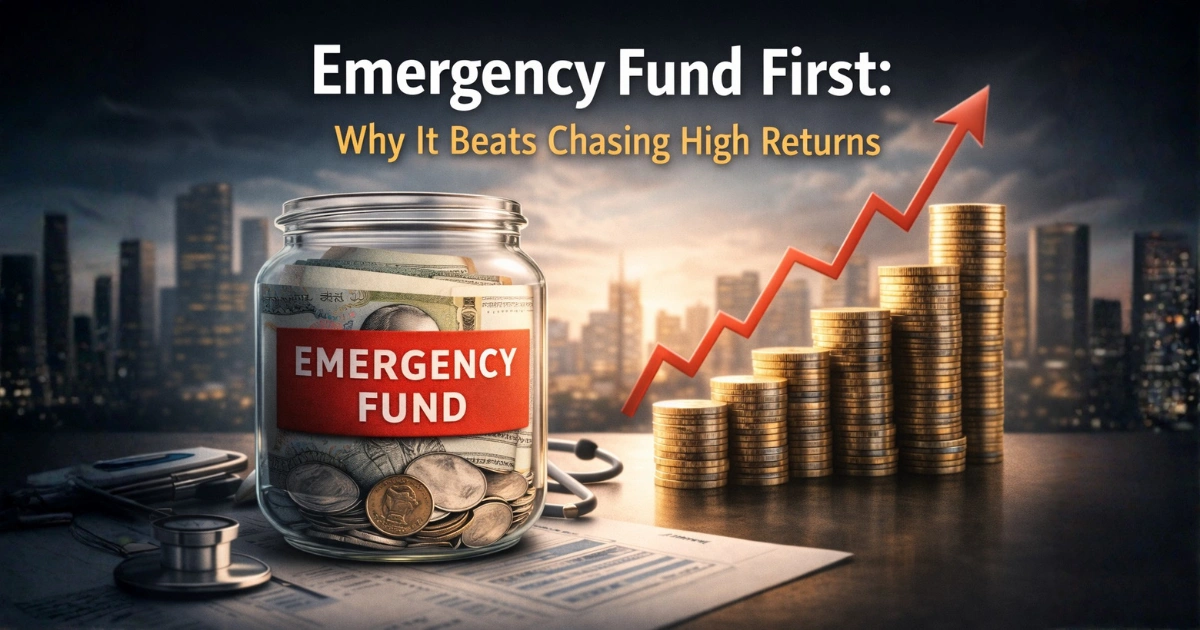
Most people don’t lose money because markets crash.
They lose money because life interrupts.
A job loss. A medical emergency. A sudden repair that can’t wait. When these moments hit—and they always do—your investment strategy doesn’t matter if your cash flow collapses.
This is why building an emergency fund before high-return chasing isn’t conservative advice.
It’s disciplined financial planning.
If you skip this step and jump straight into high-return assets, you’re not investing—you’re gambling with timing, stress, and forced decisions.
Let’s break down what an emergency fund actually is, how to build it efficiently, and why it must come before you start chasing returns.
What Is an Emergency Fund (Really)?
An emergency fund is money kept aside for sudden expenses—not for opportunities, not for lifestyle upgrades, and definitely not for market dips.
It exists for one purpose: to absorb shocks.
Most global personal finance frameworks define emergency funds this way, including detailed explanations by Investopedia:
👉 https://www.investopedia.com/terms/e/emergency_fund.asp
Think of it as the financial equivalent of airbags. You hope you never need them—but when you do, nothing else matters.
Typical emergencies include:
-
Job loss or delayed income
-
Medical expenses not fully covered by insurance
-
Urgent home or car repairs
-
Family emergencies requiring travel
Without an emergency fund, every surprise becomes a crisis.
Why This Comes Before “High-Return Chasing”
High-return investing assumes one thing: you can stay invested.
That assumption breaks the moment you need cash urgently.
If you don’t have an emergency fund:
-
You may sell investments at a loss
-
You may interrupt long-term compounding
-
You may rely on high-interest credit cards or personal loans
-
You may panic instead of planning
This is why building an emergency fund comes before:
-
Starting a Systematic Investment Plan (SIP) aggressively
-
Increasing equity exposure
-
Exploring “highest yield” ideas
Behavioural finance research consistently shows that forced selling destroys returns more than market volatility itself:
👉 https://www.morningstar.com/articles/714389/investor-behavior-why-do-investors-bail-out-at-the-worst-time
Returns don’t protect you from bad timing. Liquidity does.
Determine How Much You Need (The Right Way)
One of the most common questions is how big your emergency fund should be.
The short answer:
You should aim for having enough to cover three to six months’ worth of expenses.
In more volatile income situations—or single-income households—saving 6–9 months of expenses is far more realistic. This guidance aligns with recommendations from financial planners and regulators globally:
👉 https://www.consumerfinance.gov/about-us/blog/start-small-save-emergency-fund/
Calculate Your Target Amount
To calculate your target amount, don’t use your income. Use your expenses.
Add up:
-
Rent or EMI
-
Groceries
-
Utilities
-
Insurance premiums
-
Transport
-
School fees or essential subscriptions
Exclude:
-
Vacations
-
Dining out
-
Shopping
-
Investments
Example:
If your essential monthly expenses are ₹40,000:
-
3 months = ₹1.2 lakh
-
6 months = ₹2.4 lakh
-
9 months = ₹3.6 lakh
That’s your safety net—not optional money.
Steps to Build It Efficiently (Without Stress)
Building an emergency fund doesn’t require heroics. It requires structure.
1. Create a savings habit first
Before chasing returns, create a savings habit.
Automate transfers the day your salary hits.
Even ₹5,000–₹10,000 a month works if it’s consistent.
2. Pause aggressive investing temporarily
If you’re already investing, don’t stop everything—but slow it down.
Redirect part of your SIP amount toward your emergency fund until it’s complete.
This approach is widely recommended by financial planners because liquidity comes before growth:
👉 https://www.nerdwallet.com/article/finance/emergency-fund-why-it-matters
3. Increase contributions with income growth
Bonuses, increments, side income—channel them here first.
This is faster and less painful than cutting lifestyle later.
4. Set a clear finish line
An emergency fund feels endless if you don’t define “done.”
Once you hit your target, stop. Then shift fully into growth investing.
Where to Park Your Emergency Fund (And Where Not To)
This is where most people get confused.
Your emergency fund is not about highest yield.
It’s about availability, safety, and predictability.
Where to park your emergency fund
-
High-quality liquid instruments with quick access
-
Options that allow withdrawal within 24–48 hours
-
Low volatility and capital protection
What to avoid
Despite popular advice chasing returns, avoid parking your safety net in savings accounts, FDs, equities, or liquid funds without understanding access and risk.
Why?
-
Equities can fall when you need money most
-
FDs may have penalties or lock-ins
-
Some liquid funds can face short-term stress
-
Regular savings accounts often lose value to inflation
The key rule: If access or value can be uncertain, it’s not ideal for emergencies.
Many regulators also caution against confusing investment products with contingency reserves:
👉 https://www.rbi.org.in/Scripts/FAQView.aspx?Id=83
Split your emergency fund if needed—some for instant access, some for stability.
Common Mistakes People Make
-
Treating emergency funds as “optional”
-
Investing emergency money for higher returns
-
Mixing it with long-term investments
-
Using it for planned expenses
-
Not replenishing it after use
An emergency fund is not a one-time task.
It’s a system you maintain.
Pro Tips From Real-World Experience
-
Keep emergency money separate from daily-use accounts
-
Label it mentally as “do not touch unless life breaks”
-
Revisit the amount every year as expenses rise
-
Rebuild it immediately after any withdrawal
-
Don’t over-optimize returns—optimize peace of mind
Financial calm compounds just like money does.
Final Thoughts: Stability Is the Real Alpha
Markets reward patience.
Life tests preparation.
Building an emergency fund before high-return chasing is what allows you to stay invested when others panic, sell, or borrow.
It’s what turns volatility into opportunity instead of stress.
If your emergency fund isn’t ready, that’s your next financial move—no matter how tempting returns look elsewhere.