
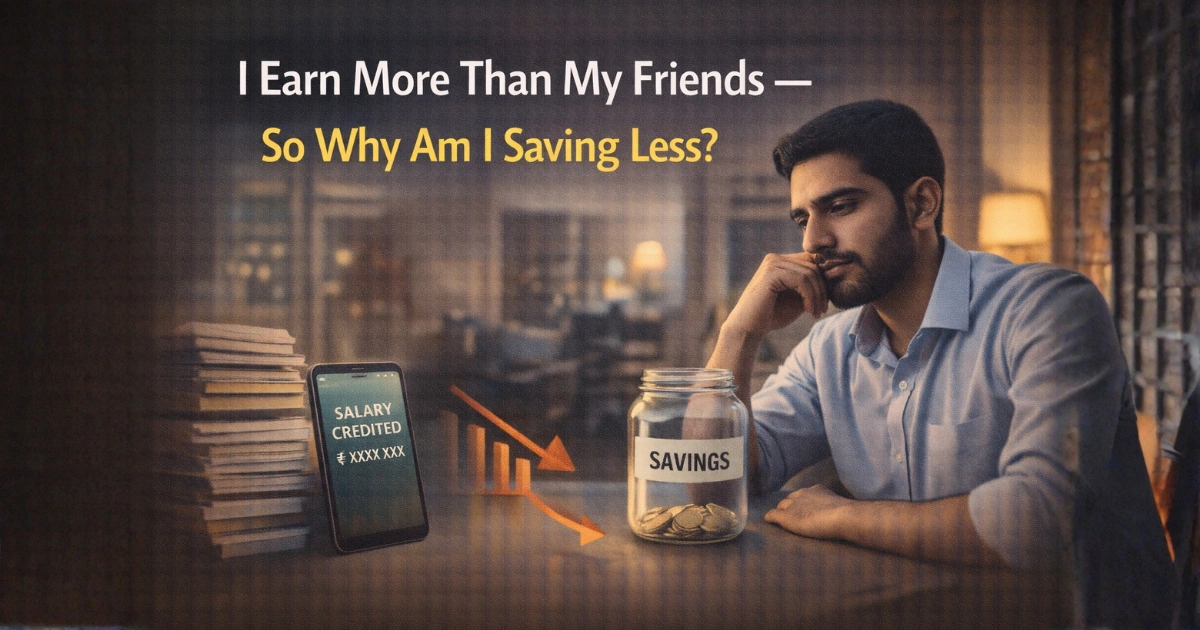
It’s a strange, uncomfortable feeling.
You look around and realise you earn more than most of your friends — yet somehow, your savings account doesn’t reflect it. They’re buying homes, investing steadily, and planning ahead, while you’re still wondering where all your money disappears every month.
If you’ve ever thought, “I make good money… so why am I still not saving enough?” — you’re not alone.
High income doesn’t automatically lead to high savings. In fact, many people earning well above average quietly struggle with the same problem — a pattern highlighted in research on income-versus-savings behaviour by the OECD:
👉 https://www.oecd.org/finance/financial-education/
And surprisingly, it rarely has anything to do with laziness or lack of ambition. Instead, it’s shaped by psychology, social pressure, lifestyle choices, and habits we don’t always notice clearly.
Therefore, let’s break down the real reasons this happens — and what you can do to turn things around without feeling deprived or guilty.
The Hidden Truth — Income Isn’t the Same as Financial Progress
We often assume money follows a straight line:
Higher income → better savings → stronger financial future.
However, life rarely works that neatly.
Sometimes people who earn less save more — not because they are luckier, but because their decisions are more intentional. Meanwhile, high earners may drift into patterns that quietly erode financial stability — a behaviour often described in financial-psychology studies as the prosperity paradox.
Here’s a helpful explainer on why higher income doesn’t guarantee wealth:
👉 https://www.investopedia.com/articles/personal-finance/092015/why-high-income-doesnt-equal-wealth.asp
And one of the biggest culprits is something most of us slip into without even noticing.
Lifestyle Inflation — The Silent Savings Killer
Lifestyle Inflation happens when expenses rise as income rises — a concept widely discussed in personal-finance research:
👉 https://www.investopedia.com/terms/l/lifestyle-inflation.asp
You get a raise, so you upgrade your phone.
You switch jobs, so you move into a nicer apartment.
You start earning more, and dining out becomes routine instead of occasional.
Nothing feels extravagant. However, everything becomes slightly more expensive than before.
The problem isn’t the upgrades themselves — it’s that they replace savings instead of improving quality of life responsibly. Eventually, you wake up earning twice as much as before — yet your bank balance still feels fragile.
Why Lifestyle Inflation Feels Normal
Quite simply, it is socially rewarded.
Higher income brings subtle pressure to “live like you deserve it.” Better clothes, trendier trips, newer gadgets, more frequent plans — and gradually, spending becomes identity-based rather than purpose-based.
It doesn’t feel like overspending. Instead, it feels like progress.
Eventually, you realise the progress was external, not financial.
This behavioural shift links closely to hedonic adaptation, where people quickly adjust to upgrades and treat them as the new normal:
👉 https://www.behavioraleconomics.com/resources/mini-encyclopedia-of-be/hedonic-adaptation/
The Comparison Trap — Spending to Keep Up
Another major reason high earners save less is The Comparison Trap — a phenomenon aligned with social-comparison theory:
👉 https://www.apa.org/science/about/psa/2005/02/santos
You look at friends’ lifestyles and silently measure your own.
They’re travelling, eating out, posting wins, buying things — and suddenly your spending becomes less about need and more about belonging.
Often, the inner dialogue sounds like:
-
“Everyone else is going — I should too.”
-
“They’re my age and doing this — I can’t be left behind.”
-
“If they can afford it, I should be able to as well.”
However, here’s the catch:
You’re comparing lifestyles — not financial realities.
You don’t see:
-
their debt
-
their family support
-
their financial goals
-
their stress level
-
their long-term obligations
Someone who spends less, saves more, and appears “low-key” on the outside may actually be building stability you cannot see yet.
Comparison fuels spending. Meanwhile, intentionality fuels savings.
Lack of Budgeting and Financial Discipline — Money Without Direction
When income increases, many people assume structure is no longer necessary.
“I earn enough — I don’t need a budget anymore.”
However, the opposite is usually true.
The more you earn, the easier it becomes to leak money unnoticed — a pattern highlighted in Harvard Business Review’s research on financial behaviour and self-control:
👉 https://hbr.org/2016/01/the-science-of-better-spending
Subscriptions continue silently.
Impulse purchases blur together.
Random expenses never get tracked.
Over time, this leads to financial drift — even when income is strong.
Budgeting isn’t about restriction. Instead, it is about awareness.
Here’s a simple budgeting starter guide:
👉 https://www.nerdwallet.com/article/finance/how-to-budget
Without awareness, money always finds a way to disappear.
Different Priorities — Not Everyone Wants the Same Things
Sometimes the reason you save less is simpler than mismanagement: your priorities differ from your peers.
Perhaps they prioritise early investing and long-term stability, while you value experiences, travel, or social lifestyle more. Neither approach is wrong — but priorities shape outcomes.
Someone quietly investing ₹10,000 a month is building a financial cushion. Someone spending the same amount is building memories.
The key isn’t to copy anyone else. Instead, it is to be honest about what you want — and whether your choices align with your goals.
Real-Life Example — Same Salary, Different Outcomes
Two friends earn nearly the same income.
Aakash spends freely — new gadgets, weekend plans, premium upgrades, always “just a bit extra.”
Riya chooses a different path. She:
-
tracks expenses
-
avoids lifestyle creep
-
saves before spending
-
invests consistently
Five years later:
-
Aakash feels anxious about money despite earning well
-
Riya feels calm and secure — not because she earns more, but because she uses money intentionally
Same salary. Different behaviour. Completely different future.
Action Steps — How to Stop Earning More but Saving Less
You don’t need drastic sacrifices. Instead, small consistent shifts create real change.
Step 1 — Identify Where Lifestyle Inflation Crept In
Ask yourself:
-
What changed after my income increased?
-
Which expenses turned from occasional to permanent?
-
Do these upgrades improve my life — or only my image?
Not every upgrade is wrong. However, every upgrade should be a choice, not a reflex.
Step 2 — Track Your Spending for One Month
No guilt — just awareness.
Patterns usually appear quickly:
-
frequent eating out
-
subscription overload
-
“small” impulse purchases
-
social-pressure spending
Most people don’t overspend in big events. Instead, they overspend in tiny repeated moments.
Expense-tracking guide:
👉 https://www.thebalance.com/how-to-track-expenses-1293682
Step 3 — Define Your Real Priorities
Do you want:
-
early financial freedom?
-
peace of mind and stability?
-
lifestyle and experiences today?
-
a balanced middle ground?
Once priorities become clear, decisions feel lighter and more intentional.
Step 4 — Pay Yourself First
Before lifestyle spending, move a portion toward savings or investments.
This strategy — Pay Yourself First — is one of the most effective ways to build savings:
👉 https://www.investopedia.com/terms/p/pay-yourself-first.asp
People who save successfully don’t wait for leftovers. Instead, they protect their future first — and design their present around what remains.
Common Mistakes to Avoid
-
assuming higher income guarantees safety
-
copying friends’ lifestyles without knowing their finances
-
avoiding budgeting because you “earn enough”
-
delaying savings until a “better salary” arrives
-
treating spending as a reward for stress
Ultimately, financial confidence comes from clarity — not comparison.
Pro Tips to Build Healthier Money Habits
-
increase income without automatically increasing expenses
-
review recurring payments every few months
-
separate emotional spending from practical needs
-
surround yourself with people who respect financial goals
-
celebrate progress — not purchases
The goal isn’t restriction. It’s control.
Conclusion — Earning More Doesn’t Make You Secure. Awareness Does.
If you earn more than your friends but save less, it doesn’t mean you’re failing. It simply means your money habits need realignment.
Income gives you potential. Habits decide what you do with it.
Whether your goal is stability, freedom, or balance, clarity around spending, priorities, and discipline is what turns income into long-term progress.
Start small. Track consciously. Spend intentionally.
And let your money finally work with you — not against you.