
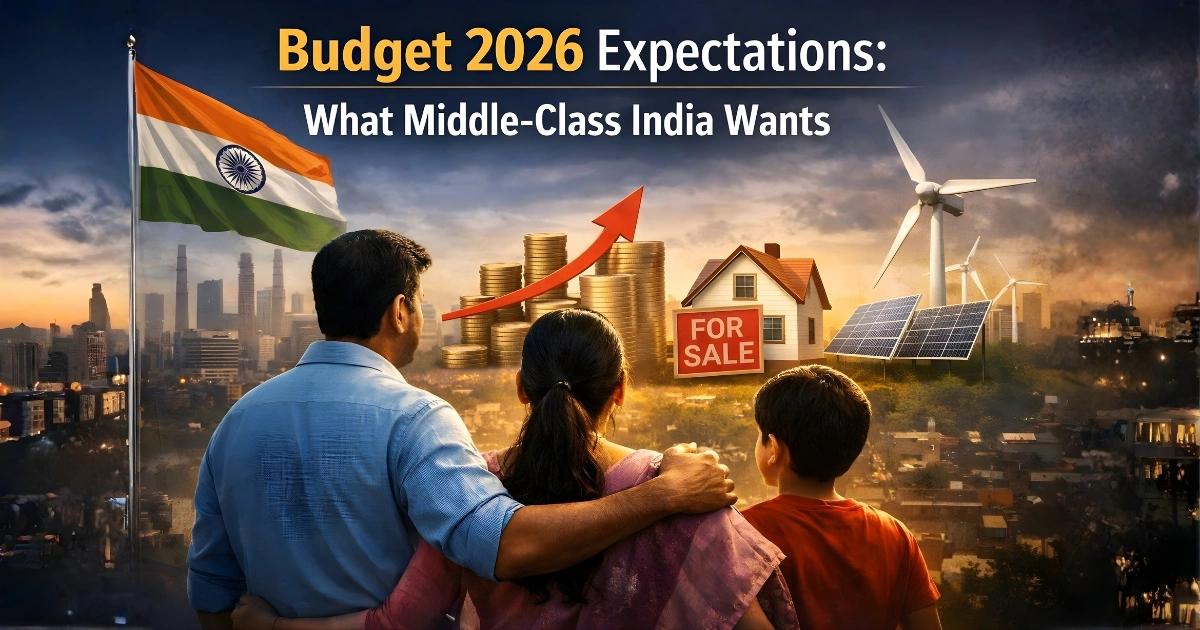
The middle class doesn’t ask for miracles.
It asks for breathing room.
After years of rising EMIs, stubborn inflation, and tax brackets that haven’t moved fast enough with income, Budget conversations in middle-class homes now sound very different. They’re not about freebies. They’re about fairness.
As India continues its steady growth—clearly visible in the economy’s performance in Q2 FY 2025–26—the expectations from the Union Budget 2026 are sharper, more practical, and grounded in daily reality.
So what does the middle class actually want from the next budget? Let’s break it down—without noise, politics, or wishful thinking.
Why Budget 2026 Matters More Than Usual
On paper, India’s macro story looks strong.
Recent data released by the Ministry of Finance and policy commentary from the Reserve Bank of India point to:
-
Stable economic growth
-
A sustained manufacturing push
-
Rising digital adoption
-
Increased focus on green energy and future technologies
But at the household level, the picture feels tighter.
Salaries have grown—but so have taxes, housing costs, school fees, and healthcare expenses. For many families, real disposable income hasn’t kept up.
That’s why Budget 2026 expectations aren’t about headline announcements. They’re about small structural changes that actually show up in monthly cash flow.
1. Substantially Reduce the Taxes of the Middle Class
This is the loudest—and most consistent—expectation.
Middle-income earners form the backbone of consumption, savings, and tax compliance. Yet they often feel squeezed between:
-
Limited subsidies
-
High marginal tax rates
-
Fewer exemptions under simplified tax regimes
The Big Ask: Fix the 30% Tax Slab
One of the most discussed demands is to shift the 30% tax slab from ₹24 lakh to ₹40–50 lakh.
Why this matters:
-
₹24 lakh no longer reflects “rich” in metro India
-
Inflation has quietly pushed average professionals into the highest slab
-
Lifestyle costs—not luxury—drive expenses at this income level
Multiple tax experts and policy reports—including recent analysis from PwC India—have highlighted slab creep as a genuine middle-class issue in their Union Budget expectation notes.
If the government truly wants to substantially reduce the taxes of the middle class, correcting slab thresholds is the cleanest place to start.
2. Easier and Cheaper Credit Access for Households and MSMEs
Credit is the fuel of growth—but for many middle-class families and small businesses, it’s still expensive and restrictive.
What People Are Hoping For
-
Lower interest rates on home and education loans
-
Simplified loan approval for salaried professionals
-
Easier and cheaper credit access for MSMEs
According to RBI lending and credit-growth data, even small reductions in borrowing costs materially improve affordability for first-time home buyers and small entrepreneurs.
For a family buying its first home, or a professional starting a small venture, a 1–2% interest rate difference can change long-term outcomes.
Affordable credit doesn’t encourage reckless borrowing. It enables stability, entrepreneurship, and upward mobility.
3. Support for Manufacturing—Without Ignoring Jobs
Manufacturing has been a consistent policy priority—and rightly so.
Government initiatives like Make in India and PLI schemes have already pushed capacity creation. Budget 2026 is expected to continue supporting:
-
Domestic manufacturing
-
Supply chain localisation
-
Export competitiveness
But the middle class wants something specific: jobs that pay sustainably, not just factories that look good on paper.
The expectation is for incentives that:
-
Encourage labour-intensive manufacturing
-
Support skilling alongside production
-
Create employment beyond metros
Manufacturing growth only matters if it translates into income security.
4. Climate Change and Green Energy: Make It Personal
Green energy isn’t just an environmental issue anymore—it’s a household cost issue.
Middle-class expectations here are practical, not ideological:
-
Incentives for rooftop solar
-
EV tax benefits beyond luxury cars
-
Affordable financing for green upgrades
Policy frameworks discussed by NITI Aayog and global climate bodies increasingly emphasise household-level adoption—not just industrial targets.
If Budget 2026 focuses on climate change and green energy, people want policies that reduce electricity bills—not just long-term climate commitments.
5. MSMEs: The Silent Employer of the Middle Class
A large section of the middle class either works for MSMEs—or runs one.
Support for MSMEs directly impacts:
-
Job stability
-
Salary growth
-
Entrepreneurial confidence
Common expectations include:
-
Easier compliance
-
Faster GST refunds
-
Better working capital access
When MSMEs breathe easier, the middle class does too. Budget policy here has one of the highest real-world multipliers.
6. Artificial Intelligence and Robotics—But With Reskilling
AI and robotics are unavoidable.
The middle class isn’t resisting this shift—but it wants protection from sudden displacement.
What people expect:
-
Budget allocation for reskilling programs
-
Tax incentives for companies investing in employee upskilling
-
Public-private partnerships in tech education
The fear isn’t technology.
The fear is being left behind without a safety net.
Common Budget Mistakes the Middle Class Hopes Are Avoided
-
Overcomplicating tax rules in the name of simplification
-
Announcing benefits that apply to very few
-
Ignoring inflation when setting thresholds
-
Prioritising optics over impact
Big announcements don’t help if they don’t show up in monthly cash flow.
What the Middle Class Can Do (Regardless of Budget Outcomes)
Budgets matter—but personal planning matters more.
Action steps to stay prepared:
-
Don’t base financial plans on budget predictions
-
Build buffers assuming no major tax relief
-
Use any relief as a bonus, not a dependency
-
Stay flexible with investments and expenses
Smart households plan for the worst—and adjust upward if things improve.
Final Thoughts: Budget 2026 Is About Trust, Not Just Numbers
The Indian middle class isn’t asking for handouts.
It’s asking for:
-
Fair taxation
-
Affordable credit
-
Job security
-
A chance to move ahead without constant pressure
If the Union Budget 2026 acknowledges this reality—and acts on it—it won’t just boost growth figures.
It will rebuild confidence.
And confidence is the strongest economic stimulus of all