
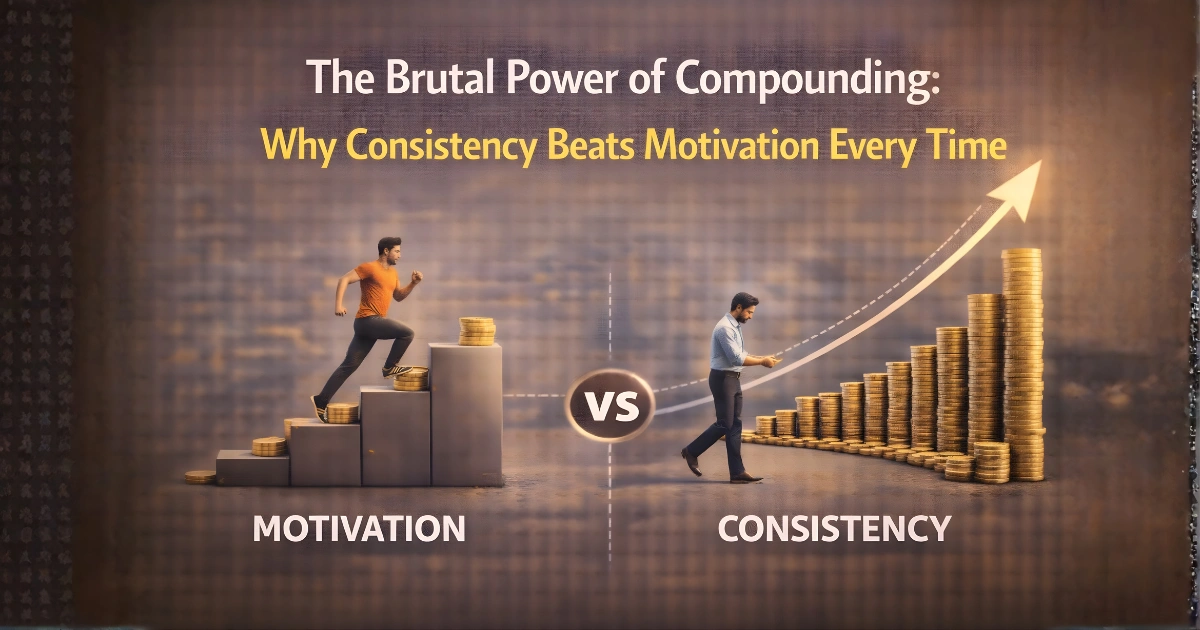
People love talking about compounding as if it’s a mystical force. A magic trick. A life hack.
But the truth is far less glamorous.
Compounding doesn’t reward excitement. It rewards repetition — the kind most people quietly abandon. Not because they lack intelligence or resources, but because consistency is brutal. The work feels slow. Progress looks invisible. And there’s no applause for doing the same boring thing again and again.
Yet that’s exactly where the leverage hides.
The brutal power of steady growth and compounding returns doesn’t come from a single giant leap. It comes from the tiny choices stacked day after day, long before the payoff shows up. Compound interest is simple and brutal — and that’s what makes it so hard to stick with. (If you want to see how it actually plays out mathematically, this breakdown from Investopedia on compound interest is worth reading.)
This isn’t magic. It’s discipline. And discipline rarely feels inspiring in the moment.
Why People Romanticize Compounding (But Rarely Benefit From It)
We admire compounding when we see the result — wealth, skill, credibility, fitness, reputation.
What we don’t see is the painfully ordinary process behind it.
Most people quit early because:
-
The results don’t show up fast enough
-
The work feels repetitive and unexciting
-
Discomfort beats intention
-
Distractions offer immediate gratification
The brutal truth is, discipline is boring most of the time. It’s not hype, it’s not motivation — it’s doing the unremarkable work when nobody’s watching. James Clear explains this idea beautifully in his article on the power of habits and identity here: Atomic Habits — systems vs. goals.
Compounding punishes impatience.
It asks you to trust effort that doesn’t pay you today — and may not pay you for years. That’s why compounding separates outcomes so dramatically over time. It isn’t magic… it’s just that most people don’t stick around long enough to see the curve bend.
The Real Reason Compounding Works: Boring, Repeated Decisions
Compounding is less about math and more about behavior.
Money compounds. Skills compound. Habits compound. Relationships compound. But none of that happens by accident.
It happens when you make small decisions that look insignificant in the moment — and keep making them long after the excitement fades.
Real-World Examples (Where the Discipline Shows Up)
Investing:
Anyone can buy a stock, index fund, or ETF. The hard part is holding it through boredom, fear, and market noise. Compounding punishes panic and rewards patience — something the Bogleheads investing philosophy has emphasized for decades.
Fitness:
One brutal workout won’t change your body. But showing up — even when energy is low — creates the real transformation. The CDC’s fitness guidelines reinforce that progress comes from consistency, not intensity:
https://www.cdc.gov/physicalactivity/basics/adults
Writing / Business / Craft:
Brilliance doesn’t appear overnight. It comes from drafts, revisions, and unglamorous practice others never see. Many creators echo this — including insights shared in Austin Kleon’s “Show Your Work”.
It’s not because people don’t understand the concept of compounding. It’s that consistency is brutal — emotionally, mentally, and sometimes physically.
Why “Motivation” Fails (And Discipline Wins)
Motivation is loud. Discipline is quiet.
Motivation spikes when things feel exciting. Discipline shows up when they don’t. The gap between the two explains why some people inch forward while others drift sideways for years.
Compounding doesn’t care how inspired you feel.
It only cares whether you return tomorrow.
People think lack of progress means something is wrong. Most of the time, nothing is wrong. You’re just still in the invisible stage — the plateau where progress accumulates beneath the surface. This concept is often described as the “Plateau of Latent Potential,” explained in detail here:
https://jamesclear.com/plateau-of-latent-potential
And that stage weeds people out.
The Brutal Nature of Compounding (And Why It Feels Unfair)
Here’s the part nobody likes to admit:
Compounding is simple, but it isn’t kind.
At first, the effort is high and the reward is small. Later, the effort becomes small and the reward explodes — but only for those who stayed in the game.
That’s why the outcomes look extreme:
same hours, different trajectories… years later.
The brutal power of steady growth and compounding returns makes success look effortless from the outside — but it was anything but effortless in the early years. Morgan Housel captures this dynamic brilliantly in “The Psychology of Money”:
https://www.collaborativefund.com/blog/the-psychology-of-money/
Compounding isn’t magical.
It’s relentlessly mechanical — and deeply human.
Common Mistakes That Break the Compounding Cycle
Most people don’t fail because they lack talent. They fail because they interrupt the process.
The Mistakes to Avoid
-
Chasing novelty instead of repetition
-
Restarting every time emotions drop
-
Expecting visible progress too early
-
Switching strategies too frequently
-
Treating discipline as a mood instead of a commitment
Every reset destroys momentum. Every shortcut delays the curve. The ones who win simply avoid quitting.
How to Build Discipline That Feeds Compounding
Compounding works best when effort becomes routine instead of heroic.
Action Steps You Can Start Now
1) Shrink the goal until you can’t avoid doing it
Don’t aim for perfection. Aim for consistency.
2) Track actions, not outcomes
Outcomes lag behind. Behavior happens daily. Tools like Habit tracking apps can help — not as motivation, but as accountability.
3) Remove friction instead of adding motivation
Simplify the decision so showing up feels easier than skipping.
4) Protect the habit during bad days
A weak effort still compounds. Zero effort resets you to start.
5) Commit to time horizons longer than your emotions
Decide once — then execute repeatedly.
Compounding rewards process-builders, not intensity-chasers.
Pro Tips for Staying Consistent When Progress Feels Invisible
-
Treat boredom as a signal you’re on the right track
-
Focus on better systems, not more inspiration
-
Assume progress is happening even when you can’t see it
-
Compare yourself only to your previous baseline
-
Build identity around showing up, not winning
The longer you stay in the game, the more unfair the results become — in your favor.
Conclusion — Compounding Is Discipline in Disguise
Compounding is not magic — it’s brutal discipline stretched across time.
The people who benefit aren’t the most talented or the most resourced. They’re the ones who tolerate boredom, resist distraction, and keep stacking small decisions when it feels pointless.
The curve always bends.
The question is whether you’ll still be there when it does.
Start small. Stay consistent. Let time multiply the work.
Your next move:
Pick one area of your life — money, skills, health, or relationships — and commit to one small habit you’ll repeat daily for the next 30 days. Don’t chase intensity. Chase consistency.
That’s where compounding starts.