
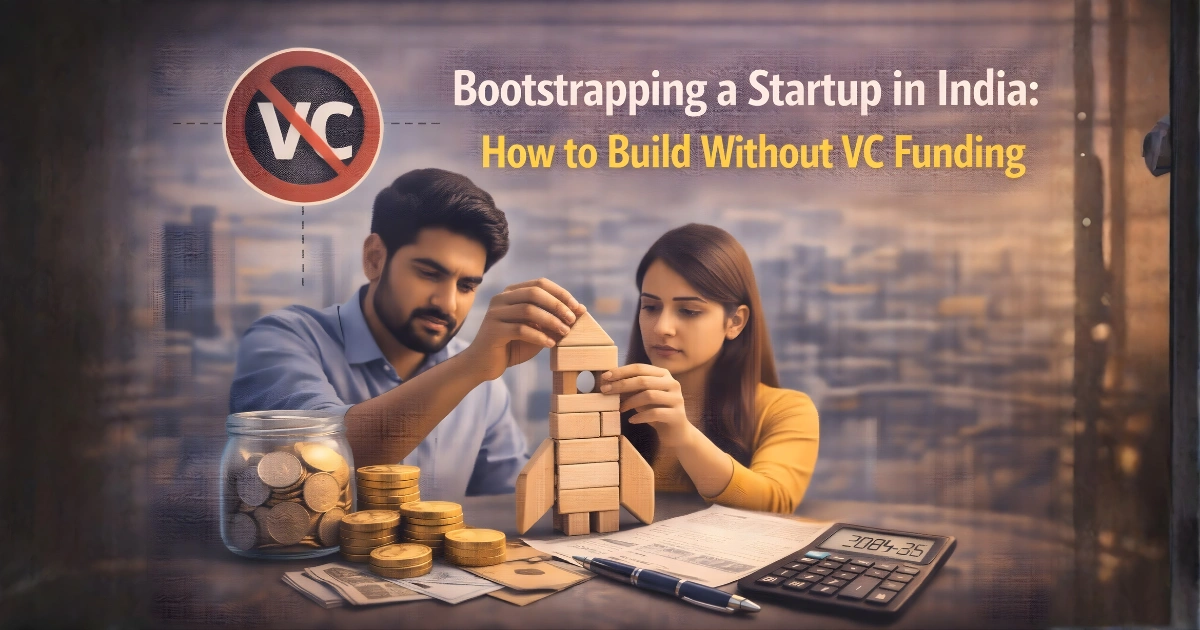
Bootstrapping a startup in India is no longer a fallback option. For many founders, it is a deliberate strategy to build sustainable businesses without giving up control too early.
Bootstrapping, or self-financing, means growing your business using personal savings and early revenue, not venture capital or outside investment. In India’s rapidly expanding entrepreneurial ecosystem, bootstrapping has emerged as a viable path for founders who value discipline, ownership, and long-term freedom.
In fact, over 90% of startups in India begin by bootstrapping, relying on personal savings or operating revenue, while only a small fraction raise institutional funding in their early years (as reflected in ecosystem data published by platforms like Startup India and industry reports). This reality makes lean building not just ideal—but practical.
What Does Bootstrapping a Startup Really Mean?
Bootstrapping a startup means funding the business yourself, especially in the early stages.
This typically involves:
-
Personal savings
-
Revenue from early customers
-
Minimal and controlled operating expenses
Unlike VC-backed startups, a bootstrapped startup grows slower but with far greater control. Founders decide priorities, pace, and product direction—without external pressure to chase hypergrowth.
Many founders adopt a hybrid approach: bootstrapping initially to validate product-market fit, then raising capital later to scale. This strategy often improves bargaining power during fundraising and lowers long-term risk.
Why Bootstrapping Works in India
India doesn’t have a single startup ecosystem—it has multiple clusters, diverse markets, and very different cost structures. While cities like Bengaluru dominate headlines, strong startups are being built quietly across Tier-2 and Tier-3 cities.
Bootstrapping benefits in India are amplified by:
-
Relatively lower operational costs compared to global markets
-
Access to skilled but cost-effective talent
-
Rapid digital adoption across smaller cities and towns
Government initiatives like Startup India have also made it easier for founders to register businesses, access incubators, and operate digitally, even without venture funding.
Positives and Negatives of a Bootstrapping Startup
Advantages of Bootstrapping
Full ownership and control
No dilution means founders retain decision-making authority.
Financial discipline
Limited capital forces smarter spending and faster learning.
Customer-first mindset
Revenue and retention matter more than vanity metrics.
Challenges of Bootstrapping
Slower growth
Scaling takes time without external capital.
Cash-flow pressure
Every expense matters; mistakes are costly.
Limited experimentation
Ideas must be validated quickly and cheaply.
Understanding both sides helps founders decide if bootstrapping aligns with their long-term vision.
Building a Bootstrapped Startup in India: Key Steps
Start With a Strong MVP
A lean, problem-focused MVP is non-negotiable.
Your MVP should:
-
Solve one clear customer problem
-
Be quick and inexpensive to build
-
Generate early revenue
Avoid overbuilding. Customers pay for outcomes—not features.
Focus on a Niche Before Scaling
Trying to serve everyone drains limited resources.
Instead:
-
Target a specific customer segment
-
Solve a deep, urgent problem
-
Expand only after repeat demand
Niche focus accelerates cash flow, which fuels bootstrapped growth.
Keep Costs Brutally Low
As a bootstrap startup, you must stretch every rupee.
Practical cost-saving strategies include:
-
Remote or hybrid teams
-
Open-source and freemium tools
-
Revenue-linked freelancers instead of fixed salaries
Tools like Zoho, Google Workspace, and open-source stacks are widely used by Indian bootstrappers to keep overheads low.
Build Cash Flow, Not Just Traction
Bootstrapped startups survive on cash, not funding announcements.
Prioritise:
-
Advance or milestone-based payments
-
Subscription or retainer models
-
Short billing cycles
Cash flow is the strongest form of validation and survival.
Bootstrapped Indian Companies That Prove the Model
Some of India’s most respected companies were built without VC money—at least in their formative years.
Notable examples include:
-
Zoho – Global SaaS leader built entirely without VC funding
-
Wingify – Known for VWO, scaled profitably
-
Tally Solutions – Dominant accounting software brand
-
Noise – Built profitably before raising capital
-
FusionCharts – Bootstrapped global SaaS product
These companies focused on profitability, product quality, and long-term thinking—proving that venture capital is not the only route to scale.
When Should You Consider External Funding?
Bootstrapping doesn’t mean rejecting capital forever.
Many startups follow this path:
-
Bootstrap early
-
Validate product-market fit
-
Raise funds to scale
By delaying fundraising, founders often:
-
Secure better valuations
-
Retain leverage and board control
-
Reduce dependency on investors
The key is timing, not ideology.
Final Thoughts: Build Slow, Build Strong
Bootstrapping your startup in India is not about playing small—it’s about building strong foundations before scaling fast.
In an ecosystem where funding is selective and competition is loud, founders who focus on customers, cash flow, and clarity stand the best chance of long-term success. Bootstrap wisely, validate early, and grow on your own terms.