
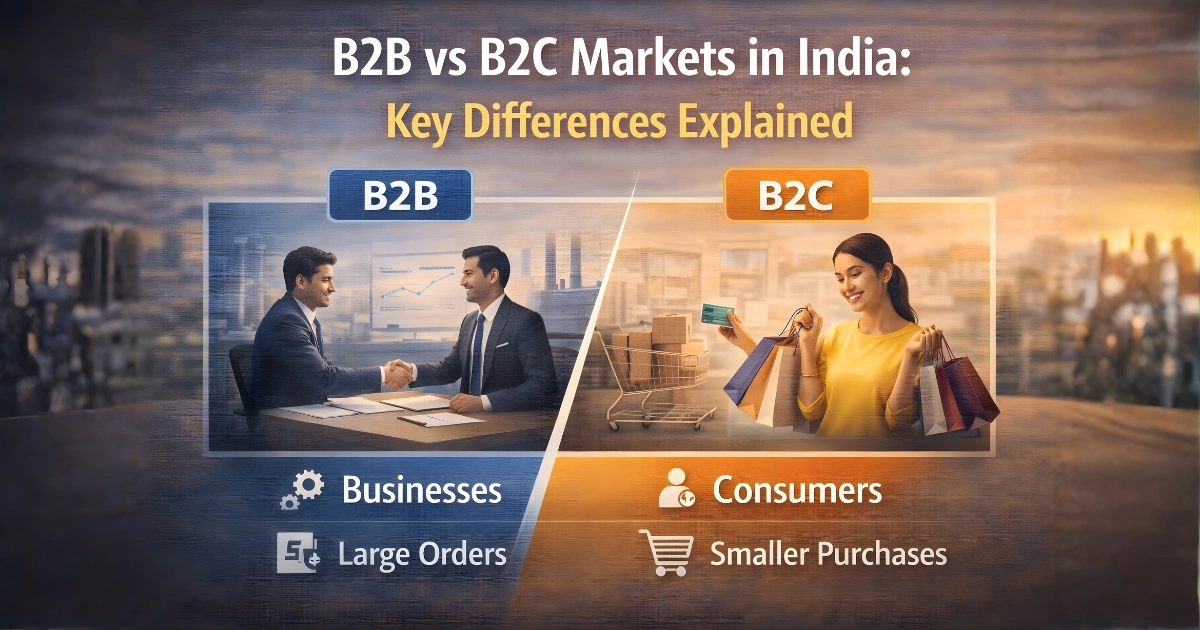
India’s market landscape is vast, diverse, and rapidly evolving. Whether you are building a startup, scaling an enterprise, or refining your go-to-market strategy, understanding the difference between B2B and B2C markets in India is critical.
At a basic level, B2B sells to businesses, while B2C sells to individuals. But beyond this simple distinction lies a wide gap in buyer behaviour, sales cycles, marketing strategies, customer value, and growth dynamics—especially in the Indian context.
This article breaks down those differences clearly, with real-world relevance for Indian businesses.
Understanding B2B and B2C in the Indian Context
What Is B2B?
B2B (Business-to-Business) focuses on serving other organisations. Products and services are designed for business use rather than personal consumption.
Examples in India include:
-
Industrial RO systems for factories
-
SaaS platforms for enterprises and SMEs
-
Raw materials, machinery, and logistics services
According to industry insights shared by NASSCOM (https://nasscom.in), India’s B2B and enterprise services market continues to grow steadily, driven by digitisation and cloud adoption.
While the B2B market targets a smaller audience, each client typically represents high contract value and long-term revenue.
What Is B2C?
B2C (Business-to-Consumer) involves selling directly to individual customers.
Common B2C sectors in India include:
-
Home water purifiers and appliances
-
FMCG products
-
Fashion, electronics, and lifestyle brands
India’s B2C growth has been accelerated by e-commerce platforms and digital payments, as highlighted in consumer market reports by Department for Promotion of Industry and Internal Trade (https://dpiit.gov.in).
B2C markets are driven by volume, branding, and consumer demand, often across large and diverse demographics.
Buyer Mindset: Logic vs Emotion
One of the most significant differences between B2B and B2C markets in India lies in how buying decisions are made.
B2B Buyer Behaviour
B2B buyers are rational, data-driven, and outcome-focused. Decisions are based on:
-
Return on investment (ROI)
-
Operational efficiency
-
Reliability and long-term value
Purchases typically involve multiple stakeholders, approvals, and risk assessments, which is why B2B buyers require longer nurturing cycles.
B2C Buyer Behaviour
B2C buyers are influenced more by:
-
Emotions and aspirations
-
Brand perception and trust
-
Pricing, convenience, and offers
Purchases are often quick or impulsive, especially in categories like fashion, electronics, and home products.
Market Size vs Customer Value
B2C: Large Market, Lower Customer Value
In B2C, individual customer value is relatively low.
Implications:
-
High sales volumes are essential
-
Customer acquisition costs must be tightly managed
-
Brand recall and visibility are critical
Growth depends heavily on marketing scale and operational efficiency.
B2B: Smaller Market, Higher Lifetime Value
B2B clients usually deliver higher lifetime value.
A single enterprise customer can generate revenue over several years through:
-
Long-term contracts
-
Renewals and upgrades
-
Cross-selling and upselling
This makes B2B revenue more predictable and stable once relationships are established.
Sales Cycle and Relationship Building
B2B Sales Cycles
B2B sales cycles in India are typically:
-
Longer and structured
-
Relationship-driven
-
Dependent on credibility and trust
For example, selling industrial equipment or enterprise software may involve months of evaluation, demos, and negotiations.
B2C Sales Cycles
B2C sales cycles are much shorter:
-
Decisions are made quickly
-
Fewer decision-makers involved
-
Discounts and promotions strongly influence timing
In many cases, purchases happen within minutes or days.
Marketing Strategy: One Size Does Not Fit All
B2B Marketing Strategy
Marketing to businesses requires precision and authority.
Common B2B strategies include:
-
Thought leadership content
-
Whitepapers and case studies
-
LinkedIn and email marketing
The goal is to educate decision-makers and build trust—an approach widely recommended in enterprise marketing frameworks by HubSpot (https://www.hubspot.com).
B2C Marketing Strategy
B2C marketing focuses on:
-
Emotional storytelling
-
Influencer and social media marketing
-
Mass digital platforms like Instagram and YouTube
Brand recall often matters more than technical detail in consumer markets.
Market Research: How Insights Are Gathered
B2B Market Research
B2B research emphasises depth over scale, using:
-
In-depth interviews
-
Focus groups
-
Expert consultations
Because the audience is smaller, quality insights matter more than sample size.
B2C Market Research
B2C research relies on:
-
Large-scale surveys
-
Behavioural analytics
-
Social listening and trend analysis
The objective is to identify patterns across millions of consumers.
Revenue Stability and Growth Patterns
B2B Revenue Characteristics
B2B businesses often benefit from:
-
Long-term contracts
-
Subscription or retainer models
-
Lower churn rates
This allows better forecasting and strategic planning.
B2C Revenue Characteristics
B2C businesses face:
-
Intense competition
-
Price sensitivity
-
Faster customer churn
Growth typically requires continuous marketing investment and innovation.
Choosing Between B2B and B2C in India
There is no universally better model—the right choice depends on your strengths and vision.
Choose B2B If You:
-
Prefer relationship-driven sales
-
Can manage longer sales cycles
-
Want stable, predictable revenue
Choose B2C If You:
-
Excel at branding and storytelling
-
Can scale operations efficiently
-
Thrive in fast-moving markets
Many Indian companies successfully operate hybrid models, serving both businesses and consumers.
Final Thoughts: Strategy Comes Before Scale
B2B and B2C markets in India operate on fundamentally different principles. One prioritises logic, trust, and long-term value, while the other thrives on emotion, reach, and speed.
Understanding these differences helps businesses design smarter products, sharper marketing strategies, and more sustainable growth models. Whether you sell to factories or families, success depends on aligning your strategy with how your customers truly buy.