Every tax season starts the same way.
A colleague mentions they paid “almost nothing” in tax.
Your payslip tells a different story.
And suddenly, you’re Googling deductions at 11 PM—hoping you missed something.
In 2026, tax-saving confusion is not because rules are unclear.
It’s because the system now gives you two choices—and picking the wrong one can quietly cost you money.
This is a practical Tax Saving Guide 2026 for salaried individuals. No theory. No loopholes. Just clear decisions based on how the new and old tax regimes actually work for FY 2025–26 (AY 2026–27).
What Changed in 2026 (And Why It Matters)
From FY 2025–26 onward, the New Tax Regime is the default.
That doesn’t mean it’s mandatory.
It means if you don’t actively choose, you’re automatically placed in it.
The government’s intent is clear:
-
Fewer deductions
-
Lower tax rates
-
Simpler compliance
This shift was formalised through amendments to Section 115BAC
👉 https://www.incometax.gov.in/iec/foportal/help/individual/return-applicable-tax-regime
But “simple” doesn’t always mean “cheaper.”
For salaried taxpayers, tax saving in 2026 is about choosing the right regime, not chasing deductions blindly.
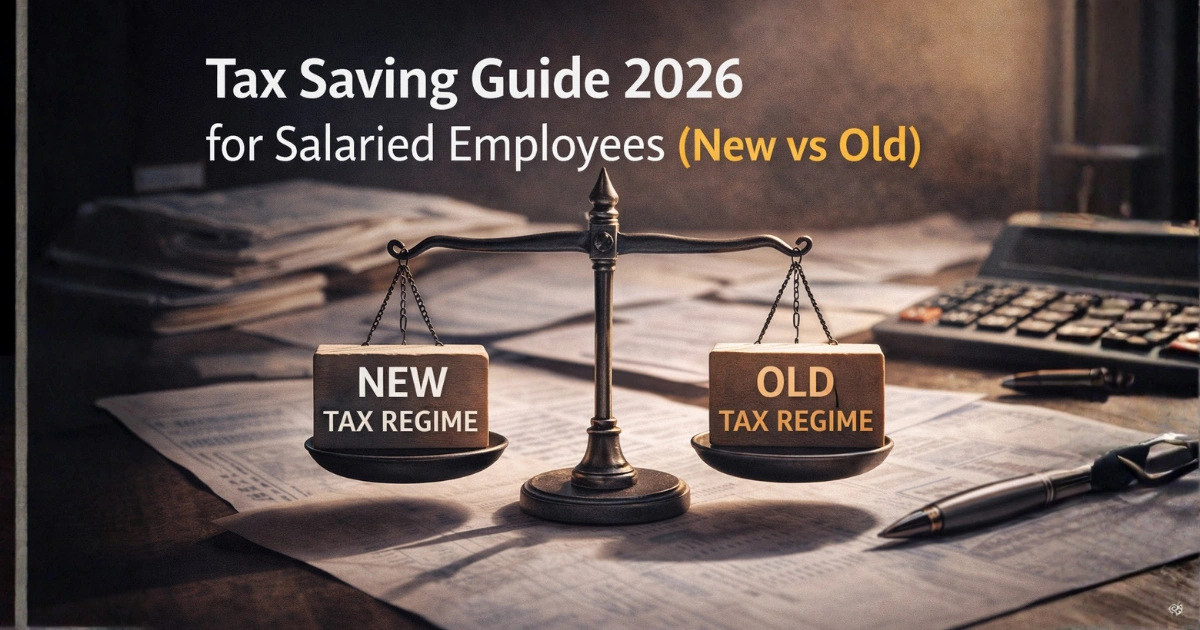
The Big Picture: New vs Old Tax Regime (Quick Overview)
Before diving into deductions, you need context.
New Tax Regime (Default in 2026)
-
Fewer deductions allowed
-
Lower slab rates
-
Best for people with minimal investments or claims
Old Tax Regime
-
Higher slab rates
-
Allows traditional tax deductions
-
Best if you actively plan and invest
Your goal isn’t to “save tax.”
Your goal is to pay the least legally possible.
What You Get Under the New Tax Regime in 2026
Let’s start with what most salaried people will see by default.
1. Standard Deduction (₹75,000)
Yes, the Standard Deduction still exists under the new regime.
This is automatic:
-
No investment proof
-
No paperwork
-
No conditions
Every salaried employee gets it.
The standard deduction was officially enhanced to ₹75,000 in Budget announcements
👉 https://www.incometaxindia.gov.in/Pages/FAQs/standard-deduction.aspx
For many middle-income earners, this alone makes the new regime attractive.
2. Rebate u/s 87A (Up to ₹12.75 Lakh Income)
Here’s where many people get confused.
Under the new regime:
-
Rebate u/s 87A applies if taxable income is within the threshold
-
Effectively, income up to ₹12.75 lakh (including standard deduction) can be tax-free
This rebate structure is explained clearly by the Income Tax Department
👉 https://www.incometax.gov.in/iec/foportal/help/individual/rebate-us-87a
If your salary is near this level and you don’t claim large deductions, the new regime can eliminate your tax entirely.
3. Employer’s NPS Contribution (80CCD(2))
This is the most underrated tax-saving tool in 2026.
Even under the new regime, Employer’s NPS Contribution is allowed as a deduction.
Key points:
-
Covered under Section 80CCD(2)
-
Over and above standard deduction
-
No ₹1.5 lakh cap like 80C
-
Depends on employer policy
Official NPS tax benefit rules are detailed here
👉 https://www.pfrda.org.in/index1.cshtml?lsid=124
For mid- to high-income salaried professionals, this can create meaningful tax savings.
What You Give Up in the New Regime
This is where the trade-off comes in.
Under the new regime, you cannot claim:
-
Section 80C investments (PF, ELSS, LIC, etc.)
-
Section 80D (health insurance)
-
HRA
-
Home loan interest for self-occupied property
-
Most other traditional tax deductions
If your tax-saving strategy relies heavily on these, the new regime may not work for you.
Why the Old Tax Regime Still Makes Sense for Many
The old regime is no longer default—but it’s far from dead.
It still works well if you actively plan.
Key Deductions Under the Old Regime
1. Section 80C
PF, PPF, ELSS, LIC, tuition fees
Up to ₹1.5 lakh
👉 https://www.investopedia.com/terms/s/section-80c.asp
2. Section 80D
Health insurance premiums for self, family, parents
👉 https://www.investopedia.com/terms/s/section-80d.asp
3. HRA
Major tax saver for salaried employees living on rent
👉 https://www.investopedia.com/terms/h/hra.asp
4. House Property Loss
Interest on home loan (self-occupied or let-out)
House Property Loss adjustment rules explained here
👉 https://www.investopedia.com/terms/l/losshouseproperty.asp
When combined, these deductions can reduce taxable income more than the lower slab rates of the new regime.
A Simple Way to Decide: New or Old?
Don’t overthink it. Use this logic.
The New Regime Works Better If:
-
You don’t invest much under 80C
-
You don’t pay rent or claim HRA
-
Your employer contributes to NPS
-
Your income is near the rebate threshold
The Old Regime Works Better If:
-
You fully use 80C
-
You claim HRA
-
You have home loan interest
-
You pay health insurance premiums
Tax saving in 2026 is about math, not emotion.
Action Steps: What Salaried Employees Should Do Now
-
Investments
-
Rent paid
-
Insurance premiums
-
Home loan interest
-
Is Employer’s NPS Contribution available?
-
Are reimbursements structured efficiently?
Calculate tax under:
-
Old regime with deductions
-
New regime with standard deduction + NPS
Choose the lower number. Period.
Common Tax-Saving Mistakes in 2026
Avoid these traps:
-
Assuming the default regime is best
-
Investing just to “save tax”
-
Ignoring Employer’s NPS Contribution
-
Forgetting House Property Loss rules
-
Choosing a regime without calculation
Tax planning isn’t about habits anymore.
It’s about annual optimisation.
Pro Tips for Smarter Tax Saving in 2026
-
Don’t blindly invest under 80C if the new regime suits you
-
Push for NPS inclusion in salary structure
-
Recalculate every year—laws and income change
-
Use deductions as tools, not obligations
A good tax deduction fits your life—it doesn’t force it.
Final Thoughts: Pay Less Tax, Not More Effort
Tax saving for salaried individuals in 2026 is simpler—but only if you stop relying on old assumptions.
The new regime rewards simplicity.
The old regime rewards planning.
Neither is universally better.
The real win is choosing intentionally.
Run the numbers.
Understand your deductions.
And let the law work for you—not against you.