Most investors chase renewables after prices run up.
That’s usually when headlines turn optimistic, valuations stretch, and the easy money is already made.
But India’s green energy story in 2026 is different.
This isn’t a short-term policy push or a temporary ESG trend. It’s a once-in-a-generation infrastructure buildout—backed by capital, policy clarity, and real demand.
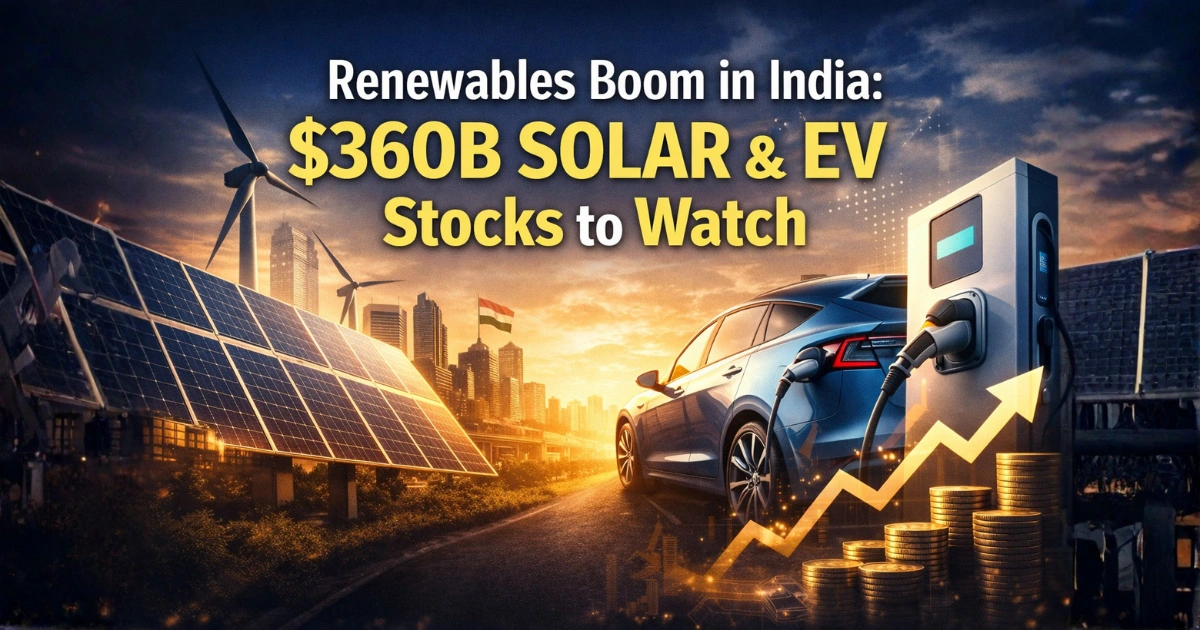
By 2030, India is expected to invest over US$360 billion into renewable energy, EVs, and supporting infrastructure, as outlined in multiple policy roadmaps published by the Ministry of New and Renewable Energy (MNRE) and global agencies like the International Energy Agency (IEA). The target is ambitious: 500 GW of non-fossil fuel capacity. Unlike past targets, this one is already being executed on the ground.
Solar parks are expanding. EV factories are running. Battery supply chains are localising.
For investors, this creates a rare window to participate before the full earnings cycle plays out.
Why India’s Renewable Energy Boom Is Structural, Not Cyclical
India’s energy demand is rising relentlessly. Urbanisation, data centres, manufacturing, and EV adoption are pushing power consumption higher every year—something consistently highlighted in CEA and RBI infrastructure outlook reports.
At the same time:
-
Fossil fuel imports strain the trade balance
-
Solar and wind tariffs have fallen sharply (MNRE auction data confirms this)
-
Global capital increasingly prefers green projects
The result is simple: renewables are now the cheapest and cleanest option at scale.
That’s why solar, wind, EVs, batteries, and grid infrastructure are emerging as long-term compounding themes, not speculative trades.
Solar & Green Power Stocks: Where the Capacity Is Being Built
India’s renewable story begins with utility-scale solar and green power producers. These companies lock in long-term power purchase agreements (PPAs), build massive capacity, and generate predictable cash flows—an approach similar to global renewable leaders covered in BloombergNEF energy transition reports.
Key Solar & Green Energy Players to Track
-
Adani Green Energy Ltd
One of the largest renewable platforms in India with aggressive solar and wind expansion. Scale is its biggest advantage—but leverage and execution discipline must be tracked closely. -
Tata Power Company Ltd
Combines legacy power operations with renewables, rooftop solar, and EV charging. Its diversified model benefits from both generation and distribution-side growth. -
JSW Energy Ltd
Rapidly transitioning from thermal to renewables, backed by a relatively disciplined balance sheet and focus on long-duration assets. -
Waaree Energies Ltd
A direct beneficiary of India’s domestic solar manufacturing push, supported by import curbs and PLI incentives. -
NTPC Green Energy Ltd
Backed by NTPC’s execution capability, this platform focuses on large-scale renewable projects with stable, utility-style returns. -
KPI Green Energy Ltd
A smaller but fast-growing solar developer benefiting from decentralised, captive, and industrial power demand.
Investor lens:
In green power, capacity size matters—but cost of capital, execution quality, and cash-flow visibility matter more.
EV Revolution: It’s Not Just About Selling Cars
Most people think EV investing means buying auto stocks.
That’s only half the picture.
The real opportunity lies across vehicles, batteries, components, and charging infrastructure—an ecosystem being built almost from scratch, as outlined in NITI Aayog’s EV adoption frameworks.
Top EV & Battery Stocks to Buy (Across the Value Chain)
EV Manufacturers
-
Tata Motors Ltd
India’s EV leader today, with early-mover advantage, improving margins, and growing scale. -
Mahindra & Mahindra Ltd
Expanding aggressively into EVs while maintaining strength in SUVs and tractors. Execution over the next 2–3 years is critical.
Battery & Energy Storage
-
Amara Raja Energy & Mobility Ltd
Transitioning from lead-acid dominance to lithium-ion and energy storage solutions. -
Exide Industries Ltd
Investing heavily in advanced chemistry cell manufacturing and EV-focused battery capacity.
EV Components & Systems
-
JBM Auto Ltd
Strong exposure to electric buses, EV systems, and components—often overlooked versus passenger vehicle brands. -
Bosch Ltd
A silent beneficiary of the EV shift through electronics, powertrain systems, and automation technologies.
Investor lens:
EV adoption doesn’t move in straight lines. Companies with strong balance sheets and diversified revenue handle slowdowns far better.
Where Most Investors Go Wrong in Renewables & EVs
This sector creates excitement—and that’s where mistakes happen.
Common errors include:
-
Chasing stocks after capacity announcements, not commissioning
-
Ignoring leverage and cash-flow timing
-
Treating all renewable or EV companies as equal
-
Assuming policy support guarantees profitability
Renewables reward patience and financial discipline, not hype.
How to Approach the $360B Opportunity as an Investor
You don’t need to bet everything on one stock.
A smarter approach:
-
Split exposure across power generation, manufacturing, and EV ecosystem
-
Prefer companies with visible order books or PPAs
-
Track execution milestones, not just targets
-
Think in 5–7 year cycles, not quarterly results
This is an infrastructure story. Earnings compound slowly—then suddenly.
Pro Tips for Renewable & EV Investing
-
Watch debt levels closely in capital-heavy businesses
-
Capacity additions matter only after commissioning
-
Ancillary suppliers often deliver better risk-adjusted returns
-
Corrections are entry points, not exit signals
If you’re looking for top EV & battery stocks to buy or solar leaders positioned for the next decade, discipline beats speed.
Final Thoughts: A Decade-Long Wealth Creation Theme
India’s renewable and EV boom isn’t optional—it’s inevitable.
Energy security, cost economics, climate commitments, and consumer adoption are all aligned in one direction.
The companies building this ecosystem today may not look cheap every quarter. But over time, they are laying the foundation for long-term, sustainable wealth creation.
The opportunity isn’t in predicting the next headline.
It’s in backing businesses that will still matter in 2035.