Most businesses don’t mind paying tax.
What they hate is collecting tax on behalf of the government, reconciling it every quarter, chasing customers for small amounts, and then explaining mismatches that shouldn’t have existed in the first place.
That’s exactly why Tax Collected at Source (TCS) has been such a pain point—especially after the expansion of TCS provisions in recent years.
Now, that’s changing.
From 1 April 2025, the government has rolled out a set of TCS filing changes that quietly remove some of the biggest compliance burdens for businesses. And from 1 April 2026, another important procedural change kicks in.
If you sell goods, deal with foreign remittances, trade in forest produce, or handle TCS returns, this matters more than it looks.
Let’s break it down clearly—what changed, why it matters, and what you should do next.
Quick Refresher: What Is TCS and Why It Matters
Before getting into changes, let’s set the context.
Tax Collected at Source (TCS) is a tax that sellers collect from buyers at the time of sale or receipt of payment for certain transactions, and then deposit with the government.
(Official reference: Income Tax Department – TCS overview
https://www.incometax.gov.in/iec/foportal/help/tcs)
In theory, it improves tax tracking.
In practice, it increased:
-
Working capital pressure
-
Compliance workload
-
Reconciliation issues with customers
The latest changes are clearly aimed at simplifying compliance without reducing transparency.
Removal of TCS on Sale of Goods: A Big Win for Businesses
Removal of TCS on Sale of Goods (Section 206C(1H))
This is the headline change.
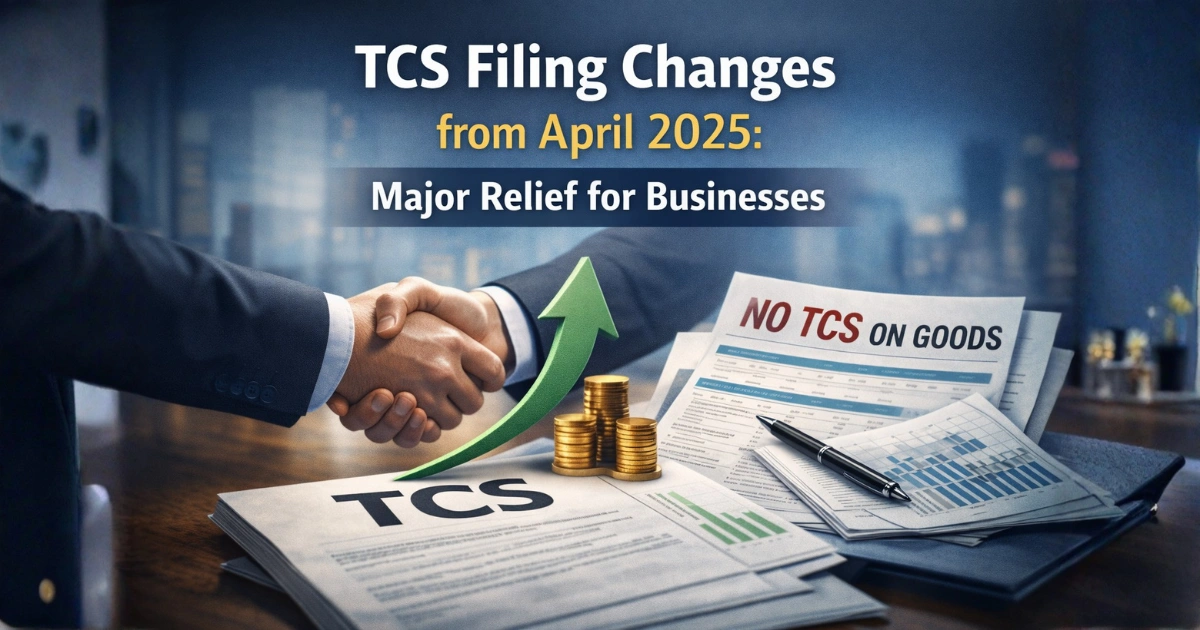
From 1 April 2025, TCS on sale of goods under Section 206C(1H) is removed.
Earlier, if your business turnover exceeded ₹10 crore and you sold goods worth more than ₹50 lakh to a customer, you had to collect TCS—even if margins were thin and payments were delayed.
(Section reference:
https://www.incometaxindia.gov.in/pages/acts/income-tax-act.aspx)
What this removal means in real life:
-
No more collecting 0.1% TCS on routine B2B sales
-
No follow-ups with customers for small TCS amounts
-
No quarterly reconciliation headaches for goods sales
Example:
A manufacturing company selling raw materials to distributors no longer needs to track cumulative customer sales just to check TCS applicability.
This single change dramatically reduces friction for trading, manufacturing, and wholesale businesses.
LRS Remittance Threshold Increase: Fewer Transactions Under TCS Net
LRS Remittance Threshold Increase to ₹10 Lakh
Under the Liberalised Remittance Scheme (LRS), individuals remitting money abroad were subject to TCS once thresholds were crossed.
The new rule increases the threshold to ₹10 lakh, meaning smaller remittances are now outside the TCS net.
(Official LRS reference:
https://www.rbi.org.in/scripts/FAQView.aspx?Id=115)
This directly benefits businesses and professionals who:
-
Send money abroad for services
-
Support overseas business expenses
-
Facilitate client payments
It also reduces unnecessary TCS credits that individuals earlier had to claim as refunds through income-tax returns.
No TCS on Education Loans: Relief for Students and Families
No TCS on Education Loans Funded by Financial Institutions
Earlier, even education-related foreign remittances could attract TCS, depending on the source of funds.
Now, no TCS applies on foreign remittances for education when funded through education loans from approved financial institutions.
(Income Tax clarification source:
https://www.incometax.gov.in/iec/foportal/help/lrs-tcs)
This change might not affect businesses directly, but it reflects a broader policy intent:
TCS should not create hardship where income generation isn’t involved.
It also simplifies compliance for banks, NBFCs, and education consultants handling overseas education payments.
Reduced Rate for Forest Produce: Sector-Specific Relief
Reduced Rate for Forest Produce Transactions
Businesses dealing in specified forest produce (other than timber) will now benefit from a reduced TCS rate.
This is especially relevant for:
-
Traders
-
Processors
-
Exporters operating on tight margins
Lower rates mean:
-
Less cash flow blockage
-
More accurate pricing
-
Reduced disputes with buyers
It’s a small technical change—but meaningful for businesses operating at scale in these sectors.
Decriminalization of Late Payments: A Shift in Compliance Philosophy
Decriminalization of Late Payments and Procedural Relief
One of the less talked-about but important shifts is the decriminalization of certain late TCS payments.
Instead of immediately triggering prosecution risks, the focus is now on:
-
Monetary penalties
-
Interest recovery
-
Procedural compliance
This aligns with the broader government push toward decriminalization of minor economic offences
(Policy background:
https://dea.gov.in/decriminalisation-economic-legislation)
For compliant businesses, this reduces fear-driven compliance and allows focus on accuracy over panic.
From April 1, 2026: Time Limit on TCS Correction Statements
2-Year Limit on Correction Statements
Starting 1 April 2026, correction statements for TCS returns can only be filed within two years from the end of the relevant financial year.
This means:
-
Errors can’t be fixed indefinitely
-
Old mismatches won’t linger forever
-
Businesses must reconcile returns on time
Practical takeaway:
You’ll need stronger internal checks during filing—because “we’ll correct it later” won’t always be an option.
Action Steps for Businesses
Here’s what businesses should do now:
-
Review whether TCS on sale of goods still applies to your transactions
-
Update accounting and ERP systems from April 2025
-
Train teams on revised LRS and sector-specific rules
-
Strengthen reconciliation processes before the 2026 correction limit applies
Early preparation avoids last-minute confusion.
Common Mistakes to Avoid
-
Continuing to collect TCS on goods out of habit
-
Ignoring sector-specific rate changes
-
Delaying reconciliation assuming unlimited correction time
-
Misapplying LRS thresholds
Most errors won’t come from ignorance—but from outdated processes.
Pro Tips from the Ground
-
Update client communication templates—many buyers will expect TCS removal immediately
-
Align finance and sales teams on revised applicability
-
Close TCS reconciliations quarterly, not annually
-
Keep documentation clean—simplification doesn’t mean lax scrutiny
Conclusion: TCS Is Finally Becoming Easier to Live With
These TCS filing changes aren’t cosmetic.
They remove friction where it added no real value, reduce compliance overload, and signal a more mature tax administration approach.
If businesses understand and implement these changes correctly, TCS goes back to being a reporting mechanism—not a daily operational headache.
Now is the right time to realign systems, educate teams, and simplify workflows.