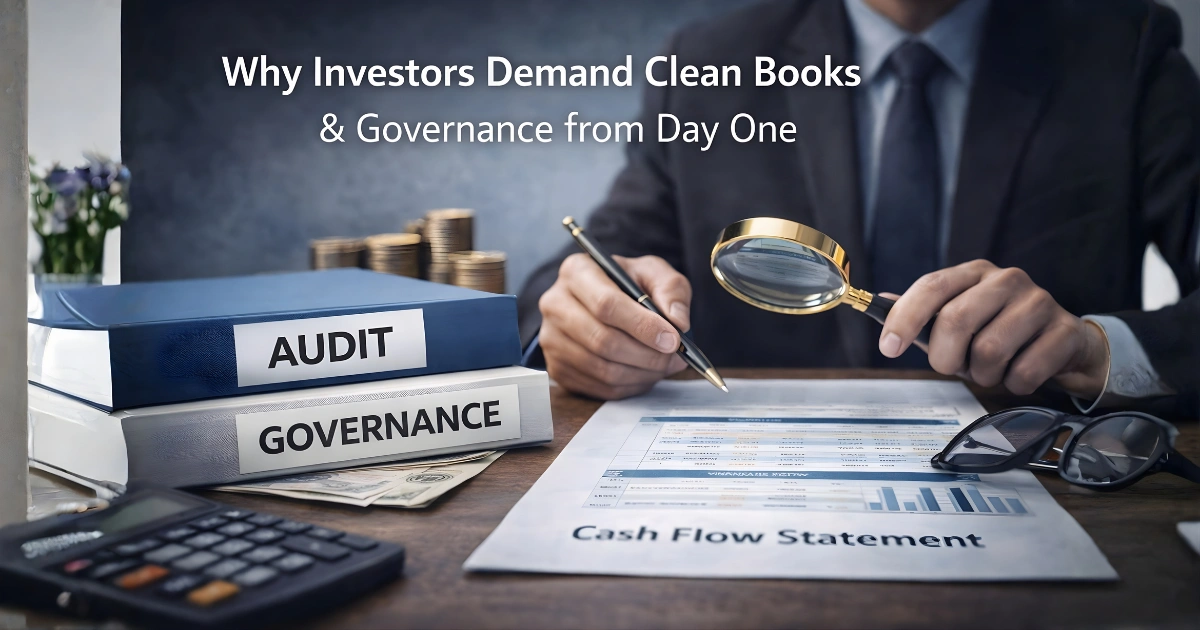
The Question Investors Ask First (But Rarely Say Out Loud)
Ten years ago, investors asked founders about vision.
Five years ago, they asked about growth.
In 2025 and beyond, the first silent question is simpler—and harsher:
“Can I trust these numbers?”
Because in today’s market, traction without governance is noise.
And growth without compliance is risk.
That’s why governance and compliance are no longer back-office hygiene. They’re front-line investment filters.
This article explains why investors now demand cleaner books from day one, what “clean” actually means, and how founders who take this seriously move faster—while others stall or fail quietly.
Why “Clean Books” Suddenly Matter So Much
Let’s be clear: this shift didn’t happen overnight.
Three forces collided.
1. Regulatory Scrutiny Is No Longer Forgiving
Across markets, corporate governance strictness now demands proper documentation of every sensitive information exchange—from shareholder decisions to financial controls.
Regulators and exchanges have tightened expectations around disclosures, audit trails, and internal controls, a trend well documented in governance updates from bodies like SEBI, SEC, and global compliance advisories.
Informal practices that once slipped through now trigger:
-
Due diligence delays
-
Compliance red flags
-
Valuation haircuts
Investors don’t want to fix governance later. They want it built-in.
2. Data Now Drives Valuation (Not Stories)
Modern investing is data-heavy.
Revenue quality.
Cash flow accuracy.
Expense classification.
Related-party transactions.
If the data doesn’t reconcile cleanly, valuation becomes guesswork—and investors hate guessing.
That’s why all financial intermediaries must maintain clean, transparent, and auditable books—a principle consistently highlighted in financial reporting standards and explained clearly in resources like Investopedia’s guide to financial statements and audits.
Messy data doesn’t just slow deals.
It kills confidence.
3. Risk Appetite Has Shrunk
Capital is selective.
In a competitive market, investors don’t take unnecessary risks when cleaner opportunities exist. This shift toward risk minimisation has been widely discussed in investor letters and market analysis from publications like Harvard Business Review and McKinsey.
If two startups look similar:
-
One has tight governance
-
One has “we’ll fix it later” accounting
The decision is already made.
What Investors Actually Mean by “Clean Books”
This isn’t about perfection.
It’s about clarity and consistency.
Clean books mean:
-
Every transaction is explainable
-
Numbers reconcile across systems
-
Documentation exists, not excuses
-
Controls are visible, not implied
Or put simply:
If someone else opens your books tomorrow, nothing surprises them.
This expectation mirrors standard due-diligence checklists used by institutional investors and M&A advisors globally.
Compliance Isn’t a Burden. It’s an Asset Class.
This mindset shift matters.
Founders often see compliance as:
-
Cost
-
Delay
-
Distraction
Investors see it differently.
Compliance isn’t a burden; it’s an asset class.
Why?
Because it delivers:
-
Faster deal execution
-
Lower legal risk
-
Cleaner exits
-
Higher buyer confidence
Strong governance compounds value quietly—until it suddenly shows up as a better term sheet. This value creation effect is frequently cited in IPO readiness and M&A preparation guides.
How Clean Governance Accelerates Deals (Not Slows Them)
Here’s what actually happens in real funding or M&A processes.
With Clean Books:
-
Due diligence moves faster
-
Fewer follow-up questions
-
Lower transaction friction
-
Reduced need for indemnities
Result: faster deal execution and stronger negotiating power.
With Messy Books:
-
Endless clarifications
-
Data rooms reopen repeatedly
-
Lawyers drive the process
-
Valuations get “adjusted for risk”
Same business. Very different outcome.
The Hidden Cost of “We’ll Fix It Later”
This is the most expensive sentence founders say.
Because fixing governance late usually means:
-
Retrospective cleanups
-
Restated financials
-
Broken audit trails
-
Investor trust erosion
Once trust erodes, it rarely fully returns.
Good governance is cheap early.
It’s painfully expensive later.
Where Most Founders Go Wrong
These are patterns investors see repeatedly:
-
Using spreadsheets too long without controls
-
Mixing personal and business transactions
-
Inconsistent revenue recognition
-
No audit trail for approvals
-
Manual reconciliations done “when time permits”
None of this looks dramatic.
That’s exactly why it’s dangerous.
Why Automation Is Becoming Non-Negotiable
Manual processes don’t scale trust.
As transaction volume grows, human reconciliation breaks.
This is where automation stops being a “nice-to-have”.
For example, an automated reconciliation platform like reconcile.money ensures your books are clean and transparent from day one—not just at audit time.
Automation helps by:
-
Creating consistent audit trails
-
Reducing human error
-
Enforcing process discipline
-
Making compliance continuous, not episodic
Investors trust systems more than promises—a point echoed in fintech and accounting transformation studies by Deloitte and PwC.
Governance as Exit Insurance
Think beyond funding.
Every serious exit—IPO or acquisition—depends on governance quality.
Buyers don’t just acquire revenue.
They acquire risk history.
Clean governance gives:
-
Clearer exit pathways
-
Fewer last-minute deal collapses
-
Better pricing leverage
This is why governance conversations now happen years before exits, not months—a reality highlighted in M&A post-mortems and failed-deal analyses.
Practical Action Steps for Founders (Do This Now)
You don’t need a Big Four setup on day one.
You do need intent and structure.
Start here:
-
Separate business and personal finances completely
-
Document approvals for all material decisions
-
Standardize revenue and expense classification
-
Maintain reconciled, auditable records monthly
-
Use tools that enforce discipline, not just storage
Clean books are built through habits, not heroics.
Pro Tips Investors Won’t Tell You Directly
-
Governance quality signals founder maturity
-
Messy books raise doubts beyond finance
-
Clean data reduces legal overreach
-
Transparency builds negotiating leverage
-
Trust compounds faster than growth
The best founders understand this early.
Final Thought: Clean Books Are the New Pitch Deck
In today’s market, stories open doors.
But clean books close deals.
Governance and compliance aren’t about fear.
They’re about optionality.
They give you:
-
More choices
-
Better partners
-
Cleaner exits
If you’re building something meant to last, don’t treat compliance as admin.
Treat it as strategy.