The First Business Decision Most Founders Get Wrong
Before your first client.
t=”413″ data-end=”416″ />>Before your first hire.
=”yoast-text-mark” data-start=”439″ data-end=”442″ />>Before your first rupee of revenue.
You make one decision that quietly decides how fast you can grow, how easy funding will be, and how painful compliance becomes.
That decision is your business structure.
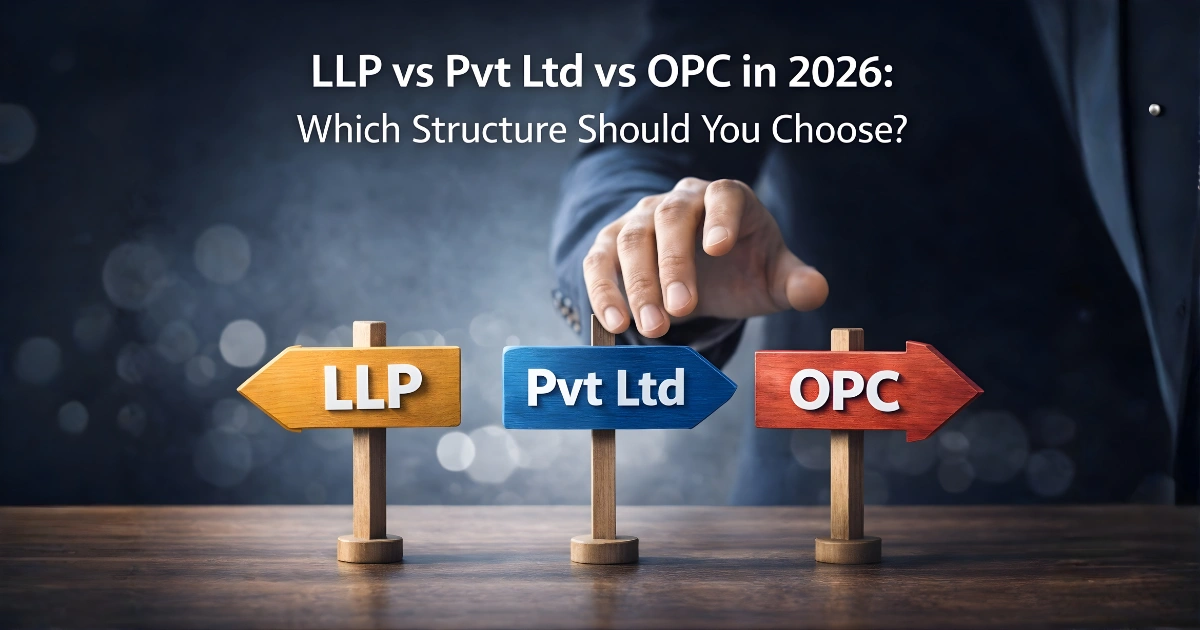
In 2026, Indian founders are still stuck choosing between:
-
LLP
-
Private Limited
-
OPC
And many choose based on cost or hearsay—not consequences.
This guide breaks down LLP vs Pvt Ltd vs OPC in plain English, with real use cases, not textbook definitions.
Why Choosing the Right Structure Matters More in 2026
India’s startup ecosystem has matured.
Investors are sharper.
Compliance is stricter.
Founders are more ambitious—and more exposed to risk.
Choosing between sole proprietorship vs partnership, LLP vs Private Limited, or OPC is no longer just a legal formality. It directly affects:
-
Fundraising ability
-
Founder control
-
Tax efficiency
-
Exit options
-
Long-term stress
The Ministry of Corporate Affairs (MCA) has steadily increased reporting and governance expectations, making structure choice more important than ever.
(Refer to the MCA portal on company and LLP compliance for a sense of regulatory depth.)
The “cheap to start” option often becomes the most expensive to fix later.
Quick Snapshot: LLP vs Pvt Ltd vs OPC (Founder View)
| Feature | Pvt Ltd | LLP | OPC |
|---|---|---|---|
| Founders | Min 2 (can have more) | Min 2 | 1 |
| Funding | Easiest (VC/Angel preferred) | Harder (No Equity) | Hard (Convertible Notes Possible) |
| Compliance | High | Medium / Low | Medium |
| Control | Board + Shareholders | Partners | Sole Founder |
| Ideal For | Scalable, funded startups | Service firms, SMEs | Solo founders |
Now let’s break this down properly.
Private Limited Company: Built for Scale and Capital
If your ambition includes funding, fast growth, or exits, Pvt Ltd is the default choice.
Why Founders Choose Pvt Ltd
Investor-friendly structure
VCs and angels strongly prefer Pvt Ltd companies because equity is clean, transferable, and familiar. This preference is openly stated in funding guides by Y Combinator and Sequoia-backed accelerators.
Clear ownership and governance
Shareholders, board structure, ESOPs—all clearly defined under the Companies Act, 2013.
Best structure for ESOPs
Critical if you plan to hire senior talent. Most ESOP frameworks referenced by top Indian law firms are designed primarily for Pvt Ltd companies.
The Trade-Off
Pvt Ltd companies have higher compliance compared to LLPs and OPCs:
-
Regular board meetings
-
Annual ROC filings
-
Statutory audits
-
Higher professional costs
You can review the statutory requirements directly on the MCA compliance checklist for private limited companies.
This structure rewards ambition—but punishes casual founders.
Ideal If You Are:
-
Building a scalable startup
-
Planning VC or angel funding
-
Comfortable with structured governance
If funding is on your roadmap—even “maybe”—start with Pvt Ltd.
LLP: Flexible, Cost-Efficient, and Underestimated
An LLP is often misunderstood as a “small business” structure. That’s inaccurate.
Why LLPs Make Sense in 2026
An LLP is feasible when it comes to cost-efficiency and low compliance.
Key benefits:
-
Lower annual compliance than Pvt Ltd
-
No mandatory board meetings
-
Profit-sharing flexibility
-
Limited liability for partners
The MCA’s LLP framework was specifically designed to support professional partnerships and SMEs.
(See MCA guidelines on LLPs for structural intent.)
The Big Limitation: Funding
LLPs cannot issue equity.
That’s why:
-
VC funding is nearly impossible
-
Angel funding is rare
-
ESOPs don’t work the same way
This makes LLP registration vs OPC or Pvt Ltd a strategic decision, not a cost one.
Ideal If You Are:
-
Running a service firm (consulting, agency, CA, legal, IT services)
-
Bootstrapped or partner-led business
-
Focused on steady profits, not blitzscale growth
LLP is underrated—but only when used for the right business model.
OPC (One Person Company): Control Without Partners
OPC exists for founders who want limited liability without co-founders.
It sits between:
-
Sole proprietorship (simple, risky)
-
Pvt Ltd (safe, but heavy)
Why Founders Choose OPC
-
Single founder ownership
-
Limited liability protection
-
Better credibility than sole proprietorship
OPCs have fewer compliance requirements compared to Pvt Ltd companies, but more than sole proprietorships—something the MCA explicitly outlines in OPC rules and thresholds.
The Hidden Catch
-
Hard to raise equity funding
-
Mandatory conversion if turnover or paid-up capital crosses prescribed limits
-
Growth eventually forces a structure change
Convertible notes are technically possible, but most investors still hesitate—something frequently discussed in early-stage investor forums and startup legal explainers.
Ideal If You Are:
-
A solo founder testing an idea
-
A professional building a personal-brand business
-
Not raising capital in the short term
OPC is a temporary structure, not a final one.
LLP Registration vs OPC: A Common Confusion
Many solo founders ask:
“Should I start with OPC or LLP?”
Here’s the clarity:
-
Choose OPC if you want full control and no partners.
-
Choose LLP if you’re okay with a partner and want lower compliance + flexibility.
If you expect to bring in co-founders soon, LLP makes more sense than OPC—because conversion later involves cost, filings, and downtime.
Common Mistakes Founders Make
-
Choosing LLP to save money, then struggling to raise funds
-
Starting as OPC and being forced into rushed conversion later
-
Ignoring compliance load while choosing Pvt Ltd
-
Not aligning structure with the business model
-
Listening to “my CA said so” without understanding long-term impact
Your structure should match where the business is going, not where it is today.
Practical Action Steps Before You Decide
-
Write down whether you’ll need external funding in the next 24 months
-
Decide if you want partners now or later
-
Estimate compliance comfort (time + money)
-
Think about ESOPs and senior hiring
-
Choose the structure that avoids forced conversion
Changing structures later is possible—but rarely painless.
Final Verdict: Don’t Choose Cheap. Choose Correct.
In 2026:
-
Pvt Ltd is for ambition and funding
-
LLP is for profitability and flexibility
-
OPC is for control and solo execution
There’s no “best” structure.
There’s only the structure that lets you sleep better while building seriously.
If you’re unsure, that’s not weakness—it’s a sign you’re thinking like a founder, not a hobbyist.