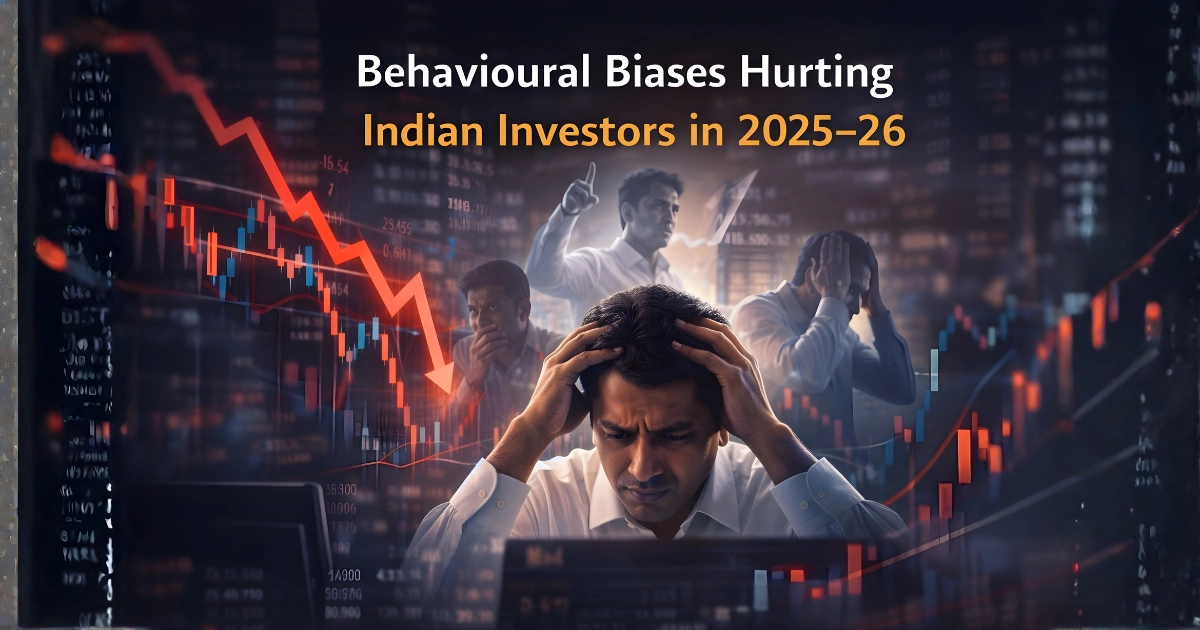
Introduction: The Market Isn’t the Real Problem. Your Brain Might Be.
Ask Indian investors how 2025–26 has treated them, and you’ll hear mixed answers.
Some will blame volatility.
t=”513″ data-end=”516″ />>Some will blame operators.
=”yoast-text-mark” data-start=”542″ data-end=”545″ />>Some will blame “bad luck.”
But here’s the uncomfortable truth:
Most portfolio damage this year hasn’t come from the market. It has come from behaviour.
The Indian market environment in 2025–26 has been fast, noisy, and emotionally charged. Sharp rallies. Sudden corrections. Social-media-driven stock ideas. In this setup, retail investors aren’t losing because they lack information—they’re losing because they’re human.
Behavioural finance research from Nobel laureates Daniel Kahneman and Richard Thaler has long shown that investors consistently make irrational decisions under uncertainty
👉 https://www.nobelprize.org/prizes/economic-sciences/2002/summary
👉 https://www.nobelprize.org/prizes/economic-sciences/2017/summary
Behavioural biases are quietly pushing investors toward excessive trading, panic selling, and blindly following market crowds. Let’s break down the most damaging ones—and how to protect yourself.
Why Behavioural Biases Matter More in 2025–26
This isn’t a normal market cycle.
The current phase combines:
-
High retail participation
-
Easy access to trading apps
-
Constant market commentary
-
Short-term performance obsession
SEBI data and investor awareness studies repeatedly highlight that increased access without education amplifies behavioural mistakes
👉 https://www.sebi.gov.in/investor-awareness
That combination magnifies psychological shortcuts. In calmer markets, biases hide. In volatile markets, they dominate decisions.
Understanding them isn’t academic. It’s defensive investing.
Herd Behaviour (Herding): The Most Expensive Bias in India
Herd Behaviour (Herding) is the tendency to follow what everyone else is doing—assuming the crowd must be right.
In India, this bias shows up clearly:
-
Stocks trending on Twitter or WhatsApp groups
-
Sudden rush into themes after headlines
-
Buying near tops because “everyone is making money”
Academic studies on herding in emerging markets show retail investors consistently enter late and exit early
👉 https://www.investopedia.com/terms/h/herdinstinct.asp
By the time the herd arrives, early movers have often exited.
Real-Life Example
Retail participation spikes after sharp rallies. When prices correct, the same investors exit in panic—locking in losses.
This bias fuels both excessive trading and panic selling.
Counter-move:
If an investment idea reaches you through noise, it’s probably late.
Overconfidence Bias: When a Few Wins Rewrite Reality
Overconfidence Bias convinces investors they’re better than they actually are.
A few profitable trades in a bull phase can create dangerous beliefs:
-
“I understand markets now.”
-
“This time is different.”
-
“I can exit before others.”
Research published in the Journal of Finance shows overconfident investors trade more—and earn lower net returns
👉 https://www.jstor.org/stable/2329559
In 2025–26, many new investors entered after seeing quick gains in selective sectors. When volatility returned, confidence stayed—but skill didn’t.
Overconfidence leads to:
-
Oversized positions
-
Frequent buying and selling
-
Ignoring risk management
Markets don’t punish ignorance as harshly as they punish arrogance.
Counter-move:
Track decisions, not outcomes. A bad process that works once is still a bad process.
Loss Aversion: Why Losses Hurt More Than Gains Feel Good
Loss Aversion explains why investors behave irrationally around falling prices.
Psychologically, losing ₹1 hurts about twice as much as gaining ₹1 feels good—a core insight from Prospect Theory
👉 https://www.investopedia.com/terms/l/lossaversion.asp
This leads to two classic mistakes:
-
Holding losers too long, hoping to “get back to cost”
-
Selling winners too early to “lock profits”
How It Plays Out
Investors panic sell during corrections, then hesitate to re-enter when prices stabilise—missing recoveries entirely.
Loss aversion is the engine behind most panic selling episodes.
Counter-move:
Decide exit rules before emotions arrive.
Anchoring Bias: Stuck on the Wrong Number
Anchoring Bias happens when investors fixate on a reference point—usually the buying price.
Examples:
-
“I’ll sell once it comes back to my cost.”
-
“This stock was ₹800 earlier, so ₹500 is cheap.”
Markets don’t care about your anchor. Prices move based on future expectations, not your past decisions.
Anchoring leads to:
-
Delayed exits
-
Ignoring deteriorating fundamentals
-
Emotional attachment to numbers
Behavioural finance explanations of anchoring are well documented
👉 https://www.behavioraleconomics.com/resources/mini-encyclopedia-of-be/anchoring/
Counter-move:
Ask: If I didn’t own this today, would I buy it at this price?
Confirmation Bias: Only Seeing What You Want to See
Confirmation Bias pushes investors to seek information that supports existing beliefs—and ignore everything else.
In 2025–26, this bias thrives because:
-
Algorithms show content you already agree with
-
Communities reinforce single narratives
-
Dissenting views feel uncomfortable
Harvard research shows confirmation bias worsens decision-making in complex environments like financial markets
👉 https://www.harvard.edu/research/confirmation-bias
Investors double down instead of reassessing.
Counter-move:
Actively read views that challenge your position—especially when you’re confident.
Recency Bias: Believing the Latest Trend Will Last Forever
Recency Bias makes recent events feel more important than long-term history.
After a rally, investors expect more upside.
After a correction, investors expect more downside.
Both assumptions are usually wrong.
Market cycle research by Morningstar consistently shows that chasing recent performance leads to underperformance
👉 https://www.morningstar.com/articles/behavioral-investing
Counter-move:
Zoom out. If your thesis doesn’t survive a 5-year view, it’s fragile.
Mental Accounting: Treating Money Differently When It’s All Yours
Mental Accounting is when investors assign different rules to different money buckets.
Examples:
-
Trading profits feel “free” and are risked recklessly
-
Long-term investments are treated carefully
-
Bonus money is gambled
Richard Thaler’s work shows this bias distorts risk perception
👉 https://www.investopedia.com/terms/m/mentalaccounting.asp
Counter-move:
All capital deserves the same discipline—regardless of source.
How These Biases Show Up Together
Rarely does one bias act alone.
In real life:
-
Herd behaviour + overconfidence = aggressive entries
-
Loss aversion + anchoring = refusal to exit
-
Recency bias + confirmation bias = trend chasing
Together, they lead to:
-
Excessive trading
-
Panic selling
-
Following market crowds
Practical Action Steps to Protect Yourself
You can’t eliminate biases—but you can manage them.
-
Write down your investment thesis before buying
-
Predefine exit rules
-
Reduce decision frequency
-
Automate long-term investments
-
Review behaviour, not just returns
Structure beats willpower.
Conclusion: The Best Edge in This Market Is Self-Awareness
In the 2025–26 Indian market, information is everywhere. Opportunity is not the problem.
Behaviour is.
If you understand herd behaviour, overconfidence bias, loss aversion, anchoring bias, confirmation bias, recency bias, and mental accounting, you’re already ahead of most participants.
The market will remain uncertain.
Your response doesn’t have to be.
Fix behaviour first. Returns follow.