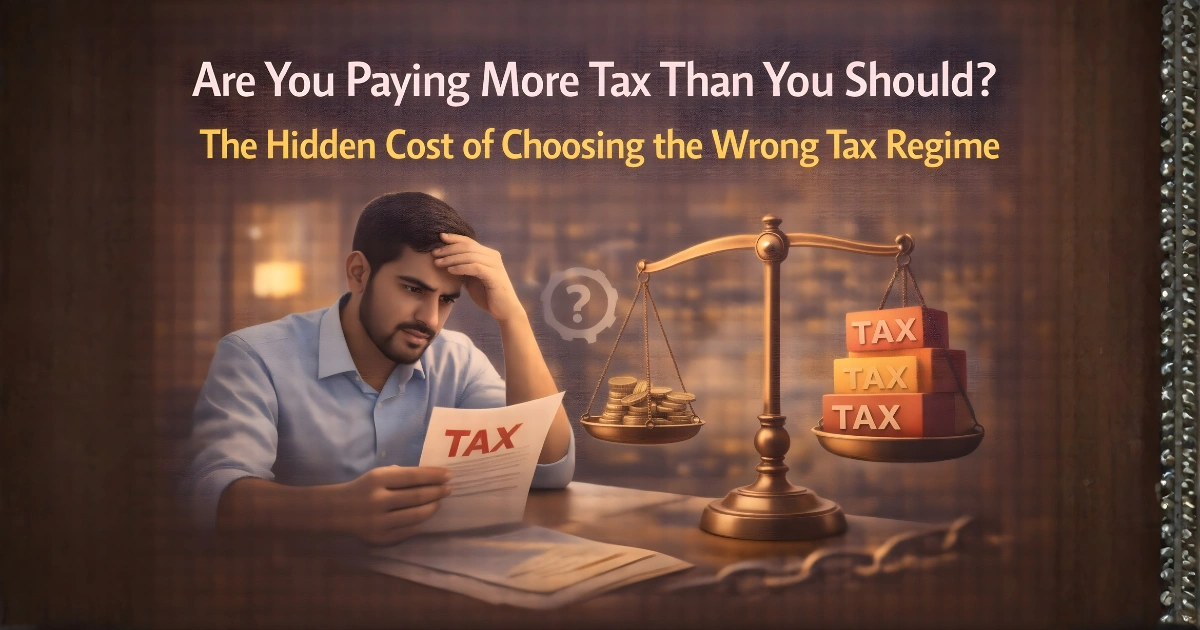
Most people assume that once they’ve filed their returns and paid what the calculator shows, the job is done. Tax paid. Year closed. Move on.
But here’s the uncomfortable truth: a huge number of individuals and businesses quietly pay more tax than they should — not because they’re dishonest or careless, but because they don’t fully understand how the system works. In many cases, you paid in more income tax than you owe without even knowing it.
And no — this isn’t about loopholes or risky tactics. It’s about missed deductions, wrong choices, ignored tax credits, and one silent mistake millions make every year:
Picking the wrong tax regime.
Let’s unpack how this happens, why it matters, and what you can do to stop leaving money on the table.
Why Overpaying Tax Happens More Often Than You Think
Paying income tax is more than just a legal obligation — it’s one of the biggest financial responsibilities you handle each year. Yet the system is complex, rules change often, and most people rely on default options instead of informed decisions.
The Income Tax Department itself regularly updates rules and clarifications through its portal:
👉 https://www.incometax.gov.in/iec/foportal
That complexity leads to one common outcome:
People end up paying more taxes than legally required simply because they don’t use all the deductions, exemptions, and tax-advantaged options available to them.
Sometimes the problem is as small as not claiming an expense. In other cases, it’s a structural mistake that repeats every single financial year.
Let’s look at the most common causes.
The Big One — Picking the Wrong Tax Regime
Choosing between the old tax regime and the new tax regime is one of the most impactful decisions you make each year. The Central Board of Direct Taxes provides regime details and slabs here:
👉 https://incometaxindia.gov.in/Pages/tax-information-services/individuals/tax-slabs.aspx
Yet many people pick one blindly — or stay in the same regime out of habit — without comparing numbers.
Under the wrong regime, it’s surprisingly easy to realise later that you paid in more income tax than you owe.
When the Old Regime Makes More Sense
The old regime works better if you:
-
Invest in Section 80C instruments (PPF, ELSS, EPF, etc.)
-
Claim HRA, medical insurance, or education loan deductions
-
Pay home-loan interest
-
Receive multiple allowances and exemptions
A detailed list of deductions and claims under the old regime is explained here:
👉 https://www.incometax.gov.in/iec/foportal/help/deductions
If your deductions are meaningful, the old regime can reduce taxable income significantly.
When the New Regime Works in Your Favor
The new regime benefits people who:
-
Don’t invest much in tax-saving instruments
-
Receive fewer allowances
-
Prefer a simpler slab structure with lower rates
Official guidance on the new regime features and conditions is available here:
👉 https://www.incometax.gov.in/iec/foportal/help/individuals/new-tax-regime
If deductions are minimal, the new regime often results in a lower final tax — even without exemptions.
The Problem Most Taxpayers Miss
Many people choose based on assumption instead of calculation.
Some stick to the old regime because they’ve “always used it.” Others switch because someone said it’s simpler.
But taxes don’t reward assumptions — they reward math.
Running a side-by-side calculation (the department also offers an online comparison tool):
👉 https://www.incometax.gov.in/iec/foportal/services/income-tax-calculators
…often reveals that picking the wrong regime can cost you thousands — every single year.
The Silent Ways People Overpay Taxes
Overpaying tax isn’t always about major mistakes. Often, it’s a series of small, ignored opportunities that quietly add up.
Ignoring Eligible Deductions
Plenty of legitimate deductions go unused, including:
-
Health insurance premiums (Section 80D)
-
Education loan interest (Section 80E)
-
Donations to registered charities (Section 80G)
-
Home-loan interest components
-
Approved disability and medical-treatment deductions
Official explanations for these sections are listed here:
👉 https://www.incometax.gov.in/iec/foportal/help/tax-filing/sections-deductions
If you don’t claim them, the government doesn’t correct you — the extra tax just stays paid.
Not Tracking Work-Related or Business Expenses
For freelancers and business owners, missed expenses directly inflate taxable income.
Commonly ignored allowable expenses include:
-
Software & tools
-
Professional fees
-
Office rent and utilities
-
Equipment & depreciation
-
Travel and communications
The Income Tax Department’s guide on allowable business expenses is useful here:
👉 https://www.incometaxindia.gov.in/pages/guides/business-professional-income.aspx
Without records, the tax system assumes those expenses don’t exist — and you overpay.
Forgetting to Claim Tax Credits
Credits reduce your tax payable, not just taxable income — which makes skipping them even costlier.
Learn the difference between deductions and credits here:
👉 https://www.investopedia.com/articles/taxes/09/tax-deduction-credit-difference.asp
When credits are overlooked, you literally end up paying more than required.
Real-Life Examples of Paying More Tax Than Necessary
Example 1 — The Employee Who Never Reviewed Their Regime
Riya chose the old regime years ago. Since then, she stopped investing in 80C — but never switched.
After comparing, she realised:
-
Her deductions were minimal
-
The new regime would have reduced her tax significantly
She unknowingly overpaid for three years in a row — simply because she never ran the numbers.
Example 2 — The Freelancer Without Expense Records
Arjun works as a designer.
He pays for tools, devices, internet, subscriptions… but never tracks or claims them.
His income remains artificially high on paper — meaning he files honestly but still overpays tax.
Action Steps — How to Check If You’re Overpaying Tax
Step 1 — Compare Both Tax Regimes
Use a calculator instead of guessing:
👉 https://www.incometax.gov.in/iec/foportal/services/income-tax-calculators
Whichever results in lower final tax, choose that.
Step 2 — List Every Deduction & Allowance
Cross-check against:
-
Form 16
-
Investments & insurance
-
Home / education loans
-
HRA and rent receipts
-
Professional or business expenses
Reference guide for personal tax deductions:
👉 https://www.incometax.gov.in/iec/foportal/help/deductions
Step 3 — Keep Proofs & Records Organized
Maintain:
-
Digital invoices
-
Bank & investment statements
-
Expense folders
This also helps during assessments and notice responses:
👉 https://www.incometax.gov.in/iec/foportal/response-to-notice
Step 4 — Get a Professional Review
If your finances are complex, a one-time expert review can reveal years of missed opportunities.
Certified tax-planning principles overview:
👉 https://www.icai.org/post/income-tax-resources
Common Mistakes That Lead to Unnecessary Tax Payments
-
Filing in a hurry without review
-
Blindly relying on employer declarations
-
Never comparing regimes
-
Treating tax planning as a once-a-year activity
-
Not updating strategy when income/life changes
Taxes evolve. Your approach should too.
Pro Tips to Stop Overpaying Tax Going Forward
-
Plan at the start of the financial year — not the end
-
Automate tax-saving investments where possible
-
Treat tax planning as part of wealth strategy
-
Review your regime every year
-
Re-evaluate after job, loan, or income changes
Conclusion — Don’t Pay More Just Because You Didn’t Know Better
Overpaying tax doesn’t appear as a warning message. It hides inside assumptions, missed deductions, and unreviewed regime choices.
The goal isn’t to avoid taxes.
It’s to pay only what you are legally required to — nothing more, nothing less.
Take time to review, compare, and question defaults. And if you’re unsure, seek guidance — even a single review can reveal where your money is silently slipping away.
Start now. Re-check your regime, list your deductions, and make sure your next tax payment truly reflects what you owe — not more than it.