Most people hear the term GST and immediately think of confusing rules, endless paperwork, and government jargon that never seems to make sense. If you’ve tried Googling “how GST works” before, you’ve probably found explanations that feel more like rulebook photocopies than real guidance.
This guide takes a different route.
Let’s break down Goods and Services Tax in a way beginners can actually understand — using everyday examples, simple explanations, and clarity on what really matters when you run a business in India.
What Exactly Is GST — and Why Was It Introduced?
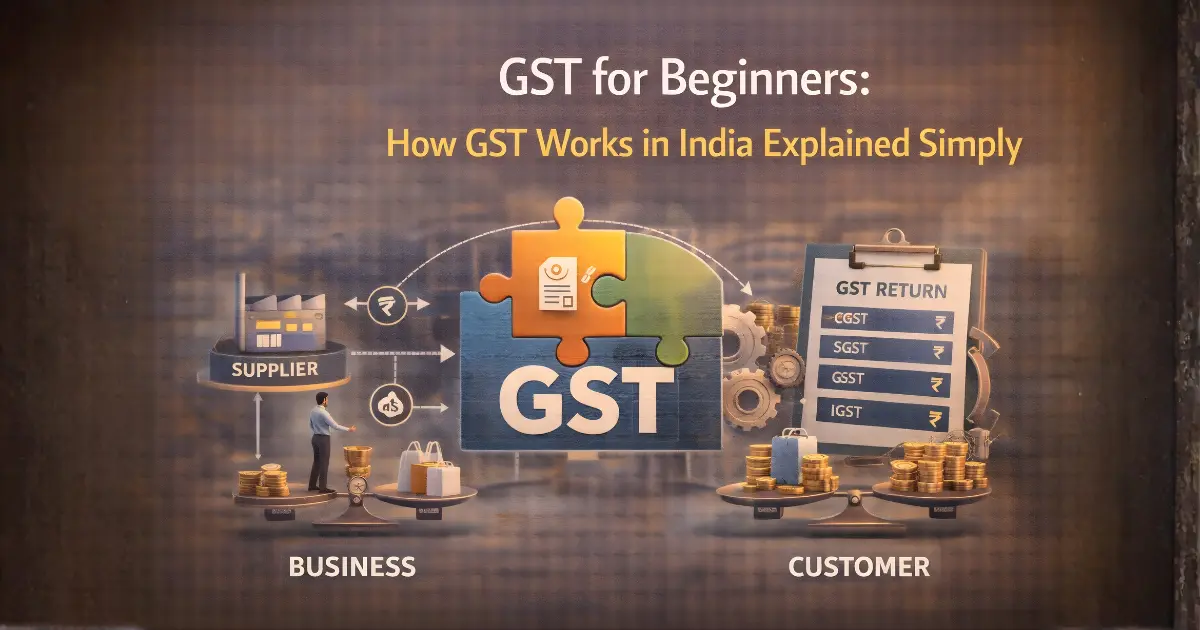
GST (Goods and Services Tax) is a unified, multi-stage, destination-based indirect tax on the supply of goods and services across India. Instead of paying different taxes like VAT, excise, or service tax, GST replaces them with one structured framework.
A simple overview of how GST works is explained on the official GST Portal:
👉 https://www.gst.gov.in/
The big idea behind GST was:
-
One Nation, One Tax
-
Lower cascading tax burden
-
Seamless tax credit across value chains
Before GST, a product could be taxed multiple times at different stages. GST changed that through input tax credit, ensuring tax is paid only on value added.
For background on why GST replaced earlier indirect taxes, see the Ministry of Finance explainer:
👉 https://www.finmin.nic.in/gst
Why Beginners Should Care About GST
If you’re a small business owner, freelancer, trader, or startup founder, GST affects:
-
Pricing and margins
-
Cash flow
-
Compliance and invoicing
-
Input tax credit eligibility
A beginner-friendly introduction is available here:
👉 https://incometaxindia.gov.in/pages/gst.aspx
Once you understand the basics, it becomes far less intimidating.
How GST Works — The Simple Breakdown
GST depends on where the transaction happens.
🔹 Intra-state supply (within the same state)
-
CGST — Central Government share
-
SGST / UTGST — State / Union Territory share
Official split reference:
👉 https://www.cbic.gov.in/htdocs-cbec/gst/central-tax-acts
🔹 Inter-state supply (between states or imports)
-
IGST — collected by the Centre and later apportioned to the destination state
IGST framework reference:
👉 https://www.cbic.gov.in/htdocs-cbec/gst/igst-act
Real-world example
Sell ₹10,000 worth of goods:
-
Customer in the same state → CGST + SGST apply
-
Customer in another state → IGST applies
Same product — different tax mechanism.
The Real Benefits of GST (Beyond Buzzwords)
Meaningful advantages include:
-
Simplified indirect taxation
-
Lower cascading effect through ITC
-
Easier movement of goods across states
-
Transparent pricing and billing
-
Encourages formal, digital business practices
CBIC outlines benefits for businesses here:
👉 https://www.cbic.gov.in/htdocs-cbec/gst/gst-benefits
Who Needs to Register for GST?
Registration is mandatory if you meet certain thresholds.
Turnover limits and categories are detailed on the GST Portal:
👉 https://www.gst.gov.in/help/threshold
You generally must register if:
-
Goods turnover exceeds ₹40 lakhs (₹20 lakhs in special category states)
-
Services turnover exceeds ₹20 lakhs (₹10 lakhs in special category states)
-
You make inter-state supplies
-
You operate via e-commerce platforms
-
You export, import, or supply online
Apply online here:
👉 https://www.gst.gov.in/help/registration
Once approved, you receive a 15-digit GSTIN.
Why GST Registration Matters
Being registered allows you to:
-
Collect GST legally
-
Claim input tax credit
-
Avoid penalties for non-compliance
-
Work with GST-compliant customers & vendors
CBIC compliance overview:
👉 https://www.cbic.gov.in/htdocs-cbec/gst/compliance
Understanding Input Tax Credit (ITC)
ITC is the feature that removes cascading tax.
You can subtract GST paid on purchases from GST collected on sales.
Official ITC rules & conditions:
👉 https://www.cbic.gov.in/resources//htdocs-cbec/gst/itc-forms-rules.pdf
Example
-
GST paid on inputs → ₹9,000
-
GST collected on sales → ₹14,400
-
Net GST payable → ₹5,400
Common ITC mistakes to avoid
-
Claiming ITC without valid tax invoices
-
Ignoring purchase-sales mismatch
-
Delayed return filing blocking credit
GST Rate Slabs in India
Goods & services fall into slabs such as 0%, 5%, 12%, 18%, 28%.
Official rate schedules & notifications:
👉 https://www.cbic.gov.in/htdocs-cbec/gst/gst-rate-schedule
Charging the wrong rate can lead to penalties or notices.
How GST Compliance Works in Daily Operations
Typical responsibilities include:
-
Issuing GST-compliant invoices
-
Maintaining sales & purchase records
-
Filing periodic returns
-
Reconciling ITC
-
Paying dues on time
Return-filing guidance:
👉 https://www.gst.gov.in/help/returns
Accounting tools or a professional can simplify ongoing compliance.
Practical Steps to Get Started With GST
-
Check whether your turnover requires registration
-
Apply on the GST Portal and upload documents
-
Update GSTIN on invoices & records
-
Use software / CA for filing & reconciliation
-
Track notifications and rate changes
Official notifications page:
👉 https://www.cbic.gov.in/htdocs-cbec/gst/gst-notifications
Common Beginner Mistakes to Avoid
-
Charging GST without registration
-
Using non-GST invoices
-
Missing return deadlines
-
Ignoring inter-state rules
-
Assuming small errors don’t matter
Penalty provisions reference:
👉 https://www.cbic.gov.in/htdocs-cbec/gst/gst-penalties
Pro Tips for Managing GST Like a Professional
-
Automate records instead of manual spreadsheets
-
Match purchase-sales entries monthly
-
Verify vendor GSTIN before claiming ITC
-
Seek expert help for exports / e-commerce
-
Treat GST as part of pricing strategy
GSTIN verification tool:
👉 https://services.gst.gov.in/services/searchtp
Businesses that understand GST make smarter financial and operational decisions.
Conclusion — GST Is Complex Until Someone Explains It Right
GST isn’t just a tax — it’s a framework shaping how modern Indian businesses operate. Once you understand how GST works, when registration applies, and how ITC affects cash flow, it stops feeling intimidating and becomes a powerful compliance tool.
If you’re planning to register, streamline systems, or clarify obligations, explore the GST resources above — or speak with a qualified professional for tailored guidance.