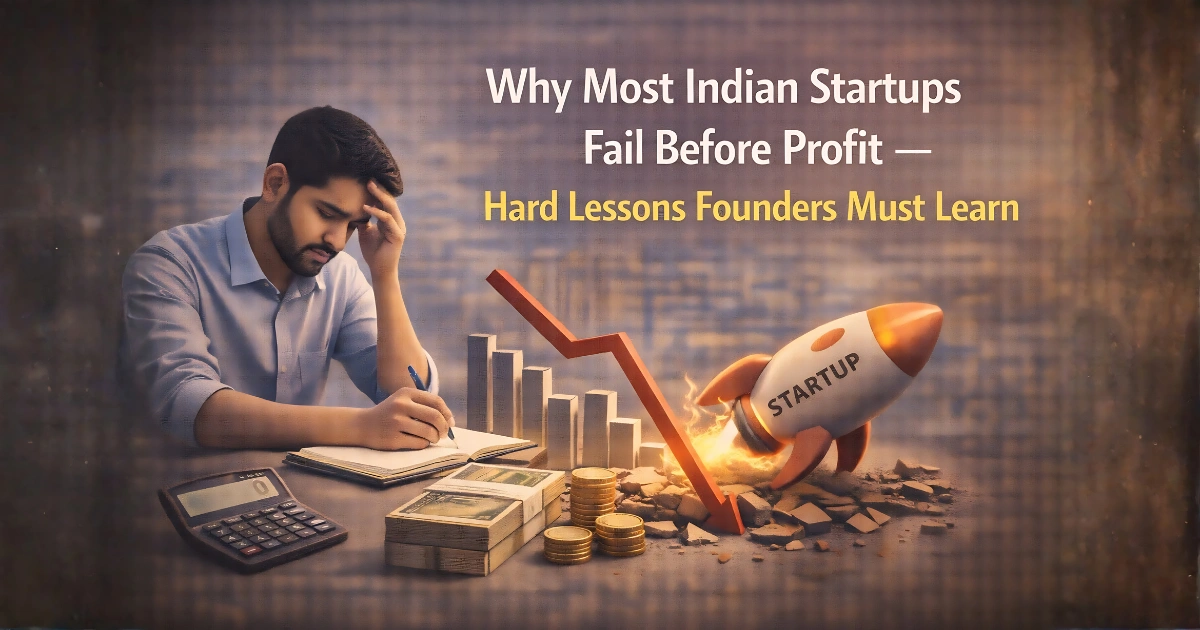
Every year, thousands of founders in India leave stable jobs, drain savings, sacrifice relationships, and bet everything on a startup dream. And yet, a painful number of those startups never even make it to their first profitable month.
Not because the idea was terrible.
Not because India lacks opportunity.
But because the reality of building a business here is far tougher — and far more misunderstood — than pitch decks and LinkedIn posts ever admit.
Startup failure isn’t rare — multiple reports including the Startup India insights and CB Insights’ Startup Failure Report show that most startups shut down due to weak fundamentals rather than external market conditions.
👉 https://www.startupindia.gov.in/
👉 https://www.cbinsights.com/research/startup-failure-reasons-top/
The truth is harsh:
Many startups burn through capital quickly on marketing, hiring, or tech without first achieving a stable revenue model. They chase valuation instead of validation. They build a product that nobody actually wants. They push for growth before proving customers care enough to pay — a trend frequently highlighted in Harvard Business Review analyses on startup mortality and failure lessons.
👉 https://hbr.org/2019/05/why-start-ups-fail
And by the time founders realize it, the runway is gone — long before profit ever shows up.
This isn’t a failure story meant to scare you. It’s a reality check meant to help you avoid the same fate.
Let’s break down why most Indian startups die before profit — and what founders can do differently.
💔 The Real Reason Startups Fail: It’s Not The Market — It’s The Misalignment
Ask any struggling founder and you’ll hear the same surface explanations:
“Competition killed us.”
“Investors didn’t support us.”
“The market wasn’t ready.”
But look closer and a different pattern emerges.
Most startups don’t die because of external pressure. More often, it’s internal mismanagement — weak decision-making, poor planning, ego-driven strategies, and lack of genuine customer focus.
The CB Insights Top Reasons Startups Fail Report repeatedly shows that lack of market need, mispricing, and poor execution outrank competition or funding issues.
👉 https://www.cbinsights.com/research/report/startup-failure-reasons-2024/
A lot of founders fall into the trap of chasing projections instead of solving problems.
And when that happens, the business becomes a spreadsheet exercise instead of something people actually value.
By the time reality hits, it’s already too late.
🧩 Problem #1: Wrong Product, Wrong Market, Wrong Time
Many startups fail because they never had the right product–market fit to begin with — a principle consistently emphasized in Y Combinator’s Startup Playbook and PMF frameworks.
👉 https://www.ycombinator.com/library/4A-the-yc-startup-playbook
Instead of solving a real problem, they end up building:
-
Products people like but won’t pay for
-
Features inspired by Western markets but misaligned with Indian behavior
-
Trend-driven products instead of needs-driven ones
India is price-sensitive, trust-driven, and value-centric — insights documented across Bain & Company India Consumer Market Reports.
👉 https://www.bain.com/insights/topics/india-insights/
If your product doesn’t fit local expectations, no branding campaign can rescue the misalignment.
🔥 Problem #2: Cash Burn Without Clarity
Here’s a pattern nearly every failed startup shares:
They start spending as if growth is guaranteed.
Large hiring, premium offices, big marketing budgets, and complex tech — all before validation. The Sequoia India “Survival Guide for Startups” explains how uncontrolled burn destroys otherwise promising businesses.
👉 https://www.sequoiacap.com/article/survival-guide/
Vanity metrics look impressive.
Revenue doesn’t.
When burn rises faster than learning or traction, cash disappears before the model is ever proven.
Noise replaces proof.
⚔️ Problem #3: Competition Without Differentiation
India is one of the most competitive startup ecosystems in the world — but too many companies enter crowded spaces without meaningful differentiation.
Without:
-
Clear positioning
-
Unique value
-
A defensible reason to exist
They get squeezed between better-funded players and traditional businesses.
McKinsey India growth-strategy research shows that execution only works when paired with distinct value advantage.
👉 https://www.mckinsey.com/in/our-insights
Otherwise — they become replaceable.
🧱 Problem #4: Weak Teams, Broken Execution
A great idea dies fast inside a weak team.
Many young startups suffer from:
-
Undefined roles
-
Founder ego conflicts
-
Poor operational discipline
-
Hiring fast instead of hiring right
Execution matters more than vision — a principle reinforced in The Lean Startup by Eric Ries and related startup-execution case studies.
👉 https://theleanstartup.com/principles
Chaos doesn’t scale.
Discipline does.
🧠 Problem #5: Focusing on Growth Instead of Sustainability
Another recurring failure pattern?
Startups chase funding, press visibility, and vanity growth charts instead of sustainable economics.
Discount-led growth collapses the moment funding slows — a trend repeatedly analyzed in unit-economics and retention benchmarks across SaaS & consumer-tech studies.
👉 https://www.lennysan.com/p/saas-metrics-benchmarks
👉 https://www.benchmarkone.com/blog/customer-retention-metrics/
Key questions that rarely get asked:
-
Will customers stay when discounts stop?
-
Does the model make money at scale?
-
Is retention stronger than acquisition?
If the answer is no — growth is simply a countdown to collapse.
❤️ Problem #6: The Human Cost No One Talks About
Behind every shutdown is a founder who:
-
Sacrificed salary
-
Stretched relationships
-
Carried silent anxiety
-
Bet everything on belief
The emotional burden of entrepreneurship is widely documented in founder mental-health research by Harvard Business School and WHO workplace-stress reports.
👉 https://hbswk.hbs.edu/item/the-emotional-toll-of-entrepreneurship
👉 https://www.who.int/publications/i/item/9789240003927
Hustle culture glorifies sacrifice.
Reality punishes burnout.
When emotional exhaustion meets fragile economics — failure becomes inevitable.
🧭 What Indian Startups Need to Do Differently
Survival improves dramatically when founders:
-
Validate demand before scaling (lean-validation approach)
-
Build for customers, not pitch decks
-
Start lean, learn fast, scale deliberately
-
Focus on retention before acquisition
-
Hire slow, train well, execute consistently
-
Treat cash like oxygen — not optimism
Much of this thinking aligns with the Y Combinator Startup Playbook and Startup India learning resources.
👉 https://www.ycombinator.com/library
👉 https://www.startupindia.gov.in/content/sih/en/learning-and-development.html
Sustainable startups aren’t louder.
They’re disciplined, patient, and focused.
❌ Common Mistakes Founders Repeat
-
Launching before understanding the market
-
Copying Western models without localization
-
Assuming funding equals validation
-
Ignoring real user feedback
-
Over-engineering products no one needs
-
Expanding before fixing fundamentals
Mistakes don’t explode.
They accumulate.
💡 Pro Tips to Build a Startup That Actually Survives
-
Talk to customers every week
-
Track revenue quality — not just scale
-
Simplify the product
-
Design around Indian price psychology & user behavior
-
Treat learning and iteration as progress
Execution beats enthusiasm — every single time.
🛠️ Action Steps: Stress-Test Your Startup Before It Breaks
Ask yourself:
1️⃣ Would customers still use this if discounts disappeared?
2️⃣ Do we offer a real reason to choose us?
3️⃣ Are we solving a meaningful problem?
4️⃣ Can this model survive without constant funding?
5️⃣ Are we improving lives — or chasing noise?
If the answers feel uncertain — don’t scale.
Learn first.
🎯 The Bottom Line
Most Indian startups don’t die because the world was unfair.
They die because the foundation cracked before the market ever tested it.
Weak models. Poor planning. No customer obsession. Blind capital burn.
Fix those — and profit becomes a milestone instead of a miracle.
🚀 Call to Action
If you’re building right now, pause and ask:
“Are we solving a real problem — or chasing the idea of success?”
Answer honestly. Adjust courageously.
Your survival depends on it.