Most people either underestimate or wildly exaggerate how much money it takes to start a business in India. You’ll hear everything from “You can start a business with ZERO investment” to “You need ₹25,000 USD before you even think about it.”
Reality sits somewhere in the middle.
You can start a small service or online business with as little as ₹10,000–₹1,00,000. But if you’re opening a retail store, café, or manufacturing unit, the number quickly jumps to ₹2,00,000–₹5,00,000+, and in some cases even lakhs or crores — something also reflected in guides published by the Ministry of MSME (https://msme.gov.in) and Startup India resources (https://www.startupindia.gov.in).
The real question isn’t:
“How much does a business cost?”
It’s:
“How much does YOUR business model cost — and why?”
This guide breaks that down honestly, with real numbers, practical examples, and a simple framework you can use before spending a single rupee.
No hype. No motivational clichés. Just clarity.
💡 The Real Cost of Starting a Business in India (Short Answer First)
The amount you need depends on:
-
Your business type (service, retail, manufacturing, online)
-
Your scale (freelancer vs store vs startup team)
-
Your location (tier-1 vs tier-2/3)
-
Whether you bootstrap or invest heavily from day one
For context, several small-business cost studies — including insights from Invest India (https://www.investindia.gov.in) and India MSME reports (https://dcmsme.gov.in) — show wide variation across sectors and cities.
Here’s the broad reality:
Online / Freelance / Consulting / IT services
👉 ₹10,000–₹1,00,000
Retail, food businesses, salons, small shops
👉 ₹50,000–₹3,00,000 (furniture, refrigerators, POS, computers)
Fitness studios, cafés, boutique stores, small factories
👉 ₹2,00,000–₹5,00,000+ depending on space and equipment
Yes — some freelancing or commission-based businesses can start with near-zero cash, but most real-world businesses require at least some upfront capital.
🧭 Why Costs Vary So Much: Bootstrapping vs Capital-Heavy Models
Bootstrapped / Low-Cost Businesses (Start Small, Grow Fast)
Best suited for:
-
Freelancing & consulting
-
Content creation & digital services
-
IT startups & remote businesses
Here, most spending goes toward:
-
Laptop & basic tech
-
Internet & software tools
-
Branding & marketing
-
Registration & compliance
This “start-lean and validate first” approach aligns well with entrepreneurship guidance shared in Startup India learning modules (https://www.startupindia.gov.in/content/sih/en/learning-and-development.html) and NITI Aayog startup ecosystem initiatives (https://www.niti.gov.in).
Capital-Heavy Businesses (Higher Upfront Spend)
Includes:
-
Retail boutiques & salons
-
Food stalls, cafés, bakeries
-
Fitness studios
-
Manufacturing units
Costs begin before revenue exists:
-
Rent & interiors
-
Equipment
-
Inventory
-
Staff salaries
That’s why many offline businesses require at least ₹50,000–₹3,00,000 to launch — a trend also reflected in SME industry cost benchmarks (https://sme.gov.in) and retail startup case study resources (https://www.startupindia.gov.in).
🧮 Real-World Cost Examples (By Business Type)
📌 Example Cost Table (Approx.)
| Business Type | Registration & Legal | Infrastructure / Office | Inventory / Tech | Marketing | First-Month Total |
|---|---|---|---|---|---|
| Retail Boutique | ₹10,000 | ₹1,00,000 | ₹1,50,000 | ₹20,000 | ₹2,80,000 |
| Café / Food Stall | ₹15,000 | ₹60,000 | ₹70,000 | ₹10,000 | ₹1,55,000 |
| IT Startup | ₹12,000 | ₹25,000 | ₹80,000 | ₹18,000 | ₹1,35,000 |
These ranges align closely with real founder experiences and estimates frequently cited in MSME and small-business startup cost references (https://dcmsme.gov.in/publications).
Numbers change — but cost categories don’t.
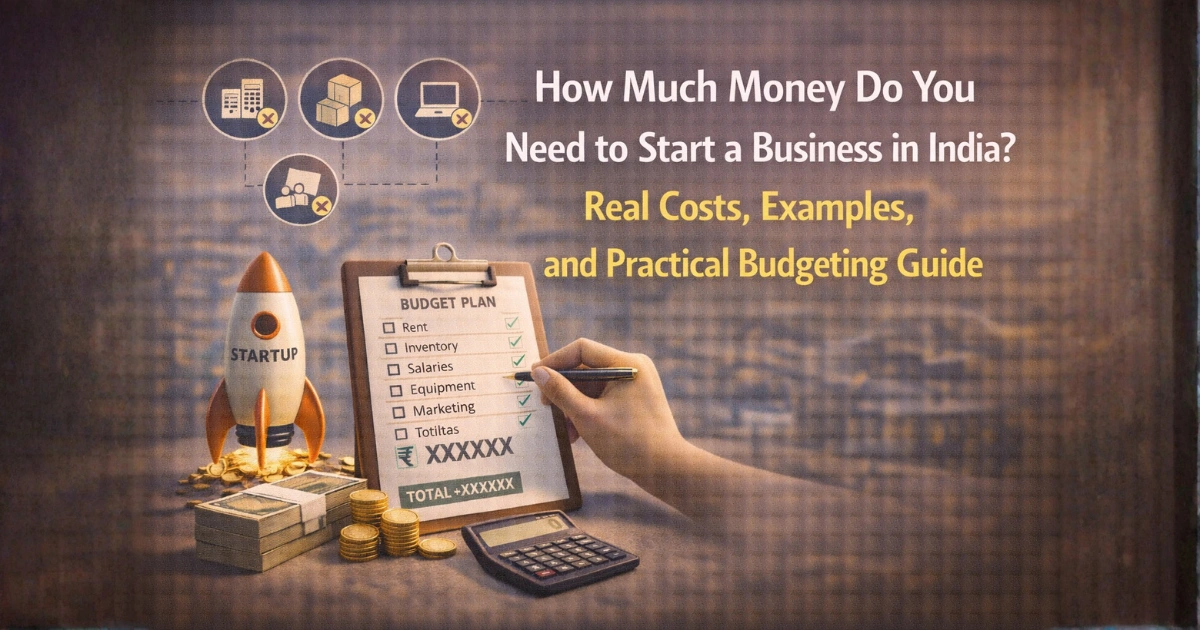
🧱 The 5 Major Cost Categories Every Founder Should Plan For
1️⃣ Registration & Legal Fees
-
UDYAM / GST registration
-
Mandatory licenses, trademarks, contracts
Approx range: ₹5,000–₹25,000
(Based on compliance guides on India MSME (https://udyamregistration.gov.in) and Startup India portals (https://www.startupindia.gov.in)).
2️⃣ Infrastructure / Office Setup
-
Furniture, fittings, deposits
-
Co-working or small office setups
Approx:
-
Service businesses: ₹10,000–₹25,000
-
Retail / physical outlets: ₹50,000–₹2,00,000+
3️⃣ Inventory or Tech Tools
-
Retail stock / packaging
-
Food equipment / storage
-
Laptops, hosting, SaaS tools
Approx:
-
Lean online: ₹20,000–₹80,000
-
Inventory-led: ₹70,000–₹2,00,000+
4️⃣ Marketing & Launch Costs
-
Branding & logo
-
Website / landing page
-
Initial ads & promotions
Approx: ₹8,000–₹30,000+
Even government entrepreneurship programs such as MSME Business Support Schemes (https://msme.gov.in/schemes) emphasize that marketing is essential for early-stage visibility — not optional.
5️⃣ First-Month Operating Buffer (Most People Forget This)
Covers:
-
Rent & utilities
-
Internet & tools
-
Salaries & miscellaneous costs
Aim for 1–2 months buffer — a principle widely recommended in small-business financial-planning resources (https://www.investindia.gov.in/startup-india-hub).
⚖️ “Can I Start a Business With Zero Investment?”
Technically yes — but only in skills-based or commission-led models like freelancing, consulting, or coaching.
Even then, you’re investing:
-
Time
-
Skills
-
Effort
For most businesses, capital is fuel — not a barrier.
❌ Common Money Mistakes New Founders Make
-
Copying someone else’s budget
-
Overspending on branding/interiors too early
-
Ignoring compliance and penalties
-
Mixing personal & business expenses
-
Scaling before validating demand
Multiple startup-failure analyses — including CB Insights post-mortem research (https://www.cbinsights.com/research/startup-failure-reasons/) — show that poor financial planning kills more startups than lack of funding.
💡 Pro Tips to Reduce Startup Costs (Without Cutting Quality)
-
Use co-working spaces instead of long-term leases
-
Buy only essential equipment initially
-
Outsource instead of over-hiring
-
Negotiate vendor & supplier pricing
-
Build revenue first — refine later
Smart founders don’t start cheap.
They start strategic.
🛠️ Action Framework: Calculate YOUR Startup Budget in 30 Minutes
1️⃣ List your business type
2️⃣ Map costs across the five categories
3️⃣ Separate one-time vs recurring expenses
4️⃣ Add a 1–3 month operating buffer
5️⃣ Decide whether to bootstrap or raise small capital
Once numbers are visible, decisions become logical — not emotional.
🎯 The Bottom Line
There is no universal answer to:
“How much money do you need to start a business in India?”
Because:
-
A freelancer and a café owner live in different financial worlds
-
Some businesses start lean
-
Others require ₹50,000–₹3,00,000+ upfront
-
Larger setups may need lakhs — sometimes crores
The goal isn’t to spend more or less.
The goal is to spend intentionally.
Start lean where you can.
Invest where it truly matters.
Build with clarity — not guesswork.
🚀 Call to Action
Before you invest a single rupee:
-
Map your costs
-
Create your startup budget
-
Validate your idea
-
Choose a business version aligned with your stage — not social-media expectations