
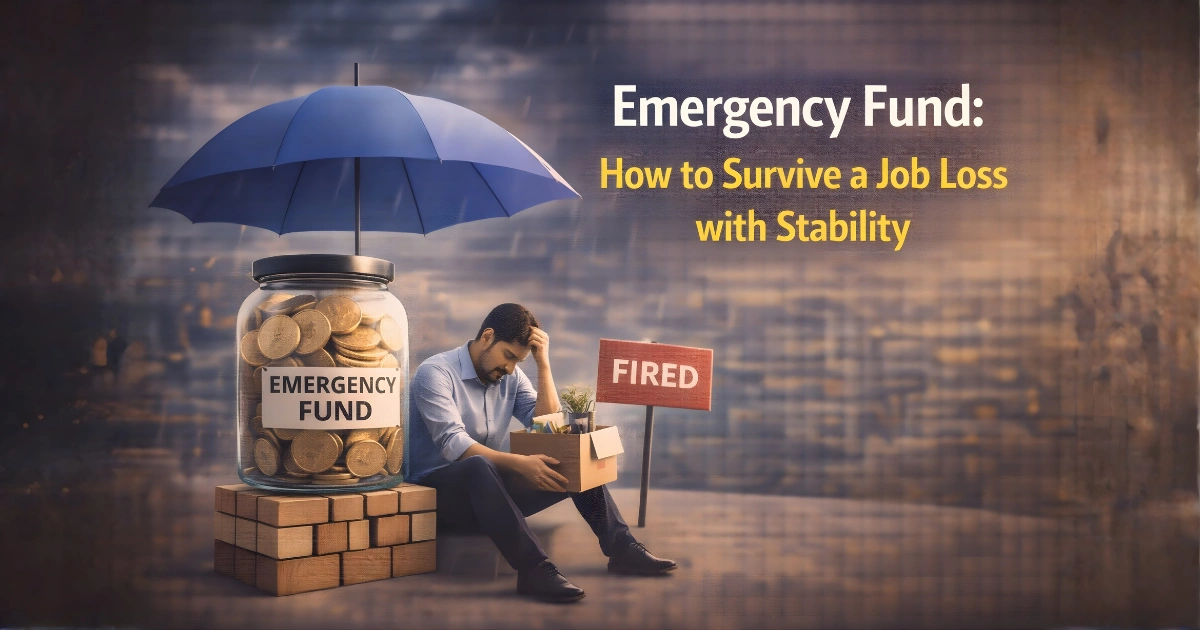
Introduction: Losing a Job Is Scary — Panicking Makes It Worse
No one plans to lose their job. When it happens, however, the shock is rarely just emotional — it’s financial, immediate, and relentless. Rent doesn’t pause. EMIs don’t wait. Groceries still need to be bought. Life keeps moving, even when your income stops.
In that moment, a harsh truth becomes impossible to ignore:
Income protects lifestyle — but savings protect survival.
For that reason, the conversation around emergency funds must be brutally honest — not motivational, and definitely not theoretical. Yes, an emergency fund is essential. Even so, it doesn’t work in isolation.
Ultimately, surviving a job loss depends not only on money, but also on behavior, mindset, and preparedness. That’s why it’s important to understand what really keeps you afloat when your income disappears.
What an Emergency Fund Really Is (And What It Isn’t)
Let’s define it clearly.
An emergency fund is a pool of readily accessible cash meant for unplanned expenses, medical emergencies, or sudden job loss. Financial planners across the world recommend maintaining one to protect against income shocks — a principle widely explained in Investopedia’s Emergency Fund Guide:
👉 https://www.investopedia.com/terms/e/emergency_fund.asp
It is not an investment, not a credit card, and not money you intend to borrow later. Instead, it is liquid cash you can access immediately — without panic, penalties, or paperwork.
Why Job Loss Hits Harder Than People Expect
Most people underestimate how quickly life begins to unravel. Within weeks, savings shrink, confidence drops, decisions become reactive, and unnecessary financial mistakes start feeling “reasonable.”
Research on unemployment stress and financial vulnerability — including insights from OECD Financial Resilience Studies — shows how income loss impacts both finances and behavior:
👉 https://www.oecd.org/financial/education/financial-resilience.htm
The real danger of job loss isn’t just the absence of income. It is the loss of control.
An emergency fund gives you something priceless in that situation: time — and time creates power.
The Real Role of an Emergency Fund During Job Loss
Let’s be precise.
An emergency fund doesn’t magically fix unemployment. Instead, it removes desperation — and that single difference changes everything.
With a fund in place, you are able to:
-
Avoid accepting the first bad job offer
-
Stay away from high-interest debt
-
Prevent panic-selling investments
-
Protect long-term goals instead of reacting to fear
Without it, every decision becomes survival-driven — and recovery becomes significantly harder.
How Much Emergency Fund Do You Actually Need?
The right amount depends on factors such as:
-
Monthly fixed expenses
-
Number of dependents
-
Job-market stability
-
Existing debt levels
Most global financial frameworks — including the 50-30-20 budgeting model — recommend saving 3–6 months of essential expenses, while higher-risk households benefit from a 9–12 month cushion.
An overview of the rule:
👉 https://www.consumerfinance.gov/consumer-tools/budgeting/50-30-20-rule/
Essentials include:
Rent / EMI • Utilities • Groceries • Transport • Insurance
Lifestyle spending does not belong in this category.
Emergency Fund Alone Is Not Enough (Here’s the Truth)
An emergency fund is necessary — but it isn’t sufficient on its own. Surviving a job loss also depends on five additional pillars.
1️⃣ Financial Discipline and Low Debt Load
Two people may lose their jobs and both may have emergency funds — yet the one burdened with credit-card debt and multiple EMIs collapses faster.
RBI guidance on debt management explains how revolving debt compounds rapidly during crises:
👉 https://www.rbi.org.in/commonperson/English/Scripts/FAQs.aspx?Id=902
Lower debt = fewer obligations, less pressure, and a longer survival runway.
2️⃣ Social and Professional Network — Your Invisible Safety Net
Most opportunities don’t come from portals — they come from conversations. According to LinkedIn Economic Graph Research, strong networks shorten unemployment periods:
👉 https://economicgraph.linkedin.com/research
A network built before a crisis becomes protection during it.
3️⃣ Adaptability and Skill Set — Your Real Employability
Emergency funds buy time; skills accelerate recovery.
Upskilling platforms such as National Career Service and Skill India can support employability:
👉 https://www.ncs.gov.in/
👉 https://www.skillindia.gov.in/
Ask yourself:
-
Can I switch roles if required?
-
Can I freelance temporarily?
-
Can I upskill quickly?
4️⃣ Access to Benefits and Support Resources
Many people overlook support they are already entitled to. Possible buffers include:
-
Severance
-
Insurance continuation
-
Employee-assistance programs
-
Government skilling initiatives such as Skill India Mission
👉 https://www.skillindia.gov.in/
Ignoring benefits means walking past help already available.
5️⃣ Mental and Emotional Resilience
Job loss affects identity, confidence, and decision-making. WHO mental-well-being guidance highlights how emotional stability influences financial behavior:
👉 https://www.who.int/teams/mental-health-and-substance-use/promoting-mental-health
Calm thinking extends your financial runway; panic shortens it.
How All These Pieces Work Together
Think of survival like this:
-
Emergency fund = time
-
Low debt = reduced pressure
-
Skills = faster recovery
-
Network = opportunities
-
Benefits = cushioning
-
Resilience = better decisions
Remove one pillar and survival becomes harder. Remove several — and money alone won’t save you.
How to Build an Emergency Fund (Without Stress)
-
Identify survival-only monthly expenses
-
Set a 3x / 6x / 9x cushion goal
-
Keep it liquid (savings, sweep-in FD, liquid funds)
-
Automate contributions
-
Refill the fund after every use
More guidance on liquidity habits appears in SEBI investor-education resources:
👉 https://investor.sebi.gov.in/
Common Mistakes That Destroy Emergency Funds
Avoid:
-
Investing emergency money in volatile assets
-
Using funds for lifestyle spending
-
Underestimating expenses
-
Stopping after saving one month
Partial protection = ongoing vulnerability.
Pro Tips Most People Miss
-
Keep the fund separate from your main account
-
Review the amount annually
-
Increase the fund as your lifestyle grows
-
Pair fund-building with debt reduction
-
Don’t publicly share emergency-fund details
Emergency funds work best quietly and intentionally.
Conclusion: Build the Fund — But Build the System Too
Yes, an emergency fund is critical. It acts as the first line of defense, the cushion that buys time, and the shield that prevents financial collapse.
However, true survival also requires:
Financial discipline • Low debt • Strong networks • Adaptable skills • Emotional resilience • Awareness of support resources
Money helps — but systems protect.
If you haven’t started yet, begin today. If you already have one, strengthen it. Job loss isn’t rare — but being prepared is.