
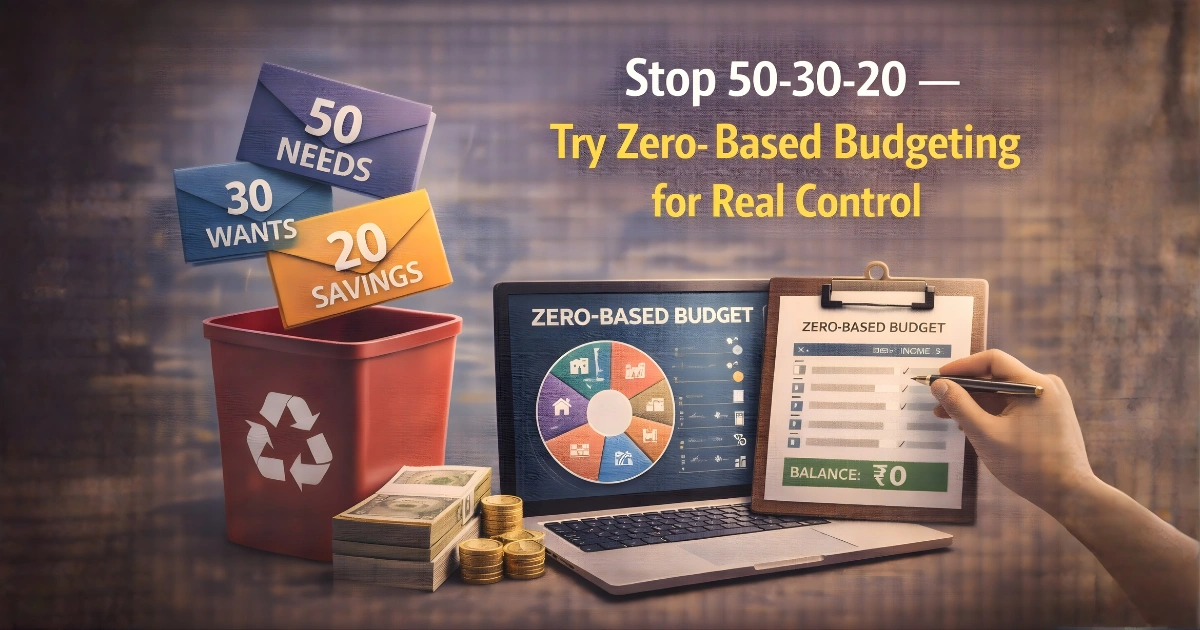
Introduction: The 50-30-20 Rule Sounds Smart — Until It Fails You
The 50-30-20 rule looks great on paper. It was popularized by U.S. Senator Elizabeth Warren and is widely referenced in personal finance resources such as the guide published by Harvard Business Review
👉 https://hbr.org/2022/01/a-simple-way-to-improve-your-financial-health
and Investopedia’s explainer on the 50-30-20 budgeting rule
👉 https://www.investopedia.com/terms/1/50-30-20-rule.asp
—but real life rarely behaves the way the framework assumes.
Spend 50% on needs.
30% on wants.
Save 20%.
Clean. Simple. Instagram-friendly.
But here’s the problem no one likes to admit:
Real life doesn’t fit neatly into percentages.
Rent jumps.
EMIs overlap.
Family expenses appear from nowhere.
And suddenly that “30% wants” bucket becomes a black hole.
If you’ve followed the rule and still wondered why your money disappears, you’re not bad with finances — you’re just using a system that’s too polite.
Today, we’re talking about a brutal budget method — one that doesn’t care about feelings, vibes, or averages.
It’s called Zero-Based Budgeting (ZBB) — a method widely applied in corporate finance and expenditure-control frameworks (as explained in McKinsey’s research on Zero-Based Budgeting)
👉 https://www.mckinsey.com/capabilities/operations/our-insights/zero-based-budgeting-reinvented
—and it forces your money to tell the truth.
Why the 50-30-20 Rule Stops Working After a Point
The rule assumes:
-
Stable income
-
Predictable expenses
-
High discipline
-
Minimal financial complexity
That’s not most people.
Here’s where it quietly breaks down:
-
“Wants” creep into “needs”
-
Savings get skipped in tight months
-
Extra income disappears without intention
-
No clarity on where money actually went
The biggest flaw?
It doesn’t tell your money exactly what to do.
And money without instructions wanders.
The Brutal Budget Method Explained (No Sugarcoating)
The brutal budget method is better known as Zero-Based Budgeting (ZBB).
The idea is simple — and uncomfortable:
Every single rupee you earn must be assigned a job.
By the end of the month:
Income − Expenses = Zero
Not because you spent everything recklessly — but because every rupee was intentionally planned, including savings.
The approach mirrors how organizations allocate funds in performance-based budgeting models discussed in CIMA and Deloitte budgeting insights:
👉 https://www.cimaglobal.com/Research–Insight/
👉 https://www2.deloitte.com/global/en/pages/finance/articles/zero-based-budgeting.html
Zero doesn’t mean broke.
Zero means accounted for.
What Zero-Based Budgeting Actually Looks Like
Let’s make this real.
Say your monthly income is ₹60,000.
Instead of percentages, you assign roles:
Rent — ₹18,000
Groceries — ₹6,000
Transport — ₹3,000
EMIs — ₹8,000
Savings — ₹10,000
Investments — ₹7,000
Guilt-free spending — ₹5,000
Buffer — ₹3,000
Total — ₹60,000
Balance — ₹0
Every rupee has a job.
That’s intentional spending in action — a concept also emphasized in the YNAB (You Need A Budget) zero-based budgeting method
👉 https://www.youneedabudget.com/learn/zero-based-budgeting/
Why This Method Feels “Brutal” (And Why That’s the Point)
Zero-based budgeting is uncomfortable because:
-
You can’t pretend you’ll “save later”
-
You see trade-offs clearly
-
Overspending in one area steals from another
-
Excuses don’t fit on spreadsheets
It removes ambiguity — and ambiguity is where bad money habits hide.
How This Beats the 50-30-20 Rule in Real Life
1️⃣ It Adjusts to Your Reality
Your expenses aren’t averages — they’re specific.
Zero-based budgeting works whether:
-
You have EMIs
-
Income is irregular
-
Responsibilities change monthly
2️⃣ It Forces Accountability
You can’t say “I don’t know where my money went.”
You told it where to go.
3️⃣ Savings Become Mandatory — Not Optional
Savings aren’t leftovers — they’re a line item, aligning with the pay-yourself-first philosophy widely discussed by financial planners and CFA Institute insights:
👉 https://www.cfainstitute.org/en/research/foundation/2013/pay-yourself-first
This alone changes everything.
The Core Rule: Every Rupee Must Have a Job
Money can go to:
-
Expenses
-
Savings
-
Investments
-
Debt repayment
-
Fun
But it cannot sit idle waiting to be wasted.
If it exists — it must be planned.
Common Myths About Zero-Based Budgeting
“It’s too restrictive”
No — it’s precise. You still spend on fun — you just decide how much.
“It takes too much time”
It takes more honesty than time. Once set up, monthly adjustments are quick.
“It’s only for extreme savers”
Wrong. It’s recommended for improving financial discipline — including in OECD household budgeting studies:
👉 https://www.oecd.org/finance/financial-education/
How to Start Zero-Based Budgeting (Step-by-Step)
You don’t need fancy tools — just clarity.
-
Know your exact monthly income
-
List all fixed expenses
-
Assign variable spending limits
-
Allocate savings and investments first
-
Reassign until the balance hits zero
That’s the discipline.
Mistakes That Make This Method Fail
People don’t fail because the method is hard — they fail because they avoid honesty.
-
Underestimating expenses
-
Forgetting irregular costs
-
Skipping buffer allocation
-
Quitting after one “bad” month
One messy month isn’t failure — it’s data.
Pro Tips to Make the Brutal Budget Sustainable
-
Review weekly, not daily
-
Adjust categories monthly
-
Track actuals vs plan
-
Keep a guilt-free spend bucket
-
Automate savings and investments
Structure creates freedom.
Who Should Definitely Try This Method
Zero-based budgeting works best if:
-
You earn decently but save inconsistently
-
You feel like money “disappears”
-
You want clarity instead of guesswork
-
You’re serious about debt reduction or wealth building
If the 50-30-20 rule feels too loose — this is your upgrade.
The Real Benefit No One Talks About
This method doesn’t just fix money.
It fixes stress.
Once money is planned:
-
Decisions get easier
-
Guilt reduces
-
Panic spending drops
-
Confidence increases
Money stops being emotional.
It becomes mechanical.
And that’s powerful.
Conclusion: Stop Guessing. Start Assigning.
The 50-30-20 rule isn’t bad.
It’s just not enough.
If you want clarity, control, and real progress, you need a system that doesn’t let money slip through cracks.
Zero-based budgeting is that system.
It’s strict.
It’s honest.
It works.
Try it for one month.
Give every rupee a job — and watch your money finally listen.